The key facts
- Kobakhidze called the European Commission's assessment 'political blackmail' and refused to repeal the foreign agents and NGO registry laws
- Tbilisi unilaterally announced in November 2024 that it would not seek to open accession negotiations until the end of 2028
- The Venice Commission twice called for a review of the legislation, citing unclear objectives, vague definitions, and disproportionate criminal penalties
Accusations against Brussels without an action plan
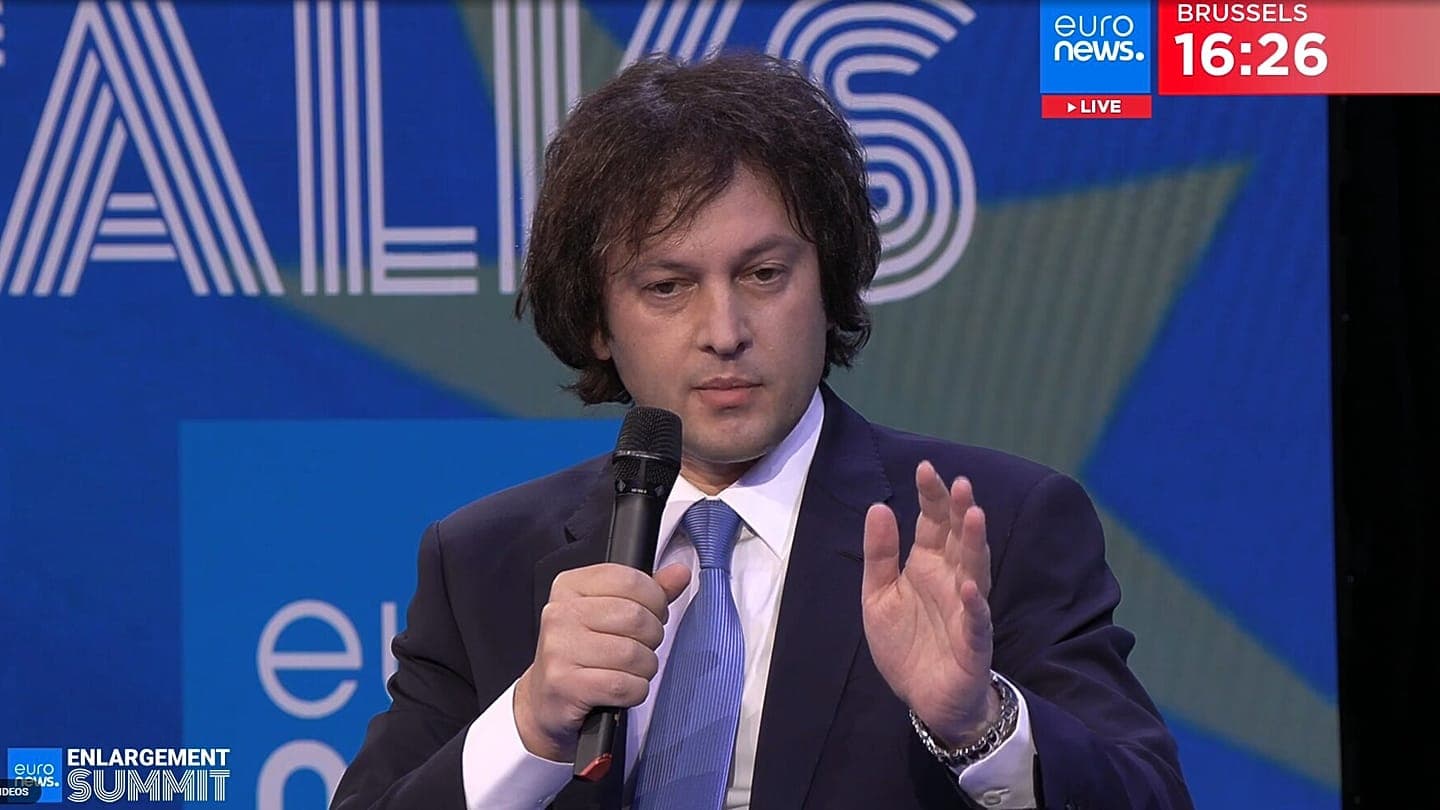
At the Euronews enlargement summit on Tuesday, Georgian Prime Minister Irakli Kobakhidze stated that his government remains 'highly committed' to joining the European Union, yet he failed to offer a convincing explanation of how he intends to revive the stalled accession process. Instead, he accused Brussels of political 'blackmail' and repeatedly placed responsibility for the breakdown of relations on the European Commission, refusing to reconsider the controversial laws that have halted Tbilisi's European ambitions, writes Euronews.
Timeline of the conflict
Georgia applied for EU membership in 2022 alongside Ukraine and Moldova following Russia's full-scale invasion of Ukraine. The Commission at that time deferred granting candidate status, citing insufficient progress in democracy, the rule of law, and institutional reforms. Kobakhidze called this decision 'a major mistake' and stated that, according to the Commission's assessments, Georgia had performed better than Moldova or Bosnia, which received candidate status. Georgia ultimately obtained candidate status in December 2023, but relations quickly deteriorated: the European Council concluded that the government's actions had effectively halted the accession process. In November 2024, Tbilisi unilaterally announced that it would not seek to open accession negotiations until the end of 2028, following the Commission's report on a serious democratic regression ranging from the judicial system to media freedom.
Refusal to repeal controversial laws
When asked why the government made such a decision despite, according to Euronews data, approximately 80% of Georgians supporting EU membership, Kobakhidze again shifted responsibility to Brussels: 'If the European Commission decides to open accession negotiations for Georgia, we will immediately join. This was not us.' A key point was his principled refusal to repeal two laws at the heart of the dispute: the legislation on transparency of foreign influence and the national NGO registry. Both documents were criticized by the Venice Commission of the Council of Europe, which twice called on the ruling party to review the legislation, arguing that the objectives are unclear, some definitions are vague, and criminal penalties are disproportionate. Kobakhidze stated that the demand for repeal violates Georgia's sovereignty, called the law 'fully compliant with international standards,' and accused the Venice Commission itself of political bias, comparing Brussels' demands to the Soviet era when Georgia was obliged to follow Moscow's directives.
What remains unclear
When journalists asked him to name specific steps to break the deadlock, Kobakhidze limited his response to a willingness to hold a public discussion with the Commission. When asked why Georgia should join the EU at all, he replied that he is 'optimistic' about the EU changing—not only in relation to Georgia but as a Union overall—given growing geopolitical challenges and economic difficulties. Following the interview, Euronews notes: Kobakhidze accused the Commission of double standards, political interference, and refusal to engage in dialogue with Tbilisi, but he did not propose a clear path out of the deadlock nor provide any signs of the government's readiness to address the EU's central concerns. The European Commission's reports are supported by the European Council, where 27 leaders must unanimously agree on a candidate's accession; in a 2025 resolution, EU leaders called on Georgian authorities to cease hostile rhetoric against EU institutions and the EU mission in Tbilisi.