The key facts
- The finds were made at the Tell Kom Abu Bello mound in Menoufia governorate, in the area of the ancient city of Terenuthis
- Among the finds are golden 'tongues', an earring, a pendant, scarab amulets and ushabti figurines with hieroglyphic inscriptions
- According to a preliminary assessment, the cemetery served mainly middle-class residents
A major burial site in Menoufia
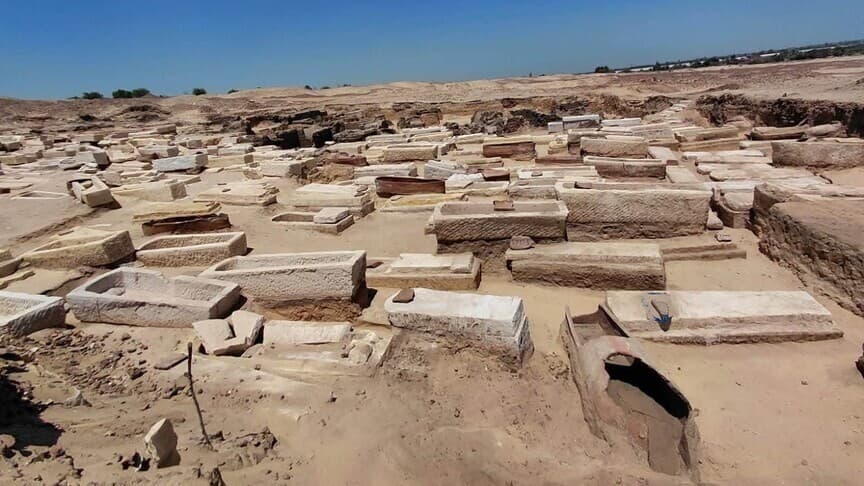
Egyptian archaeologists have discovered an ancient cemetery with hundreds of sarcophagi, golden 'tongues' and jewelry in the northern governorate of Menoufia, the Ministry of Tourism and Antiquities announced, as reported by Anadolu. The finds were made at the Tell Kom Abu Bello mound: stone and ceramic coffins, remains of wooden sarcophagi and vaulted tombs of mud brick were found there.
Chronology and social composition
The burials span the end of Egypt's Late Period, the Ptolemaic era and early Roman times; preliminary research dates most of the necropolis to the 3rd–2nd centuries BC. Secretary-General of the Supreme Council of Antiquities Hisham al-Leithy noted that the concentration of burials and sarcophagi in an open courtyard has no precedent at this site. An initial examination of the funerary goods indicates that the cemetery served mainly middle-class residents. Architectural remains extend beneath the surrounding sand and debris, suggesting buildings yet to be uncovered.
What was found in the tombs
Among the finds are gold plates shaped like tongues, an earring, a pendant and thin gold sheets, as well as scarab amulets and small funerary ushabti figurines, some of which bear hieroglyphic inscriptions. Archaeologists also discovered miniature sphinxes, fragments of statues of the falcon god Horus and two falcon burials among the sarcophagi. A number of objects are linked to the image of Isis-Aphrodite, including a clay piece depicting the goddess seated on a lotus flower nursing the infant Harpocrates.
Condition of the site and context
Some of the sarcophagi have lost their lids, while others were damaged by earlier destruction and stone quarrying. Poorly preserved human remains retained traces of embalming materials and resins, as well as remnants of shrouds dyed yellow, red, blue and gold. The necropolis lies in the archaeological zone of ancient Terenuthis, at the eastern entrance to Wadi El-Natrun — a historic source of natron salts used in mummification. Earlier excavations uncovered remains of a city and a temple of the goddess Hathor. The Ministry stated that excavations and research will continue to learn more about those buried there and their funerary traditions.