The key facts
- Voyager 1 has become the first human-made object at a distance of one light-day from Earth — about 25.9 billion km
- A signal from Earth reaches the probe in 24 hours; engineers will receive the first response only the next day
- The spacecraft has been operating for almost 50 years, but only two of its ten science instruments remain; Voyager 2 will reach the same mark only in 2035
A historic milestone at a light-day's distance
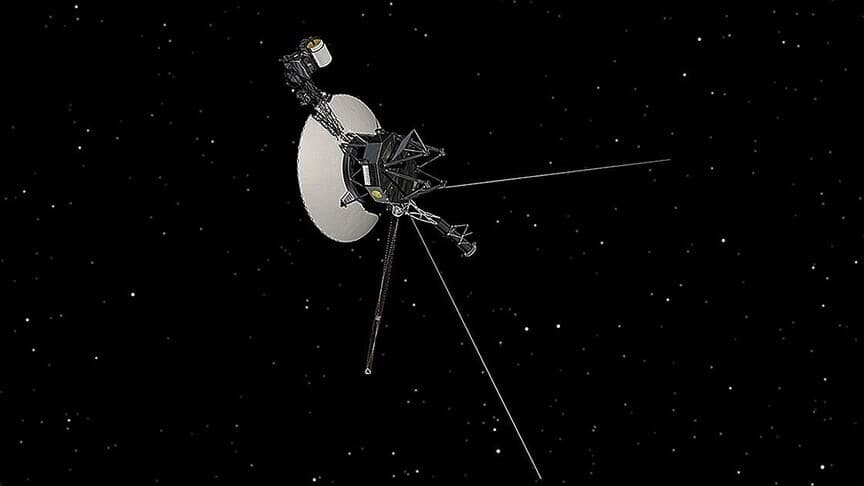
On November 18, NASA's Voyager 1 probe became the first human-made object to travel one light-day from Earth — the distance light covers in 24 hours. According to the agency's calculations, the mark was crossed at 5:16 a.m. Eastern Time in the US, which corresponds to roughly 25.9 billion km from Earth — about 173 times the distance from Earth to the Sun.
A day for a command and a day for a reply
The practical significance of the milestone is that any command from Earth now takes exactly one day to reach the probe, and the return signal takes just as long. Because of this delay, engineers at NASA's Jet Propulsion Laboratory in California will receive the first signal sent by the spacecraft after crossing the milestone only on Thursday. NASA also invited anyone interested to mark the event by flashing the probe's call sign — 'VGR' — in Morse code with phone flashlights after sunset, and a public discussion of the two spacecraft's mission is scheduled at JPL on Thursday.
Nearly half a century in flight
Voyager 1 was launched on September 5, 1977, from Cape Canaveral to study Jupiter and Saturn: in 1979 it transmitted images of Jupiter and volcanic activity on its moon Io, and in 1980 it studied Saturn and Titan in detail. In 1998 the spacecraft overtook Pioneer 10, becoming the most distant human-made object, and in 2012 it was the first to cross the heliopause and enter interstellar space — its twin Voyager 2, launched on August 20, 1977, repeated this in 2018. The probe is now flying at about 61,000 km/h, or roughly 17 km/s.
The spacecraft's aging and its remaining resilience
Over the decades of flight, the probe's nuclear power source has weakened: of ten science instruments, only two remain operational, measuring magnetic fields and plasma waves in the interstellar medium. Engineers expect to keep data transmission going for a few more years until the power runs out. The spacecraft has already survived a series of technical problems: in 2023 it was unable to transmit science data correctly for several months due to a computer malfunction, in 2024 it had to switch to a different thruster system due to clogged microchannels, and in April 2026 NASA switched off another instrument to save power.
What comes next
Voyager 2 is traveling on a different trajectory and at a lower speed — about 15.4 km/s — so, according to calculations, it will reach the one-light-day mark from Earth only in 2035. Both probes carry golden records with sounds, music and images of Earth — a message for a possible extraterrestrial civilization. According to current estimates, Voyager 1's trajectory will bring it to the inner boundaries of the Oort cloud in about 300 years, and some 40,000 years later it will pass within 1.7 light-years of the red dwarf Gliese 445. Contact with Earth will likely be lost much earlier, but the spacecraft itself may drift through the galaxy for millions of years.