The key facts
- The container ship PanStar Acro traveled from Busan to Rotterdam via the Northern Sea Route in 50 days, saving at least 10 days compared with the route through the Suez Canal
- The container ship PanStar Acro sailed from Busan to Rotterdam via the Northern Sea Route in 50 days, saving at least 10 days compared with the route through the Suez Canal
- Seoul plans regular commercial voyages along the NSR by 2030; in 2025 a record 1,812 vessels operated in the Arctic
- Analysts see risks of dependence on Russia and tensions with European partners amid the Seoul–Kyiv conflict over North Korean prisoners of war
- Analysts see risks of dependence on Russia and tensions with European partners against the backdrop of the Seoul–Kyiv dispute over North Korean prisoners of war
Test voyage through the Arctic
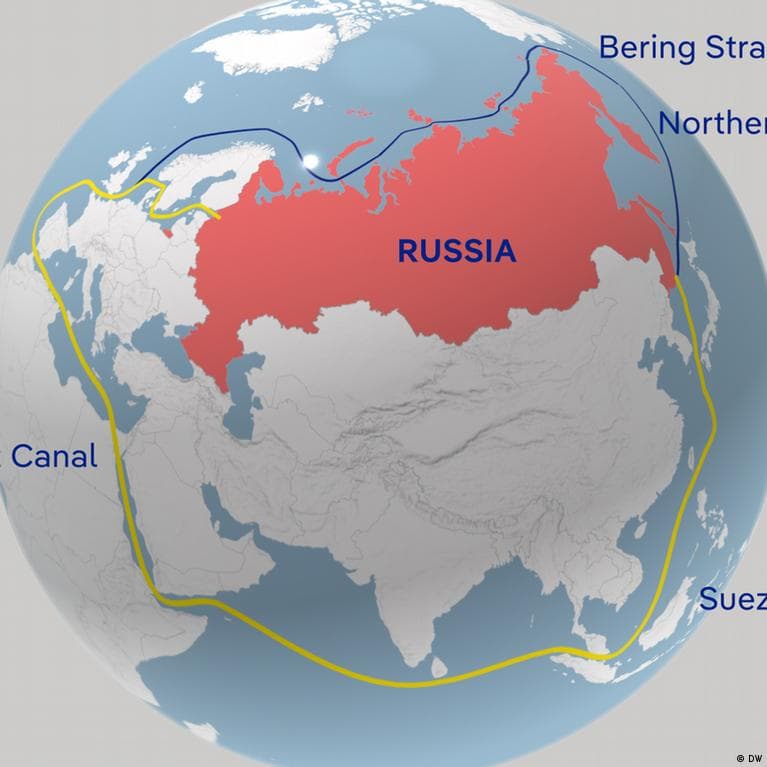
The container ship PanStar Acro departed from the South Korean port of Busan on August 22 and in October completed a voyage to Western Europe via the Northern Sea Route along Russia's northern coast, reports Deutsche Welle. The vessel completed a circular route to Felixstowe in Britain, then to Rotterdam and Gdansk, and returned via the NSR in just 50 days — at least 10 days faster than the fastest voyages through the Suez Canal. The route is roughly 7,000 kilometers shorter and allows bypassing the Middle East as a geopolitically unstable region. The ship itself is not an icebreaker, but it has ice-strengthened structural elements.
Why the route became possible and what it promises
For decades the NSR was impassable due to ice cover near the North Pole; the retreat of ice caused by climate change is making navigation possible, although during certain periods of the year commercial vessels still require icebreaker escort. According to the Arctic Council, a record 1,812 vessels operated in the Arctic last year — 40% more than in 2013. Joseph Kristanto, a maritime analyst at the S. Rajaratnam School of International Studies in Singapore, noted that the route gives South Korea a closer connection to European markets bypassing the northwestern Indian Ocean, could reduce shipping costs and transit times, strengthen Busan's position as a regional maritime hub, and create opportunities for Korean shipbuilding. The government of President Lee Jae-myung has set a launch of regular commercial voyages along the NSR for 2030; the completed voyage was merely a logistics test.
Geopolitical backdrop and risks
Analysts interviewed by DW point out that countries opposing Russia over its invasion of Ukrainefear that Lee Jae-myung seeks to expand Seoul's economic ties with Moscow — contrary to the efforts of Kyiv and its Western allies to isolate Russia. In Kristanto's view, there is also a risk of a 'new form of strategic dependence' on Russia, since Moscow substantially controls shipping along its Arctic coastline and can exert pressure through regulation and the provision of icebreaker assistance. From Europe's perspective, closer economic engagement with Russia undermines efforts to isolate it. He also noted that the concerns of European diplomats extend beyond the NSR and include, reportedly, the delivery of about 165,000 tons of fuel on sanctioned Russian tankers in August. All of this is happening against the backdrop of North Korea sending troops to help Russia in its war against Ukraine.
Seoul's motives: economics and a signal to Moscow
According to Andrei Lankov, a professor at Kookmin University in Seoul, South Korea is interested in the NSR because climate change has made accessible a route that 'makes complete economic sense.' At the same time, he says, Seoul is trying to signal to the Russian government its readiness to build relations — including in the hope of influencing Vladimir Putin so that he does not supply more weapons to the DPRK. Lankov also links this to the cooling of Seoul's relations with Kyiv: in September, President Volodymyr Zelensky confirmed at the UN General Assembly that two North Koreans captured in Ukraine had been transferred to South Korea. Seoul reacted sharply, stating that Zelensky had violated an agreement to keep the transfer secret; the dispute escalated into a diplomatic conflict with demands for apologies and the recall of some South Korean diplomats from Kyiv. Lankov suggests the conflict may have been partly for show: it allowed Lee's administration to distance itself from Kyiv and resist pressure to provide material aid to Ukraine, which would be appreciated in Moscow, while Russia could 'reciprocate' by not transferring advanced military technologies to the DPRK.
A cautious course
According to Lankov, South Korea now wants to 'fly under the radar,' study the opportunities and prepare for the moment when the war ends and sanctions on Russia are lifted. Kristanto likewise expects a 'cautious and gradual approach': Seoul is unlikely to abandon the initiative, given the growing Chinese interest in Arctic shipping, but will try to avoid unnecessarily irritating its Western partners. In his framing, South Korea is not choosing between Russia and the West, but rather trying to preserve a potentially valuable economic opportunity without sacrificing more fundamental strategic relationships.