The key facts
- Signals obtained at a scale 100 billion times smaller than an atom — about a billionth of a trillionth of a metre
- Signals obtained at a scale 100 billion times smaller than an atom — about a trillionth of a billionth of a metre
- An unstable b-quark, living for one and a half trillionths of a second, played a key role
- 28 countries approved a £150 million upgrade of LHCb, but UKRI has withdrawn the British share of funding
- 28 countries agreed on the LHCb upgrade worth £150 million, but UKRI withdrew the British share of funding
Signals from the smallest scale ever explored
Scientists have registered signals from the smallest scale of nature ever explored — 100 billion times smaller than an atom. Some physicists call this realm the 'zeptouniverse'. The study, led by scientists from Cambridge, was carried out at the Large Hadron Collider (LHC) at the European Organization for Nuclear Research (CERN) on the Swiss-French border, where atoms are smashed together to study their contents. This is reported by BBC News.
How to 'see' the invisible: the role of the b-quark
The experiment's method involves studying the 'debris' of high-energy particle collisions. One such fragment is a subatomic particle, the b-quark (beauty quark). It is unstable and exists for only one and a half trillionths of a second, but researchers managed to record its interaction with other particles at a scale of a billionth of a trillionth of a metre. The significance of the result is that, according to a number of theories, at these scales particles are more sensitive to dark matter, which makes up a significant part of the cosmos but remains invisible in every respect except its gravitational influence on ordinary matter. Thus, observations in the 'zeptouniverse' could help in the search for it and in building a more complete theory of how the Universe works.
'We are knocking on the door' — and what comes next
'We are knocking on the door of this zeptouniverse,' said Dr Harry Cliff of the University of Cambridge, who led the data analysis, adding that more data is now needed to 'find out which new particles are waiting there'. The 28 participating countries have approved a £150 million upgrade of the LHCb detector, which should increase the decay rate tenfold. However, earlier this year UK Research and Innovation (UKRI), the agency responsible for research funding, announced it was withdrawing its share of funding for the upgrade — at the same time as cuts to a number of other particle physics and astronomy projects, including the famous Lovell Telescope at Jodrell Bank.
Consequences for British scientists
Professor Tim Gershon, who leads the international LHCb collaboration,told BBC News that, because of the cuts, the UK's full participation in the research is now in question: 'The UK risks not taking part in truly major discoveries,' and the main long-term damage is the loss of the benefits of training young scientists. One of those behind the discovery, Dr Mary Richardson-Slipper, said she is reconsidering her career and considering working abroad, because 'there are more opportunities there at the moment'; according to her, many of her colleagues in fundamental physics have already left. Professor Brian Cox, who was not involved in the research, called the result 'important' but condemned the decision to cut funding: 'It would be extraordinarily strange to walk away from British scientific leadership at this moment.'
UKRI's position and context
UKRI told BBC News that it remains a fully engaged member of CERN as its second-largest funder — around £175 million a year. According to the agency's spokesperson, following an independent review, a portfolio of new infrastructure investments was formed, including projects in clean energy, medical imaging and cultural heritage, but there were traditionally more applications for funding than could be supported. The cuts are nevertheless taking place against the backdrop of a record overall increase in the science budget — and that is the contradiction highlighted in the BBC report: overall funding growth does not save individual particle physics and astronomy projects from being cut.
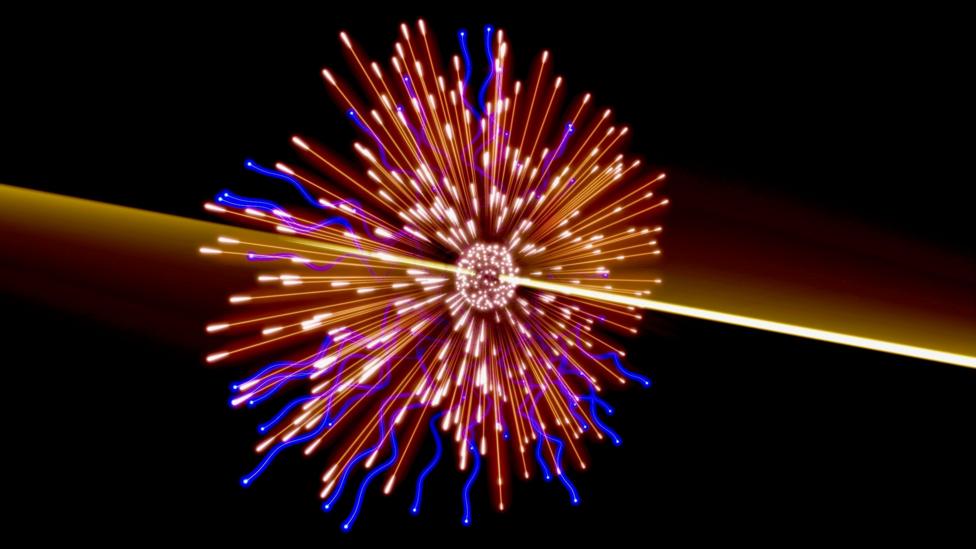 Image source, CERN/Getty Images
Many sub-atomic particles are created by smashing the insides of atoms together
 Image source, Joshua Falcon/BBC
Dr Harry Cliff is one of a team of British scientists involved in the research
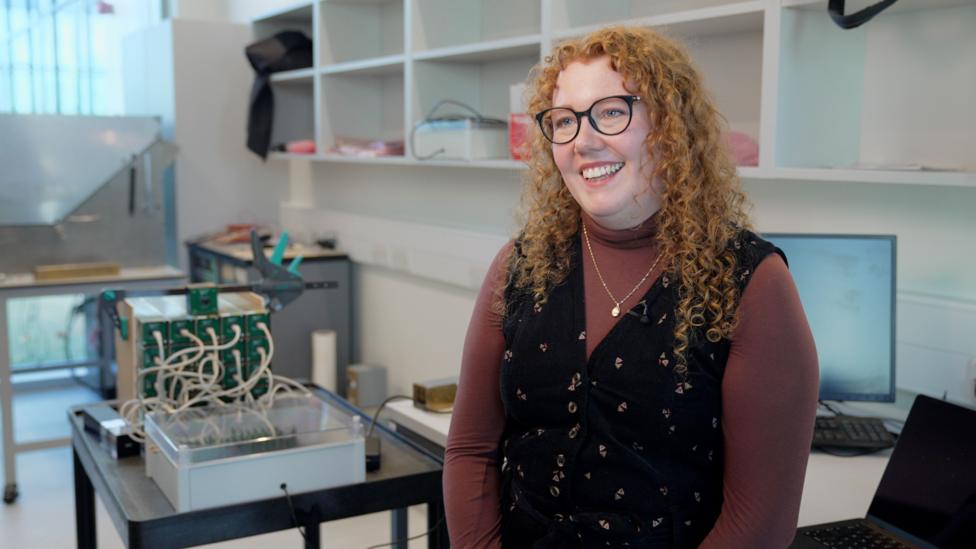 Image source, Joshua Falcon/BBC
Dr Mary Richardson-Slipper is questioning whether to continue her physics research career in the UK or find work abroad