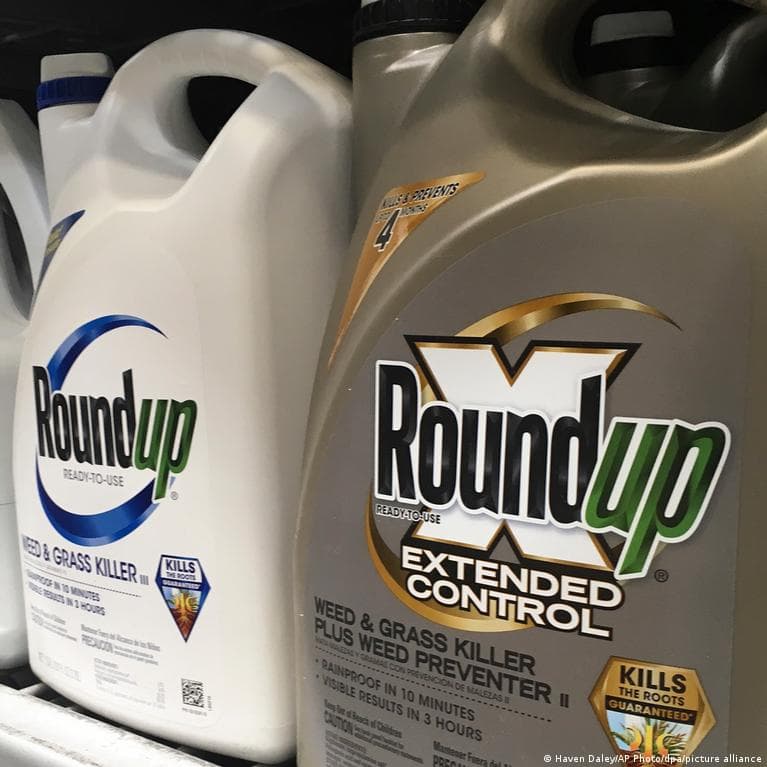
The key facts
- Jurors in Missouri unanimously sided with Bayer in the lawsuits by three women linking Roundup to cancer
- This is the first trial after the U.S. Supreme Court ruling that barred claims about the product's labeling
- Bayer is awaiting a court decision on its $7.25 billion settlement covering roughly 65,000 other lawsuits
Unanimous verdict in St. Louis
The German company Bayer has won a trial over lawsuits filed by three women who claimed that the Roundup herbicide produced by its subsidiary Monsanto caused their cancer. The jury at the court in St. Louis, Missouri, unanimously sided with the company. This was reported by Deutsche Welle.
First trial after the Supreme Court ruling
This is the first Roundup trial since the U.S. Supreme Court this year limited the possibility of complaints about the product: under its ruling, plaintiffs cannot claim that Roundup's labeling failed to warn about the cancer risk, because the U.S. Environmental Protection Agency (EPA) previously concluded that a carcinogenicity warning on the label is not required. The lawsuits in St. Louis were filed in 2020 by Theresa Aretino, Cynthia Fernandez, and Betty Larkin, who were diagnosed with non-Hodgkin lymphoma after regular use of the herbicide. Their lawyers argued that Roundup was defectively designed and unreasonably dangerous, and that Bayer was negligent in selling it. Notably, these three plaintiffs did not take part in Bayer's settlement — unlike approximately 65,000 other lawsuits filed against the company, so the Supreme Court ruling did not apply to their claims.
Bayer's reaction and unresolved questions
Bayer's U.S. litigation counsel and global head of litigation, Bill Dodero, saidthat the company is pleased with the verdict, which it says 'confirms' its conviction that there is no evidence of design defects, fraud, or negligence in the Roundup cases. According to him, the verdict should serve as a signal to plaintiffs who wish to go to court after the Durnell ruling: they will face significant difficulties in proving their claims. At the same time, Bayer continues to insist on the safety of glyphosate — the active ingredient in Roundup — calling it 'one of the most studied agricultural tools in history.' The picture regarding the substance's safety remains contradictory: the EPA previously concluded that glyphosate is probably not carcinogenic, but is now conducting a new review of its safety, while the International Agency for Research on Cancer back in 2015 classified the substance as 'probably carcinogenic' to humans — a conclusion Bayer rejects as an outlier. Meanwhile, the company is awaiting a separate court decision on its settlement of $7.25 billion (€6.5 billion), which is intended to resolve tens of thousands of remaining Roundup lawsuits.