The key facts
- According to a CNN investigation (September 2026), about 15 Ukrainian drone specialists are training FLA Tuareg rebels in northern Mali
- DW was unable to independently verify these data; HUR gave no concrete answer to the request
- DW was unable to independently verify this information; HUR gave no specific response to the request
- Mali, Niger, and Burkina Faso severed diplomatic relations with Kyiv, accusing Ukraine of supporting armed groups
- Mali, Niger and Burkina Faso have severed diplomatic relations with Kyiv, accusing Ukraine of supporting armed groups
CNN investigation into Ukrainian drones in Mali
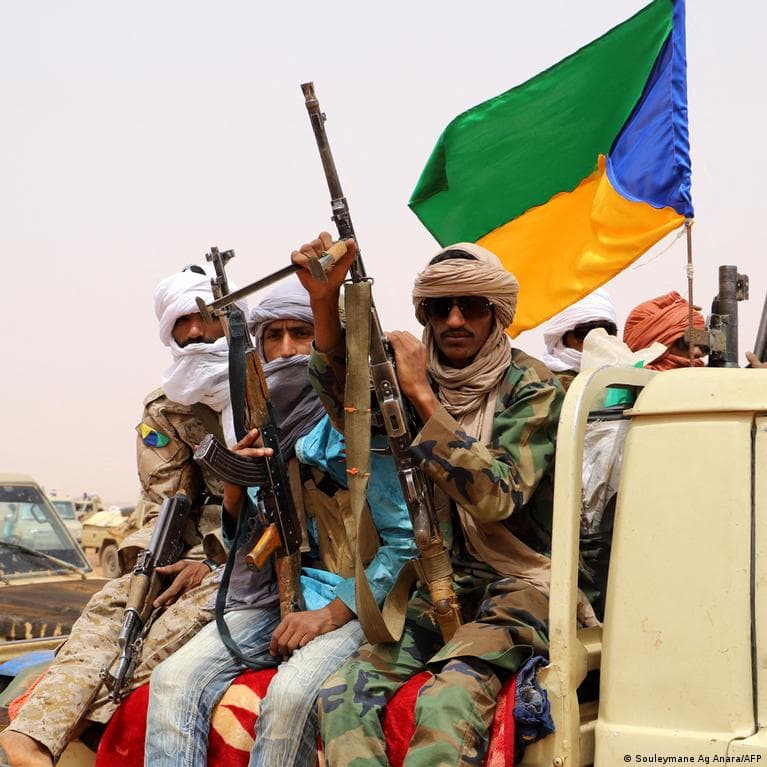
The Ukrainian-Russian war may have an African dimension: according to an investigation by the American TV channel CNN, published in September 2026, about 15 Ukrainian drone specialists are said to be supporting Tuareg rebels in northern Mali. Their common enemy is the military government in Bamako and its Russian allies. CNN reported that the Ukrainians provided drone training, operational planning, and remote support for unmanned missions. Deutsche Welle was unable to independently verify these claims.
Suspicions since 2024 and signals from Kyiv
Suspicions about the involvement of Ukrainian military intelligence (HUR) first arose in July 2024, when DW reported on the possible involvement of HUR in an ambush on fighters of the Russian private military company Wagner near Tinzaouaten in northern Mali. At the time, HUR representative Andriy Yusov said the Tuaregs had received the information needed for the attack, but Ukraine denied direct involvement; in that battle, Wagner fighters and Malian troops suffered heavy losses. New impetus to the suspicions was given by a post on X by Kyrylo Budanov — the former head of military intelligence, now chief of staff to President Volodymyr Zelensky. On September 7, he wrote that Ukrainian intelligence defends the country's interests around the world — 'from Russia to Africa… in the blazing sands of the desert and in the snows of icy Antarctica.' Budanov did not mention Mali directly, and his post does not confirm any specific operation. DW asked HUR about a possible deployment of personnel to Mali and whether the mission had been approved by the political leadership, but received no concrete answer: a representative of the agency only said the information could be provided later.
Strategic logic and an alliance with problematic partners
Experts see a strategic motive in Kyiv's possible involvement. Marta Oliynyk-Domochko, coordinator of the African studies program at the Kyiv-Mohyla Academy, told DW that Ukraine's main goal is to weaken Russian influence around the world. Russian historian Irina Filatova, professor emerita at the University of KwaZulu-Natal, considers such support plausible but has no independent evidence; in her words, Ukrainians regard Russian forces anywhere in the world as legitimate targets, and setbacks in Mali could tie down Russian resources and undermine Moscow's reputation as a security partner. However, Kyiv's partner is ambiguous: the Azawad Liberation Front (FLA) cooperates with the Al-Qaeda-linked group Jama'at Nusrat al-Islam wal-Muslimin (JNIM). Oliynyk-Domochko stresses that this is rather a situational alliance against a common enemy than an all-encompassing partnership: the FLA does not seek to overthrow the government in Bamako, but demands self-determination or broad autonomy for northern Mali. Supporting the FLA does not in itself prove aid to JNIM, but jihadists could benefit indirectly — through joint operations or access to knowledge and equipment.
Diplomatic consequences and the cost to Kyiv
Mali, Niger, and Burkina Faso — all under military governments — have already accused Ukraine of supporting armed groups and threatening their territorial integrity, severed diplomatic relations with Kyiv and deepened cooperation with Russia. In September, Malian Foreign Minister Abdoulaye Diop accused Ukraine at the UN of 'explicit and open support for terrorist groups,' according to Agence France-Presse, without presenting evidence. DW notes that these governments may have an interest in legitimizing their partnership with Moscow and portraying Kyiv as a destabilizing actor. After the military coups of 2020 and 2021, Mali turned away from Western partners toward Russia; in 2025, the Africa Corps replaced Wagnerand, according to Ulf Laessing of the Konrad Adenauer Foundation, the corps still uses Syria and Libya as transit points for flights from Russia. For Kyiv, involvement in Mali could be a relatively cheap way to weaken Russian interests outside Europe, but the partnership with the FLA carries the political risk of accusations of indirectly supporting jihadists, which could undermine Ukraine's efforts to build relations with African countries. The real scale of possible Ukrainian involvement remains unclear.