The key facts
- MAI-DxO coordinates multiple AI agents that conduct diagnosis like a panel of physicians; in simulations on complex cases accuracy was 83% versus 36% for generalists
- Best results came with OpenAI GPT-5 and GPT-5.5; on cases from urgent care departments the DxO advantage was almost nonexistent
- Microsoft is preparing a foundation medical model with Mayo Clinic and a real-world evaluation of DxO with Beth Israel Deaconess Medical Center
AI outperformed physicians in a simulation of complex cases
Microsoft's MAI-DxO diagnostic system correctly identified diagnoses in complex medical cases in a simulation more than twice as often as generalist physicians — according to results of a study published Thursday in the journal Science. Microsoft AI head Mustafa Suleyman called the result a step toward 'medical superintelligence.' The system coordinates multiple AI agents that act like a panel of physicians: they interview the patient, order tests, and discuss the diagnosis. In a simulation on complex cases from the New England Journal of Medicine, the system was right in 83% of cases, whereas generalists and primary care physicians working individually with reference materials were right in 36%. The publication notes a caveat: cases of such complexity are usually handled by specialists or teams of physicians, who were not included in the comparison.
Results depend on the foundation model
The study data show that a significant share of the improvements is tied to more powerful foundation models, with Microsoft's orchestration system adding gains on top. Microsoft tested DxO with models from OpenAI, Google, Anthropic, Meta, and DeepSeek; the best results came from GPT-5 and GPT-5.5. The company also measured cost: GPT-5 with a basic prompt scored 78.9% on complex cases at a price of about $8,400 per case; DxO reduced the cost by roughly $3,000 while raising accuracy by only about four points. With GPT-5.5 (released in April 2026), DxO raised accuracy from 72% to nearly 87% at a somewhat lower cost. However, on cases from urgent care departments there were almost no improvements in either accuracy or price — with or without DxO, results were around 85%. DxO helps more on complex cases and with weaker models: Gemini 2.5 Flash improved from 46.4% to almost 69%, but the gap between strong and weak models turned out to be larger than the gain from DxO.
Plans: a model with Mayo Clinic and trials in Boston
Suleyman told TechCrunch that Microsoft is working with Mayo Clinic on training a foundation model for healthcare, with a release planned for next year. He also stated that in 2027 the company will be 'on the cusp of a coding-style breakthrough for medical records' — streaming accurate predictions of how a medical record will develop. In his view, medical models will become 'an order of magnitude better in capabilities over the next 24–36 months.' Through a partnership with Beth Israel Deaconess Medical Center in Boston, Microsoft will evaluate DxO's clinical reasoning in hospital settings: patients will receive standard care, and those who consent will additionally interact with DxO; the system's recommendations will be compared with physicians' decisions. Microsoft AI's Vice President of Health Dominic King called it 'the largest study of its kind' and expects compelling data by the end of the study. He also noted that healthcare's main problem is the growing mismatch between demand and supply of medical expertise.
Context and Microsoft's position
Microsoft joins Google and OpenAI in claiming that their AI can match or outperform physicians. This month, Google, together with Beth Israel, published in The Lancet a clinical study of its conversational diagnostic AI AMIE in real urgent care visits under physician supervision. The Science publication is accompanied by a Microsoft manifesto on 'medical superintelligence' — the ability to outperform the strongest current healthcare systems in medical reasoning and coordination across the entire care pathway. Microsoft already sells dictation and radiology tools to physicians and sees DxO as an extension of these products. Suleyman, previously a co-founder of DeepMind (acquired by Google in 2014), joined Microsoft in 2024, followed by King. 'We must have the absolute best clinical decision-support products, number one, within the next few years,' Suleyman said.
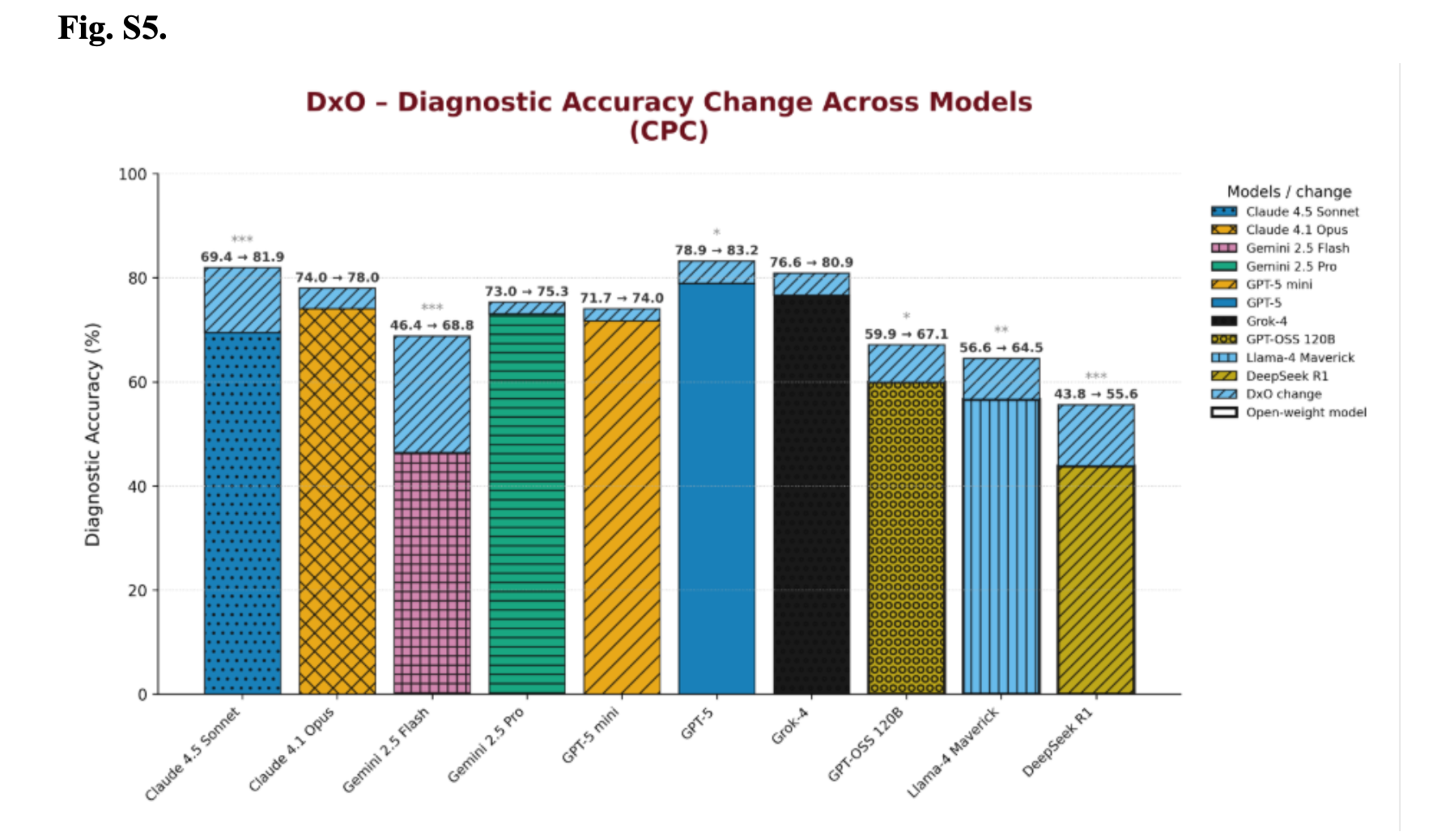
prompted with baseline prompt across different large language models.Image Credits:Microsoft AI