The key facts
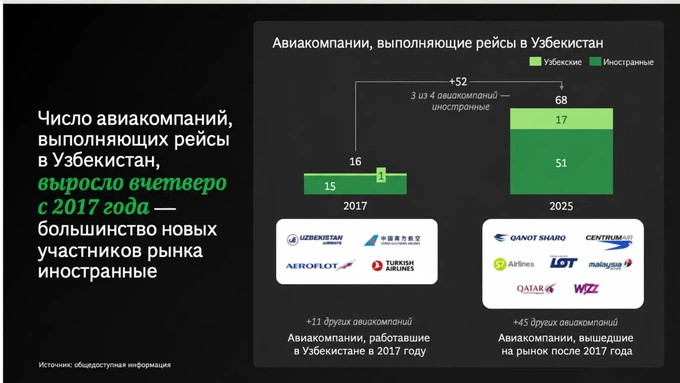
- Central Asia is the fastest-growing aviation market in the world; Uzbekistan's market is growing at roughly 16% per year, and the number of flights has more than quadrupled.
- The share of domestically produced jet fuel, according to industry estimates, could rise from 40–50% to 70–80%.
- A ticket costs the average Uzbek resident about 25 days of earnings (Kazakhstan — 4, developed countries — 1); demand for flights accelerates at a GDP per capita of $6,000–7,000 (currently around $4,000).
A Fast-Growing Market and Hub Potential
Central Asia, according to BCG's assessment, is the fastest-growing aviation market in the world, but it still remains in the shadow of hubs such as Istanbul, Dubai, Doha and Shanghai. Suresh Subudhi believes that Uzbekistan can become an independent aviation market, but this requires coordinated action by airlines, airports, the regulator and the state, as well as a clear master plan. The number of flights to the country has more than quadrupled, and the market is growing at roughly 16% per year — almost 2.5 times faster than GDP.
Airports as Economic Platforms
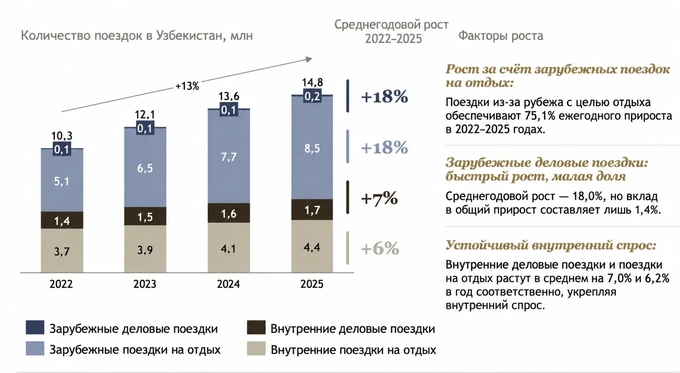
Vasily Triandafilidi noted that turning the Tashkent and Samarkand airports into economic platforms requires all the elements at once: a well-designed route network, cargo transportation, MRO (maintenance and repair), duty free, hotel and logistics infrastructure. He cited the example of Incheon Airport in South Korea, where duty free attracts luxury-segment passengers. Suresh Subudhi added that with the national carrier's plans to significantly expand its fleet, developing a competitive MRO hub becomes a natural direction, one capable of serving other airlines as well. Uzbekistan already receives about 11.1 million tourists a year, and the flows are expected to keep growing.
Fuel and Competitive Advantages
According to Subudhi, successful hubs do not necessarily have an advantage in fuel prices: Istanbul built an efficient hub without a price advantage, ensuring that transit passengers account for 40–50% or more of passenger traffic. A competitive advantage can be built on aircraft turnaround speed, operational efficiency and service quality. Commenting on Uzbekistan Airways' flight reductions to Russia due to fuel shortages and rising fuel prices, Triandafilidi said that both factors usually operate at once: a fuel shock worsens the economics, but the cuts primarily affect routes that were already on the edge of profitability even before. The share of domestically produced jet fuel, according to industry estimates, could rise from 40–50% to 70–80% with the commissioning of new capacity, including through the reorientation of refineries. Subudhi emphasized the difference between price risk and fuel availability risk: hedging (European airlines hedge for 18–24 months, American ones use it less often) does not solve the problem of physical shortage.
Regional Connectivity and Tourism
Triandafilidi believes that the priorities should be all directions at once — direct international flights, transit through Tashkent, regional airports (Samarkand, Bukhara, Urgench, Fergana) and rail connectivity. Last year the country was visited by about 12 million foreign tourists, but travelers often could not find convenient connections between cities, for example from Samarkand to Bukhara. Subudhi noted the importance of a master plan for tourist routes. Regarding the 'fifth freedom of the air' for foreign airlines at regional airports, he declined to give an assessment without a separate analysis, pointing to the need to take into account room for the growth of national carriers, tourism priorities and predictable rules for investors.
PPPs and Domestic Flights
Subudhi named typical mistakes in airport PPPs: underestimating project costs and the absence, in the business plan, of scenarios for passenger traffic deviating from the forecast in either direction. Triandafilidi believes it is too early to assess the effectiveness of the PPPs in Samarkand and Urgench; he cited the example of London Gatwick, where under private management passenger traffic grew from roughly 33 to 43 million people, while per-passenger charges, adjusted for inflation, barely changed. The domestic market, in his view, can develop, but business demand requires a frequency higher than two or three flights a week — daily morning and evening departures. The main barrier is price: a ticket is equivalent to about 25 days of earnings for a resident of Uzbekistan, compared with about four days in Kazakhstan and one in developed countries. Triandafilidi noted that demand for air travel in transition economies usually accelerates at a GDP per capita of $6,000–7,000; in Uzbekistan it is currently about $4,000, and at the current growth rate the threshold could be reached in roughly five to six years. Subudhi added that stimulating regional flights (for example, following the model of India's UDAN program or through low-cost carriers) should be done cautiously: with a premature launch, negative experience could hold back the market's development.