News

employment

News about employment: events, facts and developments on tafs uz.

11 stories

Uzbekistan enters the world's top 5 countries in poverty reduction

Uzbekistan has been recognized as one of the world's leaders in poverty reduction, entering the top 5 countries by this indicator. Over nine months of 2026, the poverty rate fell by 2.2 percentage points, and the number of poor families decreased by 184 thousand. The republic accounts for 60% of the region's success in this area. Minister of Employment Marat Zhurayev presented World Bank data, noting that 824 thousand people found permanent jobs and the incomes of 4.14 million citizens were raised.

2 min read

President of Uzbekistan visited the Chim mahalla in Kashkadarya region

Shavkat Mirziyoyev got acquainted with the development of the Chim mahalla in Koson (Kamashi) district, where 55 billion soums have been allocated for infrastructure renewal. He spoke with residents, noted the growth of higher education coverage and discussed employment measures, including greenhouses and lemon growing.

2 min read

Uzbekistan cuts employment service fees for South Korea fivefold

Uzbekistan's Migration Agency, by a director's order dated October 19, 2026, approved new tariffs for pre-departure training and employment abroad. For those traveling to South Korea on an E-9 visa, the fee was reduced from 50 to 10 BRV — from 22 million to 4.4 million soums. Until December 31, 2026, the agency's services are free for those traveling to Europe, Russia and Arab countries. The tariffs take effect on October 20 and do not apply to previously concluded contracts.

2 min read

Uzbekistan plans to grow 1 million tons of fish per year and build greenhouses for low-income families

On October 20, President Shavkat Mirziyoyev reviewed a presentation on the development of intensive fish farming and the creation of energy-efficient lemon greenhouses. In the Balykchy district of the Andijan region, full-cycle fish farming complexes are planned to be created around 24 melioration wells, and greenhouses for growing lemons on 100 hectares near nine mahallas. By March 1, 2027, an inventory of more than 4,000 wells across the country has been ordered. Next year, greenhouse complexes are planned to be built in the regions

2 min read

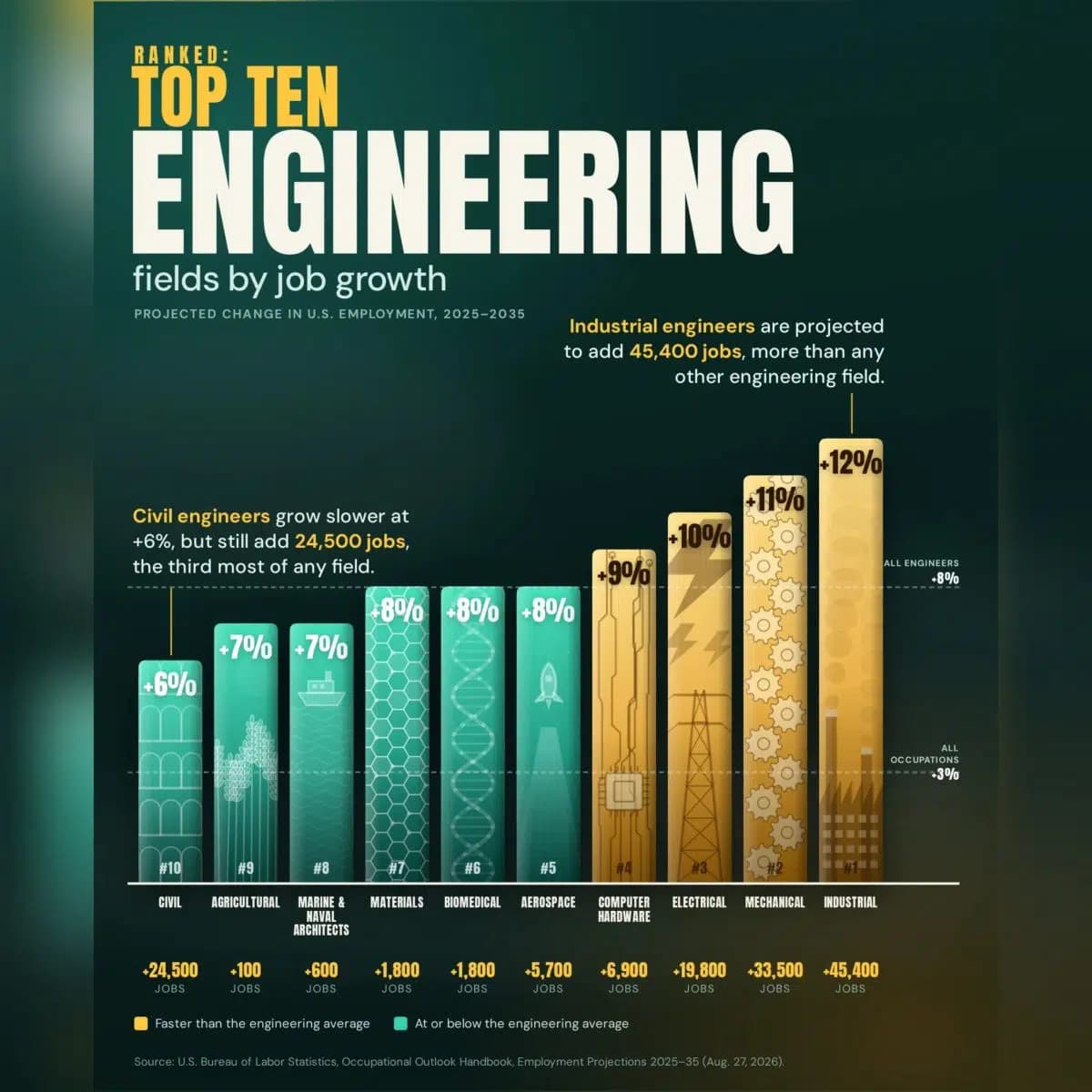
BLS: US demand for engineers will grow twice as fast as the overall labor market by 2035

According to the US Bureau of Labor Statistics forecast, employment in engineering occupations in 2025–2035 will grow faster than the economy-wide average (3.5%). Industrial (12%), mechanical (11%), and electrical engineering (10%) lead. At the same time, a high growth percentage does not always mean many new jobs: in agricultural engineering, 7% growth will yield only about 100 openings.

2 min read

More than 40% of British teenagers ask schools to teach them finance and job hunting

A Survation poll for BBC of 2,000 teenagers aged 13–18 found: 44% want more workplace experience, 43% want help managing finances, 42% want advice on finding jobs. More than half had no work experience. The England government plans to guarantee two weeks of work experience for every pupil. Four students from Newcastle shared their internship experiences.

3 min read

Uzbekistan and Croatia discuss sending citizens to work in Croatia

During the visit of the Director of the Migration Agency of Uzbekistan Muhsinkhoja Abdurakhmonov to Croatia, negotiations were held with the Croatian Chamber of Economy (HGK), the Employers' Association (HUP), and local employers. A scheme was discussed under which Croatian employers submit their staffing needs to the agency, while candidates undergo training and selection in Uzbekistan. The first practical steps are planned in construction, welding, and transport.

1 min read

Young professionals in India learn to work alongside AI

Young workers in India — journalists, lawyers, managers — are increasingly using AI for routine tasks, but emphasize the need to verify results. According to surveys by Deloitte and Emeritus, a majority of young employees use AI. Experts and reports by NITI Aayog and the World Bank point to risks for entry-level positions and uncertainty about the long-term effect on the labor market.

3 min read