The key facts
- The poverty rate under national criteria fell from 5.8% to 3.6% as of October 1
- 440 thousand families were removed from the Social Registry, 19 thousand of them returned to the poor category
- 825 thousand people have been employed since the beginning of the year, and about 1 million informally employed people have been registered
Poverty Reduction Under National Criteria
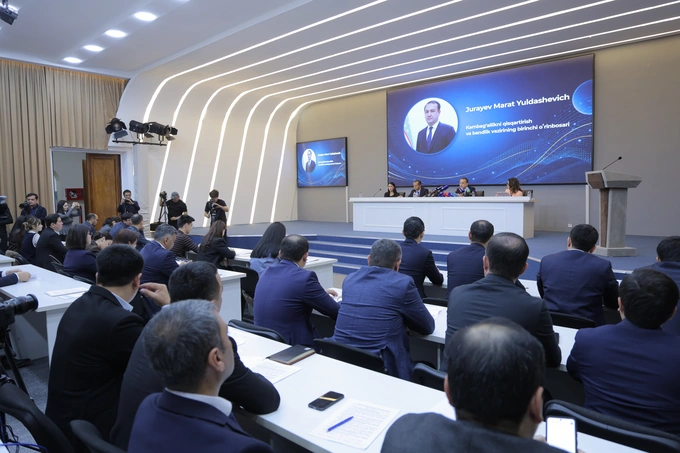
At a press conference with the leadership of the Ministry of Poverty Reduction and Employment, held on October 21, it was reported that as of October 1, the number of poor people in Uzbekistan stood at 1.4 million. First Deputy Minister Marat Zhuraev noted that at the beginning of the year the poverty rate under national criteria was 5.8%, and the number of poor people reached 2.2 million. By October 1, the figure had fallen to 3.6%, the number of poor families decreased from 533 thousand to 339 thousand, and the number of neighborhoods free from poverty reached 3,627.
How the Social Registry Works
According to Zhuraev, work with poor families is carried out in a targeted manner through the Social Registry: after a family is included, its needs, capabilities, and potential are studied, an individual plan is drawn up, and services are assigned under it in seven areas. The Ministry offers 55 types of services for sustainable employment — from job placement to engagement in entrepreneurship, provision of subsidies, and vocational training. Since the beginning of the year, 440 thousand families have been removed from the registry due to rising incomes. However, 19 thousand of them subsequently returned to the poor category. Families removed from the registry do not lose support immediately: they are transferred to the 'green' category and monitored for 12 months — if incomes fall below the threshold again, the family may be returned to the registry.
Changes in Equipment Distribution
The procedure for allocating equipment to poor families has been changed: citizens are no longer forcibly given a sewing machine or a specific tool. They independently choose the equipment they need through an electronic marketplace, and funds are allocated by the State Targeted Fund for Employment Promotion on an interest-free basis. Control over targeted use is assigned to hokim's assistants: after three and six months, they visit the household and check whether the equipment is being used, whether there are raw materials and a sales market. Zhuraev explained that in the case of selling or misusing the equipment, the citizen bears responsibility, while in the case of improper allocation, the hokim's assistant does.
National and International Poverty Criteria
The deputy minister explained that the national poverty criterion is based on minimum consumer expenditures: this year it is set at 715 thousand soums per person per month. If income per family member is below this amount, the family is considered poor. Zhuraev also answered a question about the discrepancy in figures: under the national criterion, poverty in 2025 was 5.8%, while under the World Bank methodology it was 2.3%. According to him, the World Bank uses the international poverty line of $3 per day for Uzbekistan, and these two figures are calculated using different methodologies, so they cannot be directly compared.
Employment and the Informal Sector
According to the ministry, more than a million new workers enter Uzbekistan's labor market every year. For 2026, the tasks set are to employ one million people in permanent positions at legal entities, raise the incomes of 4 million people, and register the activities of one million informally employed people. Over nine months, 825 thousand people have been employed, incomes have been raised for 4.141 million, and the activities of nearly one million informally employed people have been registered. The unemployment rate fell from 4.8% to 4.1%, and the number of officially employed people exceeded 12 million. As part of monitoring informal employment, inspections were conducted at nearly 500 catering enterprises in Bukhara, Samarkand, Khorezm, and Tashkent; the activities of 197 thousand informally working citizens were registered, and about 300 employers were held accountable.
Migrants, Released Prisoners, and Pensioners
Sobir Khayitmurdoв, Director of the Agency for Population Employment Issues, reported that since the beginning of the year, 1.115 million citizens have returned from labor migration, and about 200 thousand of them left again. Reintegration services were provided to 883 thousand people, of whom 173 thousand were employed or engaged in entrepreneurship. Of the 3,704 citizens who returned after serving their sentences, whose list was provided by the Ministry of Internal Affairs, 1,892 were employed; 1,668 quota-based jobs have been reserved for this category, and 754 people have been placed in them. As for working pensioners, Zhuraev stated that there is no legislative ban on their work and no restrictive norms are being developed. Khayitmurdoв added that more than 223 thousand pensioners continue to work in the country, and the new Labor Code abolished the provision of the previous code that allowed terminating a contract due to reaching retirement age.