The key facts
- The shortened variant of the C919 made its first flight over Shanghai — it was the compact version, not the stretched one, that entered flight testing first
- The aircraft is aimed at high-altitude airports with challenging conditions
- At Airbus and Boeing, by contrast, larger variants are more popular: the A321neo accounts for about 75% of A320neo family orders
First flight of the shortened C919
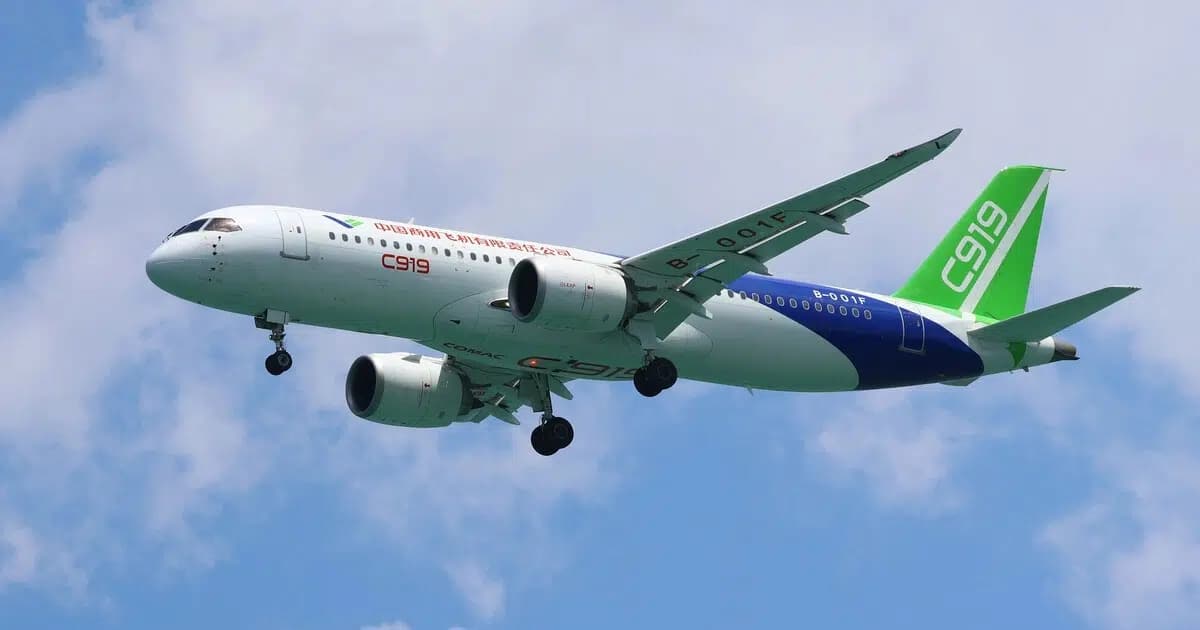
A shortened variant of the C919 passenger aircraft produced by the Chinese company COMAC has taken to the skies over Shanghai for the first time. Contrary to expectations tied to current trends in the narrow-body aircraft market, this is not a stretched version: the manufacturer shortened the fuselage to create a variant for use at high-altitude airports with some of the most challenging conditions in the world.
Why the compact version came first
The decision looks unusual against the experience of Western manufacturers. At Airbus, demand for the smaller A319neo is noticeably lower than for the successful A321neo: as of June 2026, about 75% of the A320neo family order backlog is accounted for by the A321neo. At Boeing, among ordered but not yet delivered aircraft of the 737 family, the larger MAX 9 and MAX 10 models together accounted for 36%, while the compact MAX 7 accounted for only 6%. Nevertheless, it was the shortened aircraft that was the first of the models based on the C919 to begin flight testing. This is happening against the backdrop of COMAC continuing to face difficulties in ramping up production of the base version of the C919.
Not just commerce
For Airbus and Boeing, the development of aircraft families is determined primarily by commercial interests: different variants allow several market segments to be covered and development costs to be spread across aircraft of a single platform. COMAC also takes commercial factors into account, but the development of the C919 family has another goal — addressing the tasks facing the country's industry. After receiving the type certificate for the C919 in September 2022, China officially designated ramping up production and expanding the aircraft family as priority directions of state policy. In a COMAC statement from June 2023, the strategy was formulated around 'three main tasks': increasing production rates and expanding the aircraft family, achieving technological independence, and ensuring safety and reliability.