The key facts
- President of Finland Alexander Stubb spoke at COP31 in Antalya (Turkey) with a call for collective climate action
- He named three priorities: multilateralism, science and resilience
- Stubb warned that a temporary overshoot of the 1.5°C warming threshold is “highly likely” according to the latest scientific reports
Address at COP31 in Antalya
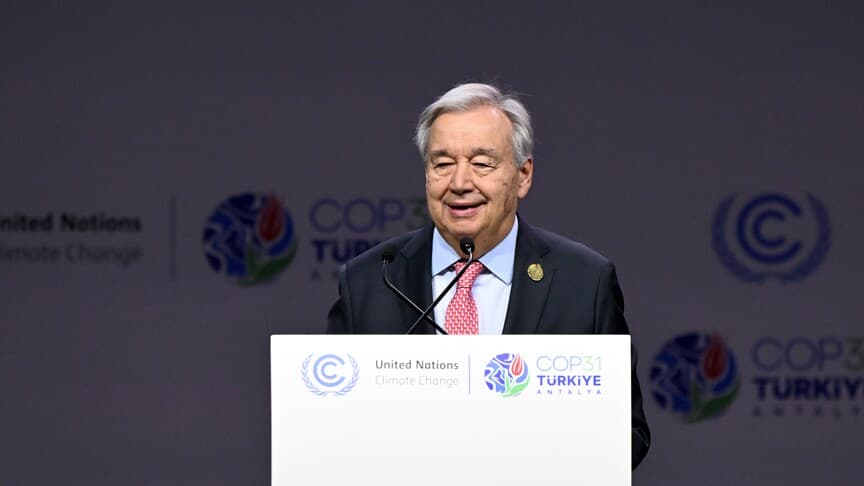
President of Finland Alexander Stubb spoke at the UN climate conference COP31, taking place in the Turkish province of Antalya, and called on countries to confront climate change together. “No country, regardless of its size, power or geography, can protect itself from the consequences of climate change. And none of us can cope with it alone,” the Anadolu agency quotes him as saying.
Conflicts must not distract from the climate agenda
Stubb warned that international conflicts must not distract from climate action: the crisis continues to affect countries around the world, and the consequences are already evident — in the devastating floods in Nepal, in rising sea levels threatening coastal and small island states, and in the forest fires in Europe.
Three priorities: multilateralism, science, resilience
The President of Finland outlined three priorities for an effective global response: multilateralism, science and resilience. In his words, without multilateralism it is impossible to tackle the climate crisis. The Paris Agreement, despite disagreements between countries, remains the common framework, but “its authority depends on implementation.” Flexible alliances and coalitions of countries ready to cooperate could sustain progress during the period of restructuring of global structures, while, Stubb emphasized, no country should be left behind.
Science and economic opportunities
Turning to science, Stubb noted that the latest reports point to a high probability of a temporary overshoot of the 1.5°C warming threshold. “Science leaves us little room for complacency,” he said, adding that advances in climate research, innovation and early warning systems can improve preparedness and save lives, while artificial intelligence, satellite data and digital networks will help adapt to change. He called the transition to clean energy not only an environmental necessity but also an opportunity to strengthen competitiveness: reducing dependence on fossil fuels, diversifying energy supply and accelerated electrification create conditions for sustainable growth, and broad access to technology can help reduce global inequality.