The key facts
- Muse Ember is the fourth model under the Muse brand: after Spark (April), Glimmer (August), and Wonder (October)
- The price is 10 cents per million input tokens, competitive with open-source DeepSeek V4.1 Flash and GLM 5.3 Flash
- The model is trained to work with text, images, and audio without a separate model and is intended as a companion to the flagship Muse Wonder
A lightweight model for routine agent work
Meta Superintelligence Lab on Monday released a new AI model, Muse Ember — the lightest and most economical model in the company's lineup. According to TechCrunch , citing Meta's release, the model is «designed to handle complex reasoning and the work agents repeat all day: tool calls, coding subtasks, routing, data extraction, and parsing long documents.»
Price as the main argument
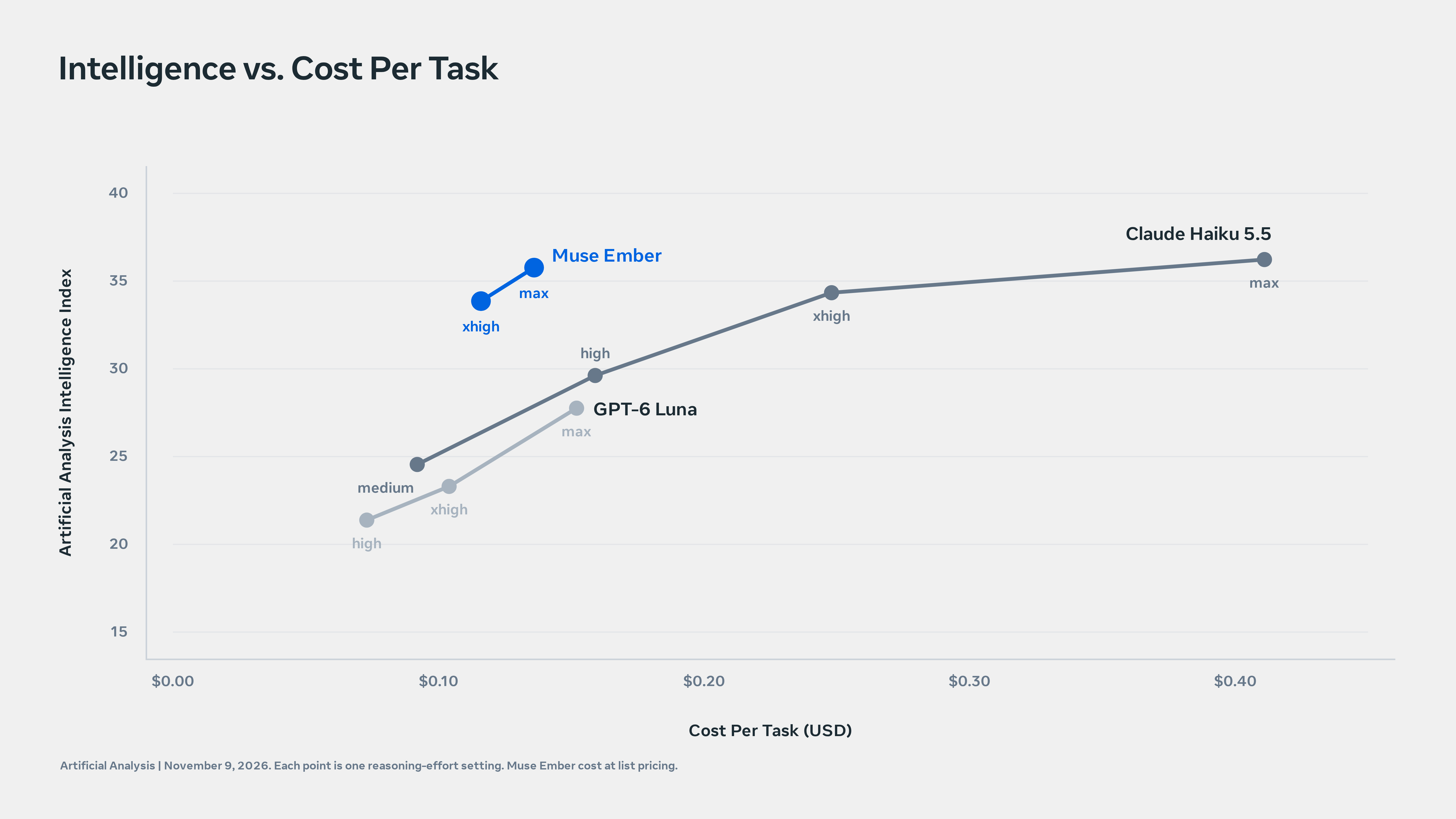
Meta emphasized the cost per task: according to Artificial Analysis' composite benchmark , Ember is shown as cheaper and at the same time «smarter» than competitors like Anthropic Haiku and OpenAI Luna. At a price of 10 cents per million input tokens, the model is noticeably cheaper than flagship rivals while remaining cost-competitive with open-source solutions such as DeepSeek V4.1 Flash and GLM 5.3 Flash.
The «one plans, another executes» pairing
Given its focus on low cost and accuracy at scale, Ember is designed to work in tandem with a heavier model — for example, the flagship Muse Wonder — within an agentic architecture. Meta describes the scheme using a support agent as an example: the heavy model sets the rules for handling a specific issue, while the lightweight one applies them to tens of thousands of requests. The formula from the announcement: «Muse Wonder plans, Muse Ember handles the volume.» For high-volume scenarios, Ember is trained to work with several media types at once — text, images, and audio: according to Meta, agents can read screenshots, charts, and scanned documents, or work with voice notes, meeting recordings, and video without a separate model.
The fourth model in the Muse lineup
Ember became the fourth model under the Muse brand. Before it came the mid-sized Spark (April), its open-source version Glimmer (August) , and the frontier model Wonder (October). The flagship consumer product — Muse Agent — debuted in September and, as TechCrunch notes, achieved unexpected success, becoming the second most popular app in the US; earlier this month, it received Spaces and video chat features. Ember's release fits into Meta's noticeably accelerated release pace: four models and an agent in eight months, with the lightweight Ember filling the low-price segment of the lineup, where Meta now competes not only with closed models but also with cheap open-source alternatives.