The key facts
- Medium launched the TK app with an AI assistant in the editor: invoked via “@TK,” skills for editorial and headline feedback, adaptation to Medium’s style guide
- TK allows publishing notes on how AI was used in a text; Medium calls this the start of “writing provenance” transparency in the AI era
- The app is free for Medium account holders, available on the web, with a desktop version planned
An AI assistant inside the editor
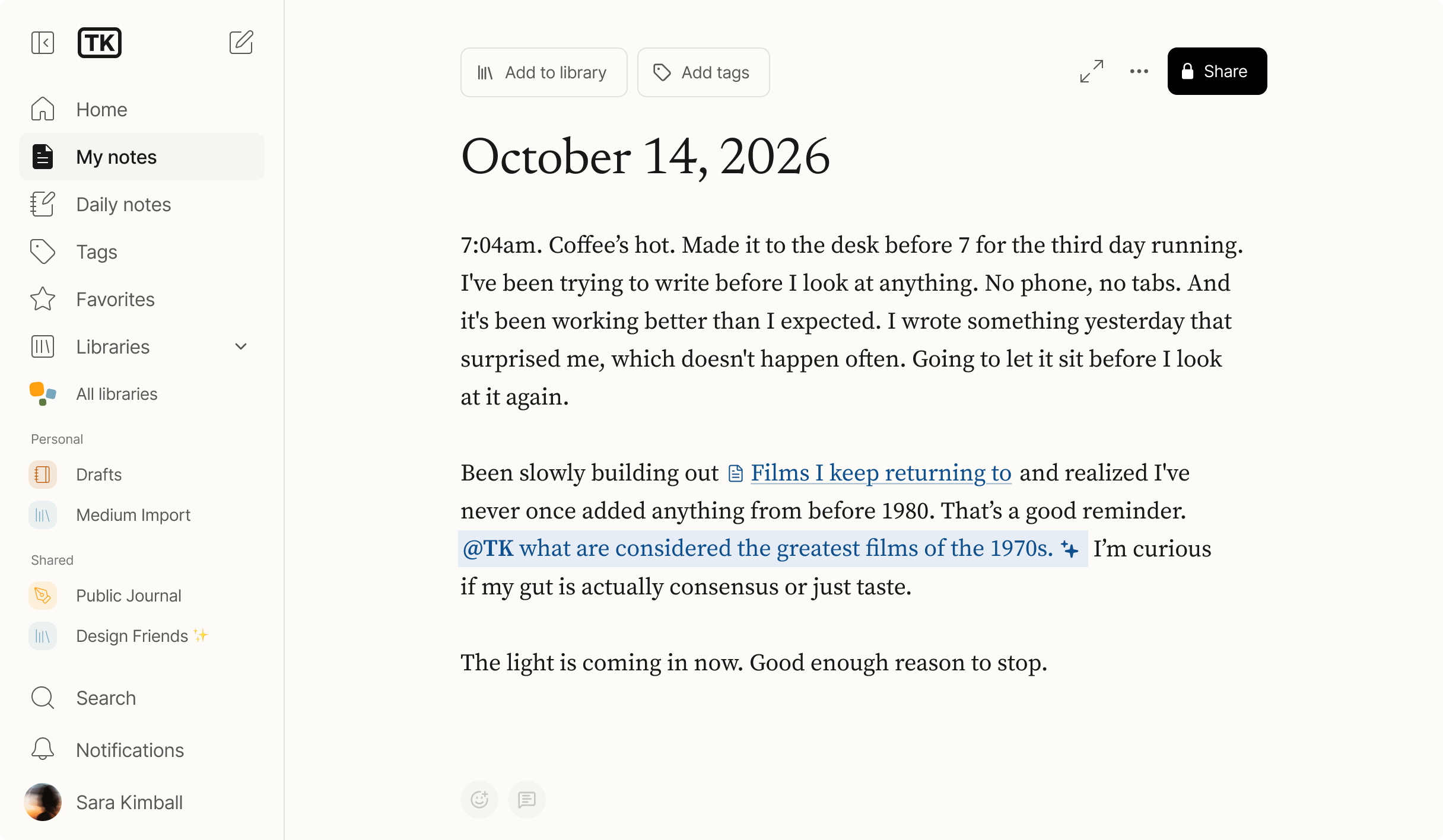
On Monday, the Medium platform launched the TK app, whose task is to embed AI more deeply into the writing process itself. As TechCrunch reports, the assistant is invoked right in the editor: the user types “@TK” and phrases a request. The name references journalism jargon: “TK” (from “to come”) is a placeholder for missing information that is easy to find in a text, since the combination “tk” almost never occurs in English words. In the Medium app, this symbol has taken on a new role — helping to “fill in the gaps.”
What TK can do
The company describes several scenarios: the assistant can answer questions for which one would normally have to switch to another tab (for example, how many days are in a given month), pull up fragments of drafts previously saved in the app, and suggest topics for writing. TK ships with separate “skills” for editorial and headline feedback, as well as for adapting a draft to the style guide of Medium publications. Additionally, the app helps organize previously written material, and via an MCP server or a Claude skill it can connect to the user’s own AI agent to take its projects and ideas into account. There is also a social layer: drafts can be shared with other people for feedback.
A launch amid debates about AI in literature
TK’s release coincided with a period when the publishing and literary community is actively discussing the role of AI in creating long-form texts: according to TechCrunch, several authors lost book deals over suspicions of using AI, and literary awards came under scrutiny after suspicions that the winning works had been written with its help. In the industry, concern is growing that an assistant’s editorial “suggestions” could effectively become the text itself instead of the author’s thoughts. At the same time, the reliability of AI-text detectors remains disputed: they poorly distinguish between text written by AI, written with its help, and written without it at all.
Medium’s position and transparency
TK openly takes a side in this debate: Medium asserts that “artificial intelligence makes writing more important, not less” and that AI “is capable of amplifying human intelligence, using the written word as a foundation.” At the same time, the company acknowledges the risk of low-quality content appearing and of the line between human and machine text blurring. The answer was a transparency feature: authors can publish notes explaining exactly how AI was used in writing. “This is the beginning of what we believe is required for publishing in the AI era — making the provenance of a text clear, transparent, and verifiable, down to the prompts and source materials,” says Medium’s blog.
Availability and limitations
At launch, TK is available on the web, with a desktop app announced as planned. The app supports Markdown import and export but is not a Markdown editor as such. Texts in TK are not encrypted — the app is designed for collaborative work — however, users can configure access permissions for their works. Medium, which according to TechCrunch is profitable, is making TK a free tool for holders of a platform account.