The key facts
- 24 of 30 volunteers reported sensing an invisible presence nearby: touches, familiar smells, visual silhouettes of the deceased
- The vividness of the 'phantoms' depended on the development of creative imagination; strong memories and sensory deprivation also played a role
- Light spots recorded by infrared equipment were provisionally explained by dust and optical artefacts
What happened in the experiment
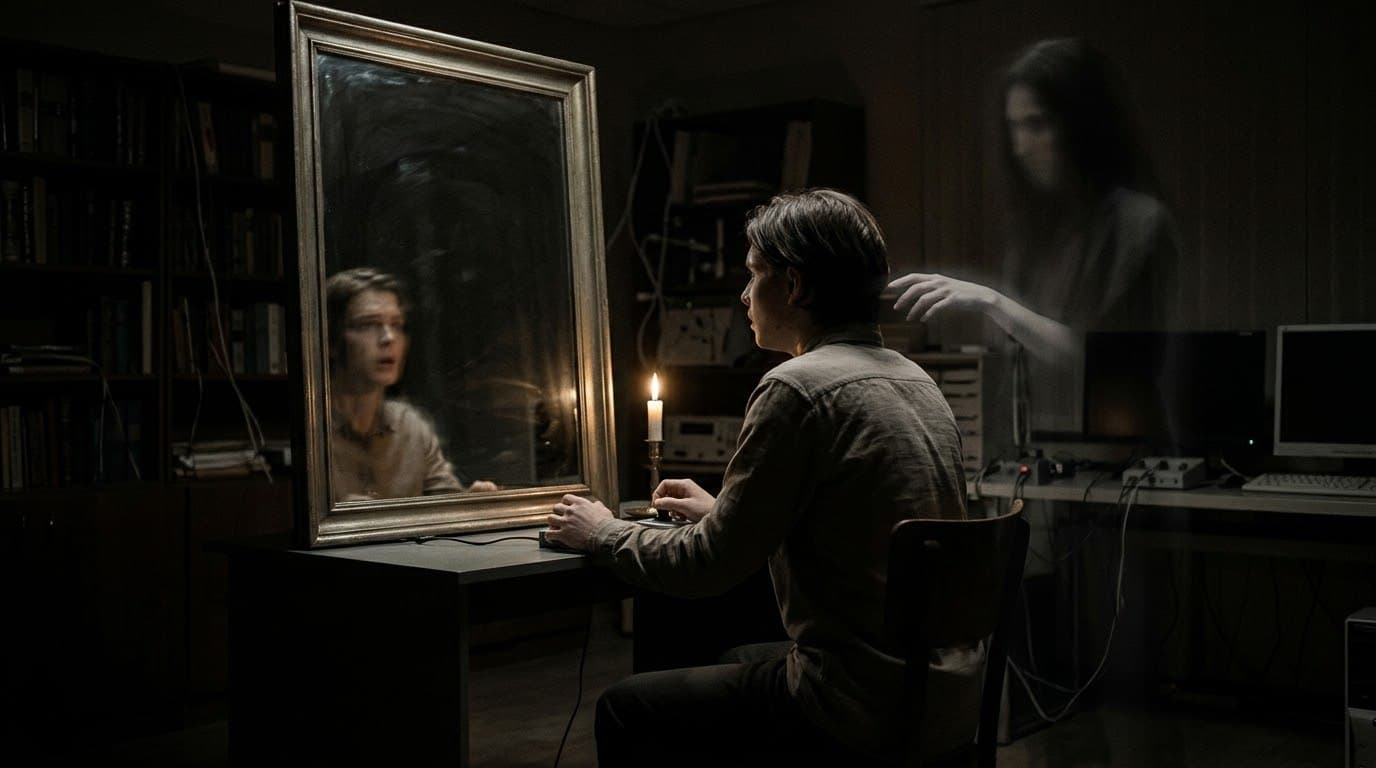
Psychologists from Georgia and Missouri set up a soundproof space — a 'psychomanteum': the walls were draped with dark fabric, the lighting was dimmed, and a reflective panel was fixed at an angle so that it concealed the silhouette of the person sitting opposite. ScienceAlert reports on the experiment; Life.ru retells it.
Preparation and procedure
Before the immersion, participants spent 15 minutes concentrating on images of loved ones, recalling their facial expressions, intonations and habits; many brought old photographs or family keepsakes for a deeper emotional immersion. Each participant was then left in semi-darkness for 45 minutes under continuous pink noise that blocked out external sounds. Whenever they experienced any anomalous sensations or visions, the subject pressed a special button on the panel.
Results
24 of the 30 volunteers reported sensing an invisible presence nearby: they described touches, picked up familiar smells and saw visual silhouettes of deceased people. One woman claimed that a deceased relative had stroked her hair. Most described the experience as profound and positive: according to project leader Christine Simmonds-Moore, the process allowed them to mentally say goodbye to their loved ones and complete long-unspoken dialogues.
How the effect is explained
The specialists found that the vividness of the 'phantoms' directly depended on the development of creative imagination. Strong memories, psychological readiness and sensory deprivation put the brain into an altered state of perception. Infrared equipment additionally recorded drifting spots of light that coincided with the participants' emotional surges; however, this phenomenon was provisionally attributed to floating dust and optical artefacts.
Context on visions in the dying
Life.ru separately cites a comment by forensic medical expert Sergey Gavrilov: he suggested that the content of the images of loved ones described by people who have survived clinical death may depend on life experience and emotionally significant memories. In some studies, changes in brain activity were recorded in dying patients, but these data do not allow one to determine which specific images the person was experiencing.