The key facts
- On November 7 at 15:43 Moscow time, an M1.2 flare lasting 22 minutes was registered in sunspot group 4566 (S07E14)
- On November 5, an M3.6 flare occurred — the strongest in the past four weeks
- The Laboratory of Solar Astronomy at the Space Research Institute of the Russian Academy of Sciences reported a resumption of flare activity after a long lull
A new M-class flare
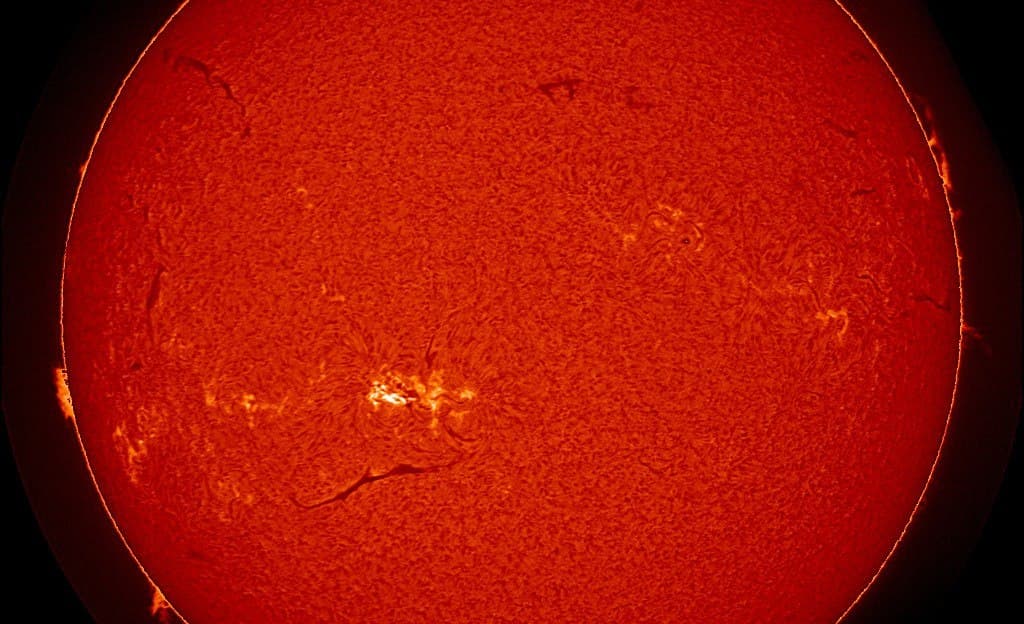
On November 7 at 15:43 Moscow time, an M1.2 flare lasting 22 minutes was registered on the Sun in the X-ray range. It occurred in sunspot group 4566, located in the region with coordinates S07E14. The Institute of Applied Geophysics told TASS about this, reports Gazeta.Ru.
Activity returns after a lull
The new flare fits into the overall picture: the day before, specialists from the Laboratory of Solar Astronomy at the Space Research Institute of the Russian Academy of Sciences reported that after a long lull, a resumption of flare activityis being observed on the Sun. Even earlier, on November 5, an M3.6 flare was recorded — at that time, the strongest in the past four weeks. Thus, over three days the Sun produced M-class flares twice, confirming the transition from a quiet period to a more active one.
What flare classes mean
Solar flares are divided into five classes — A, B, C, M and X — depending on the power of X-ray radiation. Class A0.0 is taken as the reference point, corresponding to a radiation power in Earth's orbit of 10 nanowatts per square meter; moving to the next letter increases the power tenfold. Flares can be accompanied by ejections of solar plasma: clouds of such plasma, upon reaching Earth, are capable of triggering magnetic storms. The sources' reports did not say whether the November 7 flare was accompanied by a plasma ejection or whether magnetic storms are expected.