The key facts
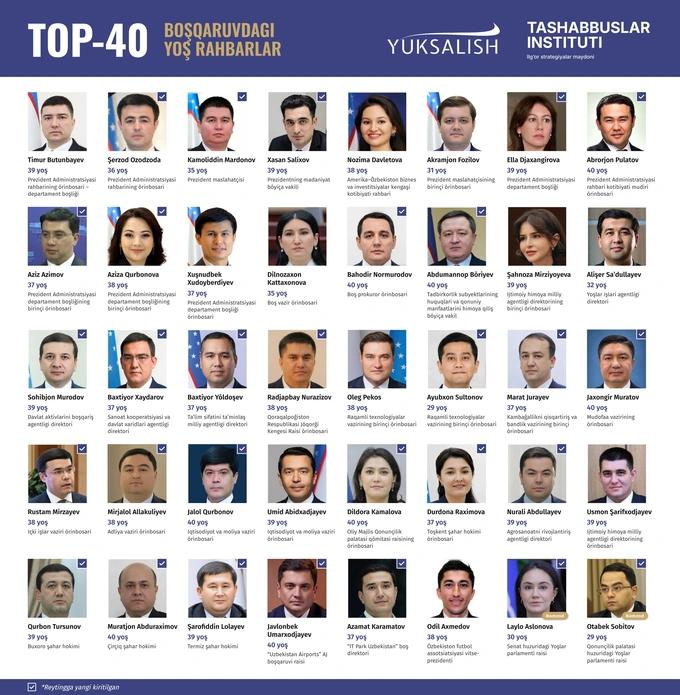
- The TOP-40 ranking includes 40 executives under 40; 29 of them (72.5%) entered for the first time.
- Among the newcomers are Kamoliddin Mardonov, Abdumannon Buriev, Sokhibjon Murodov, Javlonbek Umarkhojaev and Azamat Karamatov.
- 11 people kept their positions from the 2025 edition; the assessment is based on six criteria on a 100-point scale.
The TOP-40 ranking for 2026 has been published
The Yuksalish Movement and the Institute of Initiatives have updated the 'TOP-40: Young Leaders in Governance' ranking, which they have maintained since 2019. This was announced by the movement's press service, reports Spot.uz. The list includes 40 executives under the age of 40 in public service and other fields, with 29 of them (72.5%) entering the ranking for the first time.
Who entered for the first time
The new entrants include the President's adviser on economic policy Kamoliddin Mardonov, the President's representative on culture Khasan Salikhov, business ombudsman Abdumannon Buriev, director of the State Assets Management Agency Sokhibjon Murodov, head of Uzbekistan Airports Javlonbek Umarkhojaev, and CEO of IT Park Uzbekistan Azamat Karamatov. Also noted for the first time are deputy head of the Presidential Administration Sherzod Ozodzoda, deputy prosecutors general and deputy ministers of defense, justice, internal affairs, economy and finance, the khokims of Bukhara (Kurbon Tursunov), Chirchiq (Muratjon Abdurakhimov) and Termez (Sarofiddin Lolaev), deputy khokim of Tashkent Durdona Rakhimova, and the heads of the youth parliaments under the Senate and the Legislative Chamber.
Who kept their positions
According to the Russian version of Spot.uz, 11 participants from the 2025 edition remain in the updated list, among them Deputy Prime Minister Dilnozakhon Kattakhonova, director of the Youth Affairs Agency Alisher Sadullayev, first deputy minister of digital technologies Oleg Pekos, and vice-president of the Football Association of Uzbekistan Odil Akhmedov. In total, the ranking includes 17 heads of organizations and eight women.
How they were evaluated
The executives' performance was assessed on a 100-point scale across six criteria: changes in regulatory legal acts and the impact of initiatives, economic and sectoral indicators, handling of citizens' appeals, openness to the public and media, changes in international rankings and cooperation, and the influence of the position on reforms in the sector. Data was collected from the official websites of government bodies, electronic and official statistics, reports of international organizations and the media, after which it was verified by an expert group. The organizers emphasize that measurable results and changes in the sector are taken into account, not the participant's position itself.