The key facts
- November 6, 2026 marks 90 years since the birth of Emil Loteanu, creator of 'Queen of the Gypsies'
- November 6, 2026 — the 90th birthday of Emil Lotyanu, creator of 'Queen of the Gypsies'
- The 1976 film was seen by 64.9 million viewers and won the Golden Shell in San Sebastián
- It is based on Gorky's early stories 'Makar Chudra' and 'Old Izergil'
Anniversary of the director of 'Gypsy Camp'
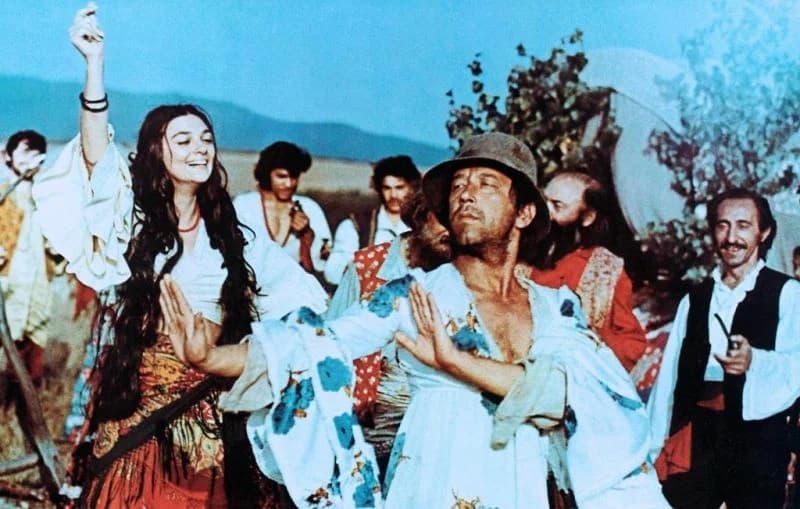
On November 6, 2026, Emil Loteanu — the director of one of the most successful Soviet films of the 1970s, 'Queen of the Gypsies' ('Tabor ukhodit v nebo') — would have turned 90. To mark the date, Life.ru published a piece on how the film was made: from its literary basis and casting to the music and its box-office fate. Filming was completed in 1975, and the film went into wide release on April 5, 1976.
The actors and chance encounters
Rada was played by Svetlana Toma, and Loyko Zobar by Grigore Grigoriu; both had already appeared in Loteanu's 'Red Meadows,' so the director worked with performers he knew well. According to Toma's recollections, she had actually been planning to enroll in a law faculty until Loteanu offered her a film role — a chance meeting determined her profession. After 'Queen of the Gypsies' was released, readers of 'Sovetsky Ekran' named her the best actress of 1976. Little Alyona Buzyleva, whose voice in 'Nane tsoha' audiences still recognize today, was brought to the auditions by chance by her brother: the girl sang to a guitar and started dancing, after which Loteanu picked her up in his arms. Filming coincided with the start of her school life, and a teacher traveled with the group, working with the girl in her free moments.
Music written twice
The film's music was composed by Yevgeny Doga, who blended folk Gypsy melodies with orchestral music; the Buzylev family helped him in his work. The songs in the film sound like part of the characters' everyday life: 'Brichka' was performed by Nikolai Volshaninov, who played Aralambi; he recorded 'Ay, mato' together with Nikolai Zhemchuzhny; 'Yablochko' is heard performed by an ensemble of Transcarpathian Gypsies, and 'I Am Dying, Mama' by Takhir Bobrov. Behind the unfamiliar words of 'Nane tsoha' lies a playful everyday story: a girl asks her father for new clothes, but hears in reply that after her wedding it will be her husband who buys them; the opening line translates as 'No skirt, no blouse.' The story of the music's creation has an unexpected detail that Doga himself recounted in an interview with 'Rodnaya Gazeta': two days before the recording, he lost the score and had no drafts, since he was used to writing in final form — and he reconstructed the prologue, the finale, and the music for the camp's procession from scratch, remaining, by his own account, satisfied with the result.
How and where it was filmed
Sergiu Finity, who played Bubulya, recalled the filming process: he ended up on set after an urgent telegram inviting him to Kaunas, and then the crew worked in Transcarpathia, where they found a nomadic Gypsy camp — about forty of its members appeared in crowd scenes. The horses were taken from Alabino near Moscow, home to a cavalry regiment that cooperated with filmmakers; Finity was given a horse named Zakat, whose trust the actor had to earn by feeding it berries in the Carpathians. Toma recalled that Loteanu was very strict on set, but after the shooting day he was caring and tender: 'Emil Vladimirovich demanded a great deal from his actors, sometimes the impossible. That impossibility — it is visible on screen.' The visual style was created by cinematographer Sergei Vronsky and production designer Felix Yasyukevich. The editing was not easy either: Finity once found the director in tears over the editing, when he was not allowed to release a two-part version.
Box-office success and literary basis
The film's success proved enormous: according to Mosfilm, it was seen by 64.9 million viewers, the studio calls it the box-office leader of 1976, and the San Sebastián festival archive confirms it was awarded the Golden Shell for best film. According to Toma, she was the one who received the prize on stage, since Lotyanu was not allowed to travel abroad. The film is based on Maxim Gorky's early stories 'Makar Chudra' and 'Old Izergil': the central love story is taken from 'Makar Chudra', where Gorky's heroine is named Radda, while the name Rada became established in materials about the film. In the story, love is from the very beginning bound up with a struggle for power over each other, and this contradiction leads the heroes to tragedy; the kinship with 'Old Izergil' shows itself in the poetic structure of the film's world — a southern night, vineyards, a road, and people disappearing into the distance. The film's title reads as a continuation of this vision: a private love drama becomes a reflection on freedom, which the heroes value more than their own happiness.
The director's fate after 'Tabor'
Emil Lotyanu was born on November 6, 1936, in the village of Klokuşna, then on the territory of the Kingdom of Romania and today in the Ocnița district of Moldova. He studied acting at the MKhAT School-Studio, but chose directing and graduated from VGIK in 1962; he first filmed at Moldova-film, and from 1973 at Mosfilm. The theme of wandering musicians, love, and the road appeared already in 'Lăutarii' (1971), and for 'My Tender and Affectionate Beast' (1978), based on Chekhov's 'A Drama on the Hunt', the music was again written by Doga. The director's personal life was also connected with his leading actresses: with Svetlana Toma they parted and reunited, but continued working together; Lotyanu married Galina Belyaeva in 1979, their son Emil was born in 1980, and the couple divorced in 1984 — Belyaeva linked the start of their disagreements to the filming of 'Anna Pavlova' in 1983. Years later, both Toma and Belyaeva were at the director's side in the final days of his life. Lotyanu died on April 18, 2003, in Moscow at the age of 66 and is buried at the Vagankovo Cemetery. The restored 4K version of 'Tabor' can be legally watched on Mosfilm's official website.