The key facts
- On November 6, 2026, Delhi's air reached the 'very unhealthy' category: PM2.5 — 157.9 µg/m³ against the WHO annual standard of 5 µg/m³
- On November 6, 2026, Delhi's air reached the 'very unhealthy' category: PM2.5 at 157.9 µg/m³ against the WHO annual standard of 5 µg/m³
- According to the DSS system, about 65% of winter PM2.5 comes to Delhi from outside, and 35% is generated within the city
- According to the DSS system, about 65% of winter PM2.5 arrives in Delhi from outside, while 35% is generated within the city
- Transport accounts for 51–53% of local PM2.5 emissions; experts demand a year-round strategy instead of seasonal measures
Another winter smog cycle
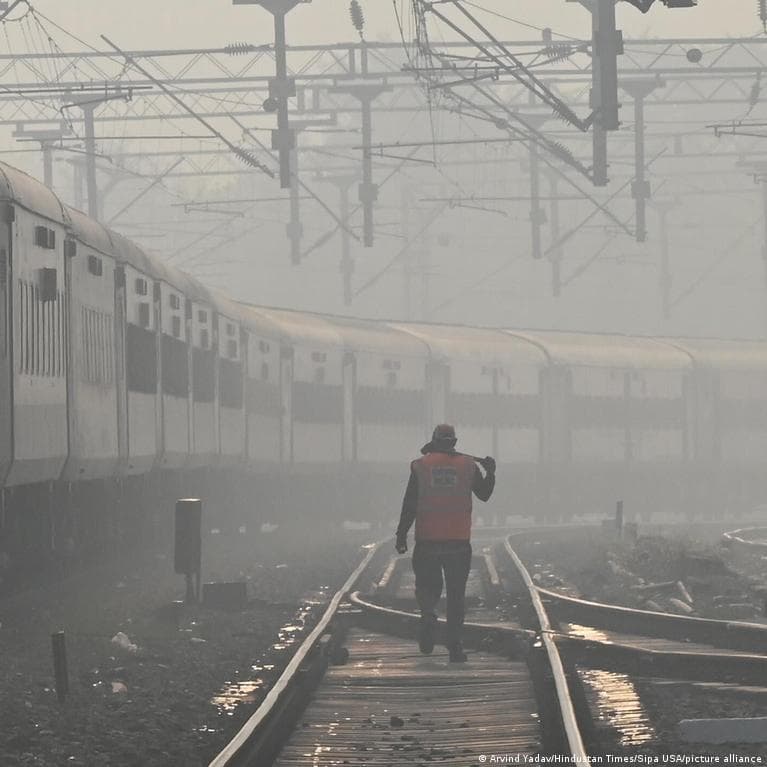
In early November 2026, the air in Delhi once again reached the 'very unhealthy' category: according to the Swiss monitoring service IQAir, the average PM2.5 concentration was 157.9 micrograms per cubic meter, while the World Health Organization recommends an annual safe level of no more than 5 µg/m³. This is reported by Deutsche Welle. For the city, it is a repetition of a familiar scenario: deteriorating air quality, emergency restrictions, an exchange of accusations between authorities — and a repetition of the entire cycle the following year.
What is known about the causes
The causes of the crisis are well studied. An expert group whose 2026 assessment was reviewed by the Delhi governmentnamed the main winter sources of PM2.5 as motor transport, industry, dust from roads and construction sites, the burning of biomass and waste, as well as pollution from neighboring regions. Sunil Dahiya, founder of the environmental group EnviroCatalysts, cited data from the government's Decision Support System (DSS) for the winter of 2025: about 65% of PM2.5 enters Delhi from outside and about 35% is generated within the city; among the largest external sources are the neighboring Noida and Gurugram in the National Capital Region (NCR). Coordination of action between Delhi and parts of three neighboring states remains the main obstacle: 'This is a shared problem, and no single city can solve it alone,' he told DW.
Why the measures do not work
In Dahiya's view, the gap lies between scientific recommendations and the actions of the authorities: scientists have been talking for more than a decade about the need for year-round measures targeting specific sources across the entire airshed, while the authorities respond seasonally. Emergency restrictions are activated only after pollution has reached dangerous levels, and short-term measures — water sprayers and smog towers — provide little relief. Structural changes (strict control of industrial emissions, cleaner fuels, expansion of public transport, electrification of transport, alternatives to burning crop residue for farmers) are advancing slowly. 'Science is not the bottleneck. The bottlenecks are implementation, regional coordination, and political will,' he said. Bhavreen Kandhari, co-founder of the Warrior Moms movement, added that burning waste instead of treating it properly only makes the situation worse.
The political dimension
Every deterioration in air quality is accompanied by political struggle. On November 6, Delhi's Environment Minister Manjinder Singh Sirsa said that the burning of crop residue in the neighboring state of Punjab contributes to the rise in pollution, whereas in Delhi itself construction, transport, and industrial sources are under control — as reported by All India Radio. Dahiya agreed that the seasonal fires in Punjab and Haryana are an 'episodic but sharp' factor capable of pushing the air from the 'very poor' to the 'severe' category for several weeks, but this is not the only source. According to him, transport alone accounts for roughly 51–53% of local PM2.5 emissions, and a significant share of winter PM2.5 consists of secondary particles formed from sulfur dioxide, nitrogen oxides, and ammonia, which points to fuel combustion at power plants, in industry, and in transport. 'Even if stubble burning stopped tomorrow, Delhi would still be breathing unhealthy air for most of the year,' he added. DW contacted several officials of the Delhi government for comment but received no response.
Who lives in the smog
Millions of Delhi residents cannot afford air purifiers and have no way to shelter from the pollution. Among them is Deepika, who works as a domestic helper in an affluent neighborhood of South Delhi: she has been coughing for a week and, in her words, 'has no choice but to endure it for the next few months.' Delhi resident Namrata Yadav, whose eight-year-old son joined her in protests against air pollution in November of last year, noted that a year later the problems persist. DW's interlocutors name a common set of priorities: year-round pollution control instead of seasonal restrictions, better coordination between governments, stricter enforcement of existing standards, and measurable targets — a sustained clean-air strategy instead of yet another winter emergency plan.