The key facts
- Under the current rules, the heating season begins after 5 consecutive days with an average daily temperature below +8°C
- Climatologist Erkin Abdullakhatov: in 2026 the start of heating in Tashkent will be the latest in the last decade
- The +8°C rule traces back to a resolution of the government of the Uzbek SSR dated September 30, 1985
Why heating may only be switched on on November 11
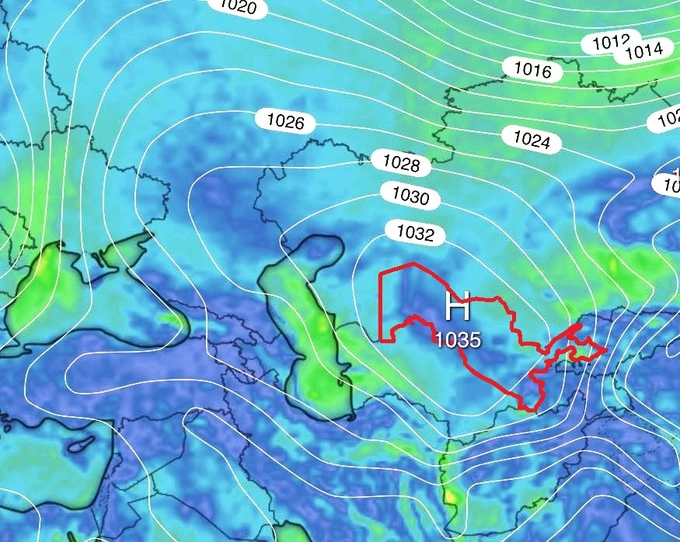
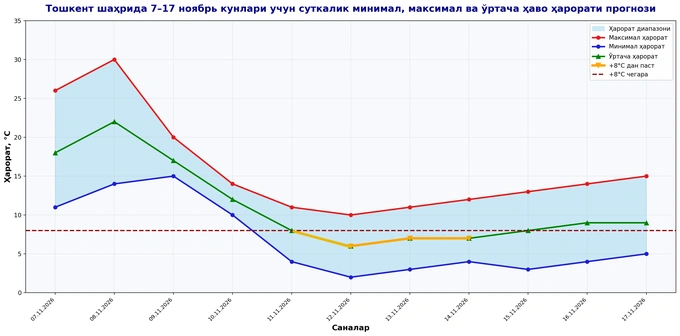
Climatologist Erkin Abdullakhatov in his column for Gazeta.uz argues that the heating season in Tashkent should begin on November 11. His argument is based on the weather forecast: in early November, a warm air flow on November 9–10 will start drawing cold northwestern air into the region, and from November 11 to 15 an anticyclone with pressure of up to 1035 hPa at its center will pass over Uzbekistan. According to Uzhydromet, by November 11 the nighttime temperature in the capital may drop to +1…+3°C; according to some foreign forecast models — to +1…+2°C at night and +10…+13°C during the day. Under such conditions, the average daily temperature will fall below +8°C for the first time in the season and stay there for about five days in a row.
The formal criterion: five days below +8°C
The current rule is set out in paragraph 13 of the resolution of the Cabinet of Ministers of Uzbekistan dated July 15, 2014, No. 194: the heating period must begin on the day following the end of a five-day period with an average daily outdoor temperature below +8°C, and end when it exceeds +8°C. The start and end dates are determined by the Council of Ministers of Karakalpakstan, regional and Tashkent city administrations. As the author notes, the wording of the rule almost verbatim repeats paragraph 32 of the rules approved by the resolution of the government of the Uzbek SSR dated September 30, 1985, No. 497— that is, the basis of the current procedure remains Soviet: in those years, seven-day weather forecasts were not yet developed, and decisions were made based on actual data from past days.
The latest start in a decade
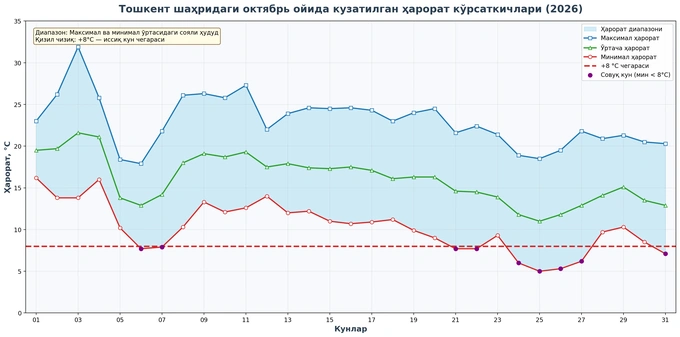
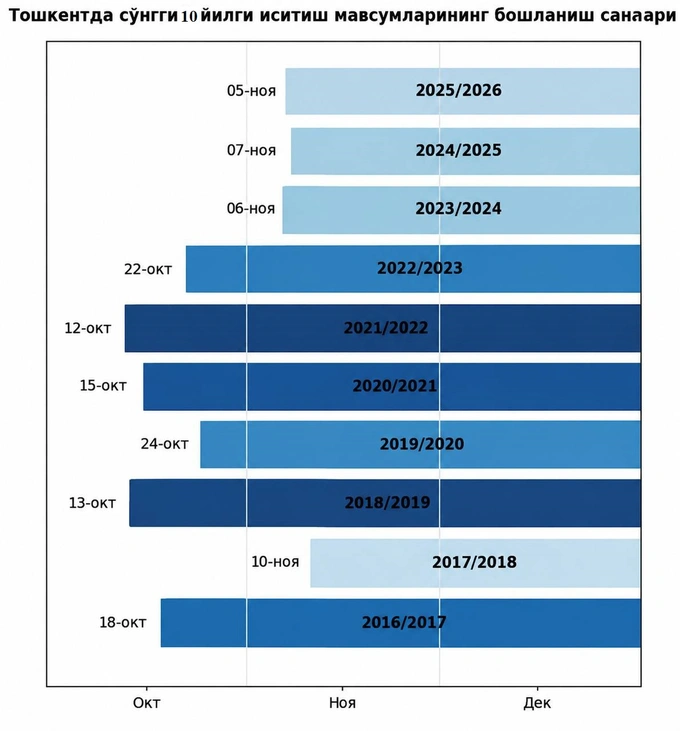
October 2026 was warm: the minimum temperature never dropped below +4°C, and on October 24–27 morning lows reached only +5…+6°C with an average daily temperature above +11°C — so there were no mass requests to turn on the heating, as there were in October 2024 and earlier. According to the climatologist's calculations, in six of the last ten seasons heating in Tashkent began as early as October: for example, in 2018 and 2021 — on October 12 and 13, respectively. If the heating is switched on on November 11, it will be the latest start in the last decade; the previous record for a late start was November 10 in the 2017–2018 season. At the same time, according to the author, the city administration in fact does not follow the rule of five days below +8°C, although it cites it every time.
What the author proposes to change
Abdullakhatov believes that instead of rules developed in the mid-20th century and almost never followed, new standards are needed that take into account the local climate and international experience. In his view, heating start standards should rely not only on temperature but also on humidity, solar radiation and other meteorological parameters — that is, on bioclimatic data, as in developed countries where such standards are based on scientific research and population surveys. Among his arguments: against the backdrop of climate change, the smooth autumn cooling has been replaced by a temperature 'carousel' with sharp swings; the thermal insulation of apartment blocks built in the last century is outdated; and the population's growing demand for a comfortable indoor climate affects both productivity and economic activity.