The key facts
- Democrats took both chambers of Congress in the midterms, strengthening oversight of Trump's policies for the rest of his term
- Democrats took both chambers of Congress in the midterm elections, strengthening oversight of Trump's policies for the rest of his term
- The US–India trade deal is still not finalized: the sides remain at odds over market access
- The $100,000 H-1B visa fee, in the attorney's view, will most likely be challenged in court
- The $100,000 fee for H-1B visas, in a lawyer's view, is likely to be challenged in the courts
A shift in the balance of power in Congress
In the midterm elections, the Democratic Party won a convincing victory and gained control of both chambers of Congress. Donald Trump's Republican administration will face a new level of oversight from lawmakers for the rest of his term, writes Deutsche Welle. The outlet notes that relations between New Delhi and Washington remain strained over the unfinished trade agreement, migration restrictions, and disagreements over India's purchases of Russian oil and weapons — even though the US granted an exemption from the oil embargo in March 2026, and in October Trump partially lifted some sanctions against Russia.
Trade and H-1B visas
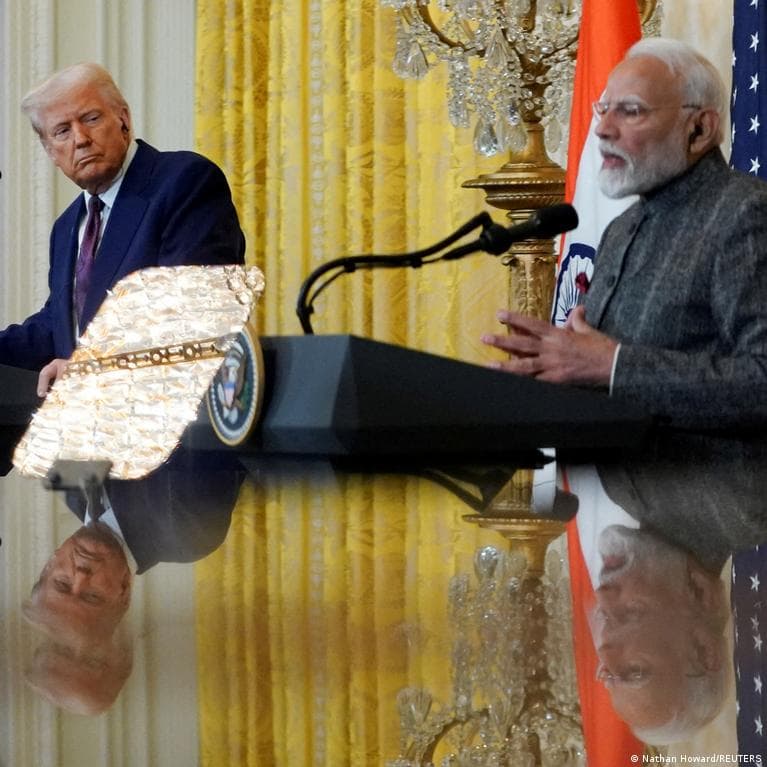
The most immediate test for Trump's India policy is trade. The interim framework document that Trump and Prime Minister Narendra Modi discussed in Februaryhas still not been finalized: the two countries continue to differ on market access and trade commitments. Expert Shanthie Mariet D'Souza (Mantraya Institute for Strategic Studies) expects the new Congress to step up scrutiny of the administration's protectionist measures and set clearer standards on environmental and labor issues. For India, whose largest export market is the US, this could offer some breathing room, while, in her assessment, the strategic partnership between the two countries will endure. On migration, the picture is different: the tightening of H-1B visa rules, including a $100,000 (€88,761) payment for certain new applications, has alarmed Indian professionals and tech companies. California-based immigration attorney Rajkrishna Iyer believes a Democratic majority may increase oversight on this issue but will not automatically reverse the measures introduced by Trump's executive order. In his view, the new fee will most likely never take effect or will be struck down by federal courts, since 'fees are not reasonable,' and legislation of that scale can only be passed by Congress. At the same time, he notes that over the past 25-plus years Congress has 'done nothing' on migration.
Russian oil, Iran, and Pakistan
It is unclear whether a Democratic Congress will force a change of course in the dispute over India's purchases of Russian energy: in September, during a vote on Russian sanctions, a significant number of Democrats joined Republicans in supporting trade restrictions against Moscow. D'Souza believes the administration will maintain its course of reducing dependence on Moscow but will act with diplomatic caution to avoid straining relations with New Delhi. An additional factor is the war in Iran: a new escalation could affect Middle Eastern energy supplies and make India more vulnerable due to its high dependence on oil imports. Former Indian ambassador to the US and Israel Navtej Sarna urges against jumping to conclusions: 'Much will depend on Trump's reaction,' but he expects Washington to become 'a more contested space' with greater congressional resistance on contentious issues, which, in his words, is good for the long-term future of the relationship. The security question also remains: India is the largest buyer of Russian arms exports, which irritates Washington, while New Delhi objects to US supplies to Pakistan, including the sale of military technology for F-16 fighter jets worth $686 million.
A more predictable Washington, or a tougher Trump?
The key question is whether the elections will lead to a more predictable Washington or a more confrontational Trump. A weakened president may seek compromises at home, but he is also capable of responding to congressional resistance by hardening his line abroad. Amitabh Mattoo (Jawaharlal Nehru University) warns that it is too early to assess the consequences: Trump could 'hit even harder' at New Delhi if he decides that Indians, in particular part of the diaspora, played a role in his party's defeat. Harsh Pant of Observer Research, by contrast, notes that the president retains significant powers in foreign policy, and the US–India partnership has traditionally enjoyed support from both parties — in his words, India is unlikely to become a point of conflict between the White House and Congress. At the same time, he believes, the experience of the past two years confirms the need for India to diversify its partnerships and reduce dependence on a single player: 'The midterm elections do not really change these calculations.'