The key facts
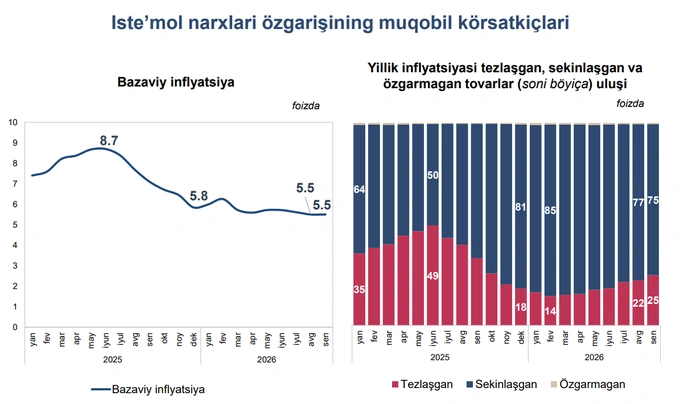
- The share of consumer basket items with accelerating price growth fell from 45% in June 2025 to 22–25%
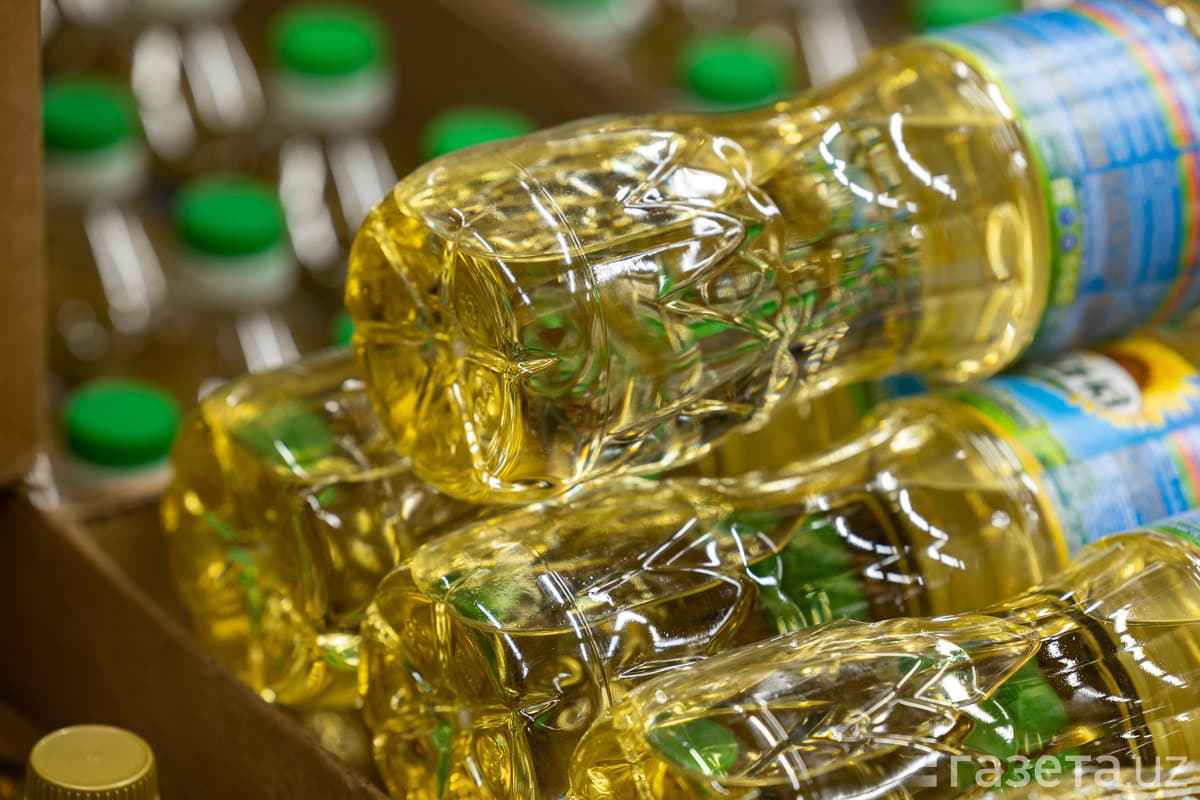
- Vegetable oil fell in price from 30–35 thousand soums per litre after the pandemic to 18–22 thousand soums
- Vegetable oil became cheaper from 30–35 thousand soums per liter after the pandemic to 18–22 thousand soums
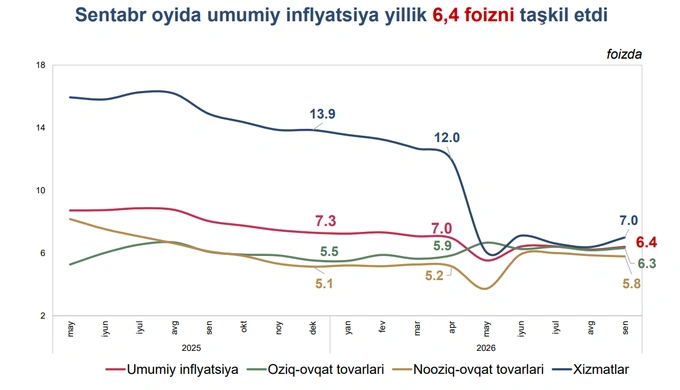
- The policy rate has been kept at 14% per annum; inflation in September 2026 was 6.4%
- The key rate has been kept at 14% per annum; inflation in September 2026 was 6.4%
Answer to a journalist's question
On 4 November, at a press conference dedicated to the decision on the policy rate and monetary policy for 2027–2029, First Deputy Chairman of the Central Bank Nodirbek Achilov disagreed with the claim that prices in Uzbekistan almost never fall after rising. The question was asked by a journalist from the newspaper Uzbekiston Ovozi, who pointed to the continued rise in the cost of fuel, electricity and staple foods and asked how the regulator plans to lower the rate under such conditions. This is reported by Gazeta.uz.
What the Central Bank's data show
Achilov explained that the dynamics differ across specific goods and services. The consumer basket includes 517 items, about 40% of which are services. In June 2025, an acceleration of price growth was observed in roughly 45% of items; now their share has fallen to 22–25%, while price growth has slowed for the remaining 70–75% of goods. As an example that prices can not only rise, he cited the exchange rate: two years ago few expected the dollar rate to fall to 11,900 soums, even though there were periods when it rose to 12,700–12,800 soums.
Examples of falling prices: oil, clothing, taxis
Achilov illustrated the actual decline in prices with the vegetable oil market: after the pandemic, a litre cost 30–35 thousand soums, but oil is now available on the market at 18, 19 and 22 thousand soums. Similar processes, in his assessment, are taking place in the clothing market and other non-food goods, where competition between local producers and importers is intensifying, as well as in the taxi market, where the emergence of new aggregators in some cases forced major players to lower their fares. The deputy head of the Central Bank linked this to an open economy: if a good becomes more expensive while import conditions are open and the impact of customs tariffs is minimal, entrepreneurs increase supplies from other countries, and competition helps bring prices down. Competition, he added, can restrain even the secondary effects of rising fuel costs, since companies cannot always pass additional costs fully on to consumers.
Why food keeps getting more expensive
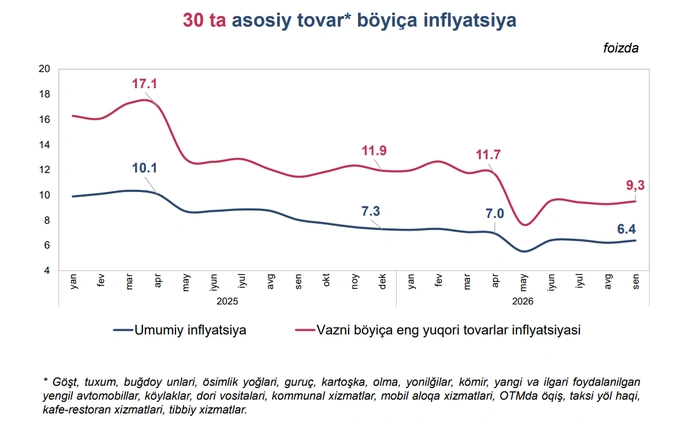
At the same time, Achilov acknowledged that the situation in the staple food market is more complicated: in certain categories price growth reaches 8–10%. Increasing the supply of meat quickly is impossible, since livestock production cannot be expanded in a short time. He recalled the government's measures — compensation of transport costs for importing meat products, loans and benefits — and noted positive changes in poultry farming which, in his assessment, contribute to stabilising chicken prices. According to him, price dynamics are influenced not only by monetary conditions but also by the level of competition, the development of markets and entrepreneurs' ability to quickly increase supply.
Inflation and the rate decision
According to the Central Bank, annual inflation in September 2026 was 6.4%, compared with 6.2% in August and 8% in September of last year. Food inflation was 6.3%, non-food inflation 5.8%, services 7%, while core inflation remained at 5.5%. Achilov attributed the September acceleration primarily to the seasonal rise in fruit and vegetable prices, as well as to increases in fuel and certain services. On the same day, the Central Bank's board kept the policy rate at 14% per annum, citing high domestic demand and inflation risks. Under the regulator's baseline scenario, inflation should approach the 5% target in the second half of 2027 and stay around that level in 2028–2029.
What got more expensive and cheaper over the month
According to the National Statistics Committee, over the month lemons and oranges fell the most in price (12.1% each), tangerines (11.9%), grapes (5.6%) and zucchini (3.7%); prices also declined for theater services (2.9%), apples (2.4%), bananas (1.7%), sugar (1%) and cement (0.9%). Fresh tomatoes rose the most in price (14.2%), cucumbers (13.5%) and carrots (12.4%). The cost of state preschool education services (6.8%), legal services (6.6%), tuition contracts at universities (6.3%), potatoes (5.5%) and eggs (5.3%) increased. Propane for vehicles and AI-95 gasoline each rose in price by 4.2%.