The key facts
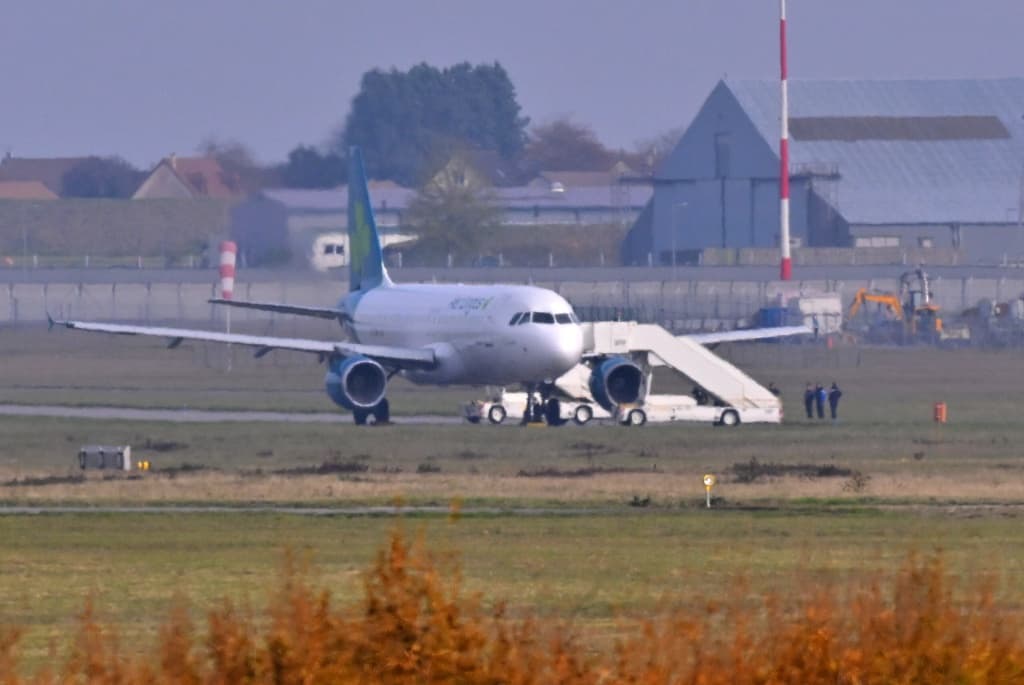
- Airbus A320 of flight EI402 Dublin–Rome landed at the Évreux military air base in Normandy after an alert signal; passengers were promised transfer to Rome
- The Airbus A320 of flight EI402 Dublin — Rome landed at the military airbase of Évreux in Normandy after an alert; passengers were promised onward transport to Rome
- According to DW, unplanned or heightened-alert landings took place in six countries in total — at least a dozen flights; The National speaks of about ten
- According to DW, unplanned or enhanced landings took place in six countries in total — at least a dozen flights; The National speaks of about ten
- This is the second wave of threats in a week: on Tuesday, November 3, at least seven flights and a cruise ship received threats, and no explosives were found in any case
Dublin–Rome plane makes emergency landing in France
On the morning of November 5, 2026, an Airbus A320 of Ireland's Aer Lingus, operating flight EI402 from Dublin to Rome, transmitted an alert signal and was diverted to the Évreux-Fauville military air base in Normandy, about 100 km west of Paris. The incident was announced by the office of French Prime Minister Sébastien Lecornu, which noted that the situation was being monitored 'in real time.' According to DW, the French Air Force said it scrambled aircraft 'immediately after the incident was reported' and escorted the airliner until it landed safely. Tracking websites recorded a sharp deviation from course in Parisian airspace: according to Flightradar24, cited by Anadolu, the aircraft turned around over the southern part of Paris, circled several times, then headed north and turned back toward the base in Normandy. Aer Lingus confirmed that the flight landed safely and the company will arrange transfer of passengers to their final destination. The radio station RTL (Life.ru cites it) reported that the decision to change the route was made on the morning of November 5; the number of people on board and the source of the threat were not named in initial reports.
A wave of threats across Europe
The Aer Lingus incident became known first, but reports of other flights soon followed. According to Deutsche Welle, at least a dozen commercial flights made unplanned or heightened-alert landings in Austria, France, Italy, Belgium, the Czech Republic and Bulgaria. A Finnair flight from Helsinki to Rome landed on schedule but under military escort (according to ANSA); a Jettime aircraft from Helsinki landed in Vienna as planned, while a Wizz Air flight Milan–Warsaw made an unscheduled landing in Vienna — although, as the BBC notes, no bomb report was received for it and the cause is unclear. Bulgarian authorities reported three emergency landings: Ryanair flights from Copenhagen and Madrid landed in Sofia, and a flight from London landed in Plovdiv (Interior Minister Ivan Demerdzhiev, according to bTV, confirmed part of this information). Two aircraft — an Aegean Airlines flight from Thessaloniki and a Ryanair flight from Porto — according to the agencies, landed on schedule at Milan's Malpensa after threats received in the morning. Madrid police called the threats against three flights at the capital's airport false and ruled out any risk after checks. In the Czech Republic, police prepared to receive four aircraft in Prague following reports of improvised explosive devices, assessing the probability of a threat as low but deploying all necessary measures; after landing, the aircraft were to be examined for hazardous materials. Belgian media, according to The National, reported the landing of a Polish LOT aircraft at Brussels Zaventem: the airline stated that flight LO235 Warsaw–Brussels landed safely, and an inspection on board and at the airport found no suspicious items.
Second wave in a week: what is known and what is not
This is already the second wave of such threats in a week. On Tuesday, November 3, at least seven flights and, according to The National, a cruise ship received threats; among those affected were flights from Manchester (which landed in Murcia) and from London Heathrow to Warsaw, as well as two Ryanair flights — from Dublin and Lisbon — which, after anonymous messages, were inspected after landing at Rome's Fiumicino. No explosives were found on any of the aircraft; the British government described the incidents as 'malicious false threats.' Life.ru separately described the closure of Warsaw-Modlin airport on November 3 after the landing of a Boeing 737 MAX flying from London with 181 people on board, with passengers evacuated and bomb disposal experts called in. According to preliminary data cited by DW, no signs of dangerous materials were found on Thursday either. EU Commissioner for Transport and Tourism Apostolos Tzitzikostas said that threats to civilians are unacceptable, but that 'it is too early to draw conclusions about whether the incident reports are connected' — national investigations are ongoing. No country has so far claimed responsibility, and none has been officially accused; The National notes that against this backdrop, European officials have previously accused Russia and Iran of 'hybrid attacks' and sabotage, which Moscow and Tehran deny. The wave of threats coincided in time with a series of cyberattacks on supermarket freezer units in several European countries and even on French blood banks; Eliran Almog, CEO of Cyviation, suggested that the repeated threats could serve both to disrupt aviation operations and to observe the reactions of airlines, airports and authorities. DW meanwhile cautions that all cases are still at an early stage, but carry potential signs of 'hybrid attacks' designed to cause maximum damage at minimal cost. For passengers, the practical outcome of Thursday was delays and onward transfers to their final destinations: Aer Lingus promised to get the passengers of flight EI402 to Rome as soon as possible.