The key facts
- Democrats, according to preliminary results, have taken the Senate and a projected majority in the House of Representatives
- Victories in Texas, South Carolina, Iowa and Kansas, as well as in the Ohio gubernatorial election
- Trump said he was ready to use the veto, but also said he was ready to work with the Democrats
Democrats take Congress
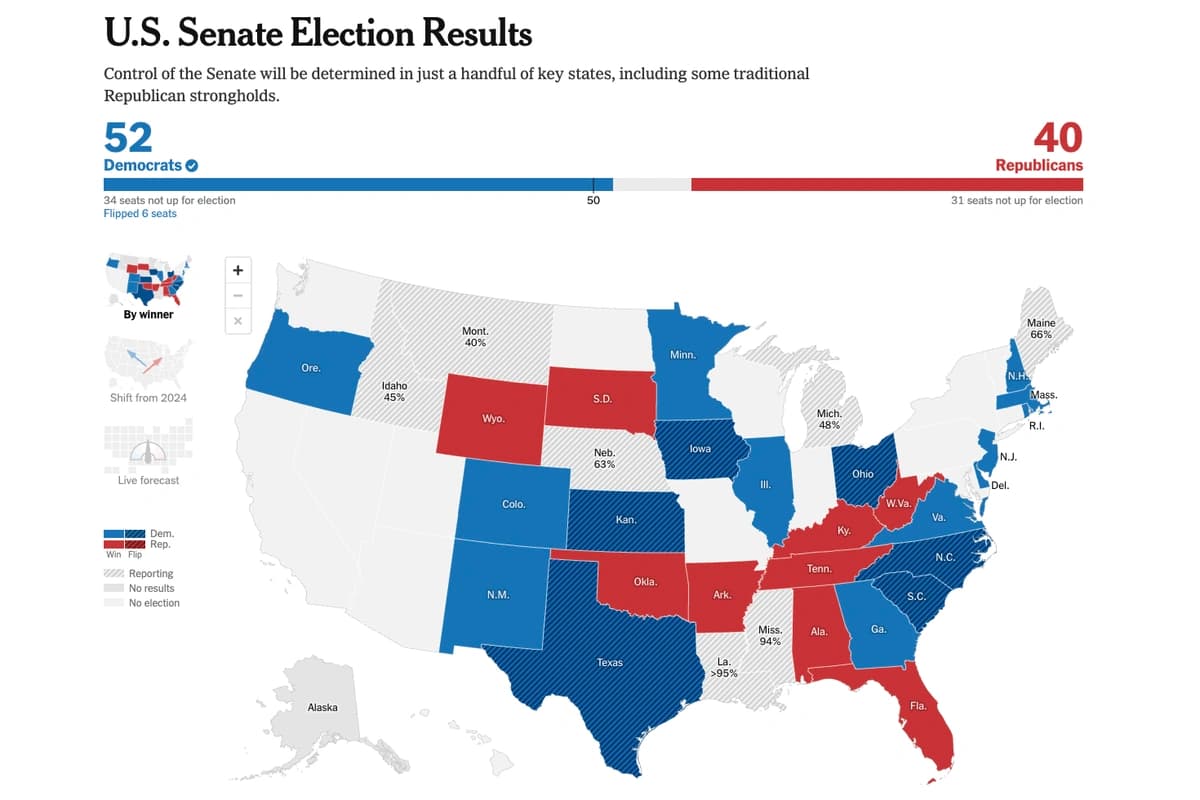
Following the US midterm elections held overnight into Wednesday, November 4, 2026, the Democratic Party has, according to preliminary results, gained control of Congress. Democrats have already secured a majority in the Senate and, according to projections, are winning a majority in the House of Representatives, which will give them a significant check on President Donald Trump. This is reported by Euronews.
Key victories in Republican states
Victories came in territories traditionally loyal to the Republican Party as well. In Texas, Democrat James Talarico defeated Republican Ken Paxton in a Senate race, while in South Carolina Democrat Annie Andrews prevailed. Democrats also won historic Senate victories in Iowa and Kansas. In the Ohio gubernatorial race, Democrat Amy Acton defeated Vivek Ramaswamy — a state that had been leaning Republican in recent years and was previously represented in the Senate by Vice President JD Vance.
Trump's reaction
In a series of posts on Truth Social, Trump apparently distanced himself from his party: 'I wasn't on the ballot, and if I had been — we would have won by a huge margin.' Later he wrote that he plans to become a 'political commentator,' analyzing the reasons for candidates' wins and losses. Even before the polls closed, he told CBS News that he could use his veto to block Democrats' bills if they gained control of either chamber: 'I have the ultimate power — it's called the veto,' adding that he had nothing against the nickname 'Mr. Veto,' and posted a photo of a red cap reading 'veto.' At the same time, according to The New York Times, cited by Euronews, Trump said he was 'absolutely ready' to accept the election results and work with the Democrats.
What has changed in the balance of power
Before the election, Republicans held 53 seats in the Senate against 45 for Democrats and two for independents; a majority required 51 seats, and about a third of the 100 senators were up for re-election. In the House of Representatives, 218 seats are needed for control — exactly the number Republicans had before the vote. Thus, according to preliminary results, both chambers are shifting from Republican to Democratic control. Midterm elections are held every two years, in the middle of a four-year presidential term, and are often seen as a referendum on the president's performance.