The key facts
- Behavioral signs of two distinct sleep states have been recorded in Portia fimbriata spiders
- In one of the phases, the internal structures of the eyes moved and the limbs twitched — this resembles REM sleep
- The spiders' daily rhythm persisted even under constant dim lighting, indicating an internal biological clock
Two states of rest in jumping spiders
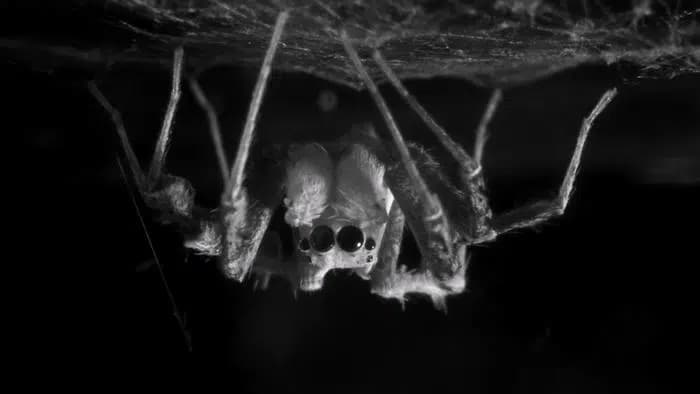
A study published in the journal PNAS has shown that spider sleep is more complex than previously thought. A team including researchers from the University of Bonn has obtained behavioral evidence of two distinct sleep states in jumping spiders, reports Kun.uz. The species chosen for observation was Portia fimbriata, which lives in the tropical forests of the Australian state of Queensland: these spiders are no more than five millimeters long, they prey mainly on other spiders, have sharp vision, and even take detour routes to reach their prey. During the day they survey their surroundings and hunt, while at night they rest in a small hammock they have spun — their body gradually sags, and the short pedipalps near the mouth draw closer together.
What exactly the scientists recorded
A few years ago, another jumping spider species, Evarcha arcuata, was already observed to exhibit movements resembling the rapid eye movement (REM) phase of sleep in humans, which is characterized by rapid eye movements. However, external resemblance alone was not enough: to speak of sleep, it was necessary to show that the resting animal reacts more slowly to external stimuli and seeks to compensate for sleep deprivation. The authors of the new work carried out a series of observations and experiments, using infrared cameras for night filming. First they checked the rhythm: under constant dim lighting, the spiders' daily cycle of activity and rest persisted — meaning it is governed not only by the alternation of day and night but also by an internal biological clock. In a detailed analysis of the night recordings of five spiders, two alternating states were found: in the first, the animals remain almost motionless for long periods; in the second, the internal structures of the eyes move, including the retinas, the legs and other body parts twitch, and sometimes the spiders curl their legs toward the body in a distinctive way.
Why this matters
The data obtained are behavioral signs, not direct proof that spiders have sleep analogous to human sleep: the authors themselves noted that external similarity of movements alone is insufficient for such conclusions, which is why tests of response to stimuli and of sleep-deprivation compensation were needed. Nevertheless, the work expands the range of animals in which signs of a complex sleep structure have been recorded and suggests that the alternation of resting states may have arisen earlier than previously believed. The details of the methods and conclusions are set out in the PNAS article itself; the Kun.uz publication is based on its content.