The key facts
- On November 4, South Africa holds municipal elections that will determine control over the country's largest cities
- According to Ipsos, ANC support may fall to 30% compared with 45.59% in 2021
- The IEC is investigating more than 700 complaints of disinformation, including a fake about mobilizing asylum seekers to vote
A vote that will test the ANC's resilience
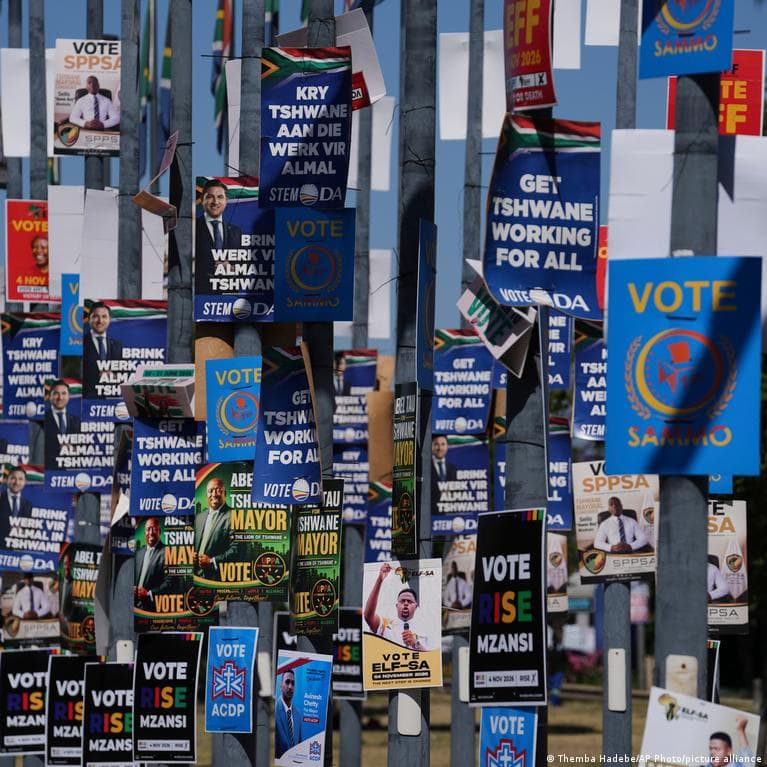
On Wednesday, residents of South Africa vote in municipal elections that will determine who governs the country's largest cities and will serve as a test of whether the electoral decline of the African National Congress (ANC) — the leading party in the ruling national coalition — continues. This is reported by Deutsche Welle in an analysis of the five main themes of the campaign. According to the Electoral Commission (IEC), 136,760 candidates are running; in Johannesburg, 75 parties are competing, in Tshwane — 70, and in eThekwini (Durban and its surroundings) — 69.
Water as the campaign's central issue
For many voters, water supply has become the key problem: in several districts of Johannesburg, outages and water rationing have continued for weeks due to worn-out infrastructure. Ferrial Adam, head of the human rights organization WaterCAN, told DW that half of the country's drinking water systems are unfit for drinking, and nearly 70% of wastewater treatment plants are in critical condition and discharge untreated sewage into rivers. In Tshwane, which includes the administrative capital Pretoria, a recent failure at a water treatment plant left more than 400 residents ill. Sanusha Naidu, an analyst at the Institute for Global Dialogue, noted that candidates' promises on water remain
ANC's decline and the fragmentation of the political field
Many voters hold the ANC responsible for the state of municipalities; the party historically held an absolute majority. In 2016, it won 53.91% of the vote and majorities in 161 of 213 councils; in 2021 — 45.59% and majorities in 122 of 213 municipalities. The research firm Ipsos predicts that support may now fall to 30%, leading to a rise in the number of municipalities governed by coalitions. Naidu links the decline to the party failing to keep up with the expectations of millennial and Generation Z voters, who now make up the bulk of the electorate.
Migration on the agenda and a wave of protests
Migration has become a prominent theme of the campaign against the backdrop of waves of protests that intensified in October with demonstrations against asylum procedures. According to the analytics firm Murmur Intelligence, the parties Action SA, MK Party and Patriotic Alliance are using immigration as an election issue, and Action SA may benefit most from these sentiments. The firm's co-founder Aldu Cornelissen estimated the potential gain from this issue at 6–8% of the vote — modest, but in a fragmented political landscape parties fight for every vote.
Disinformation and the question of turnout
The IEC is investigating more than 700 complaints of disinformation, including fake and AI-generated material. One notable claim is that the ANC allegedly plans to mobilize asylum seekers to vote for it; in fact, asylum seekers, refugees and permanent residents have no right to vote in South African elections regardless of length of residence. William Bird, director of the agency Media Monitoring Africa (referred to in DW's text as Moxii Africa), called the IEC one of the best electoral commissions in the world and noted that there is no evidence of fraud. Turnout, meanwhile, remains a key factor: in municipal elections it has historically been lower than in national ones (57.95% in 2016 and 45.87% in 2021, versus 58.64% in the 2024 national elections). Voters mark two ballots — for a specific representative and for a party under the proportional system; half of the seats in councils are allocated precisely through party lists, so turnout directly affects the composition of municipalities and the formation of coalitions.