The key facts
- Los Angeles has become the largest city in the United States to ban oil drilling; the ordinance was approved on October 28.
- Los Angeles has become the largest US city to ban oil extraction; the ordinance was adopted on October 28
- Existing operations must be phased out within 20 years, affecting hundreds of active and thousands of inactive wells.
- The industry association CIPA considers the ordinance an illegal seizure of private property and is preparing to challenge it in court.
- The industry association CIPA considers the ordinance an unlawful taking of private property and is preparing to challenge it
Ban after a decade of struggle
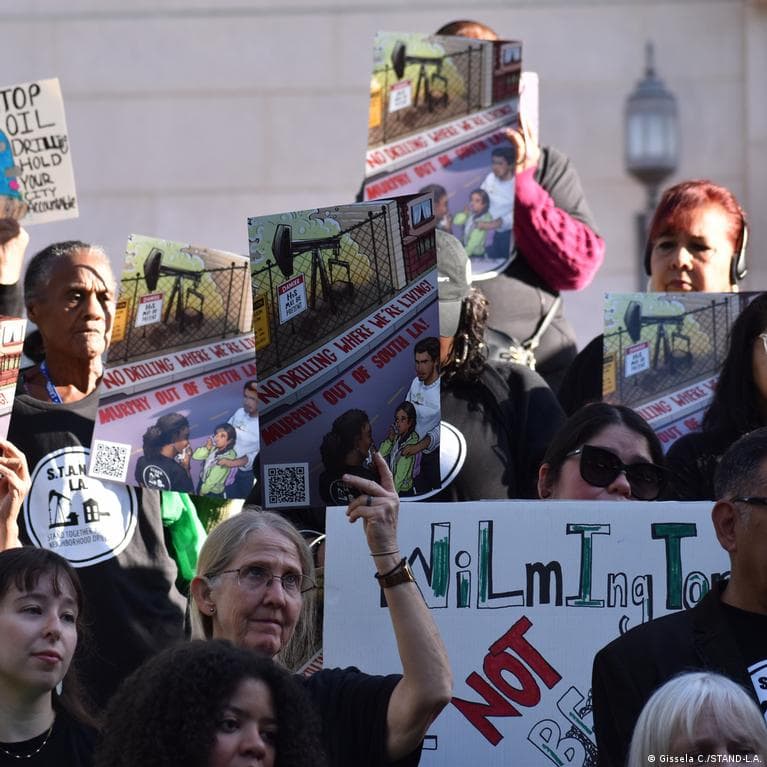
Los Angeles has become the largest city in the United States to ban oil drilling within its territory. The ordinance, approved by the City Council on October 28, immediately halts production and prohibits re-drilling or deepening of wells, while existing operations must be phased out within city limits over the next 20 years. Deutsche Welle reports, noting that the decision is the result of years of legal battles and a community campaign warning about pollution and health risks from nearby wells.
Who will be affected by the decision
Although the City of Los Angeles is only part of the metropolitan area, the measure affects hundreds of active and thousands of inactive wells, many located in working-class neighborhoods where communities of color predominantly reside. Council President Marquee Harris-Dawson stated that in South Los Angeles, corporations drilled 'just across the street' from working families' homes, and that 'no one should have to live next to an oil well.' Local resident Wendy Miranda, who has participated for years in the STAND-LA coalition, noted that 'frontline communities have been fighting for this decision for over a decade.' According to her, both she and her mother suffer from asthma, and the council's vote 'definitely means hope.'
Why wells ended up in the city
California's oil industry grew rapidly in the early 20th century, when the state produced approximately one-quarter of the world's oil, a significant portion of which came from the Los Angeles area. The city expanded around existing infrastructure, and today wells are located under residential neighborhoods, near industrial sites, and in densely populated working-class districts. Under California law, a well is considered inactive if it has not produced oil for two years; unlike plugged wells, it can be returned to operation. Residents report strong odors, headaches, nausea, and breathing difficulties; wells can emit toxic substances, including benzene and hydrogen sulfide, as well as methane—a greenhouse gas contributing to climate change. Studies have linked proximity to oil production with higher rates of respiratory illnesses and reduced lung function.
First attempt and legal resistance
This is not the city's first attempt: the Los Angeles City Council approved an ordinance to phase out oil production as early as 2022, but oil companies challenged it in court, and industry groups successfully argued that the city lacked the authority to impose such a ban. The situation changed after California enacted legislation expanding the rights of local governments to regulate and restrict oil and gas operations. Los Angeles is following the example of the much smaller California city of Culver City, which also abandoned urban oil production.
Industry objections and the issue of prices
Rock Zierman, CEO of the California Independent Petroleum Association (CIPA), told Deutsche Welle that the association considers the ordinance 'an illegal seizure of private property' and that energy companies are prepared to challenge the new measure. According to him, the ban will make residents more dependent on foreign oil from countries with lower environmental standards and 'will send jobs, investments, and revenues elsewhere.' Meanwhile, as Deutsche Welle notes citing the California Energy Commission, the link between local production and gasoline prices is not direct: prices are influenced by the cost of crude oil, refining, transportation, distribution, and local taxes. The United States, being the world's largest oil producer, both exports and imports oil and petroleum products, meaning Americans are subject to the same price fluctuations as the rest of the world.
Who will pay for plugging the wells
A separate problem is well closure: under the law, this is the operators' responsibility, with oversight by the regulator CalGEM and the Los Angeles Fire Department. However, about 80% of the city's idle wells have been inactive for more than eight years, and roughly a third for more than a century. The cost of plugging ranges from hundreds of thousands to millions of dollars; the law requires operators to submit closure plans under threat of annual fines, but according to CalGEM itself, in 2025 the agency collected only $1 million of $36 million in fines. The Carbon Tracker report showed that even if all future profits of California oil companies went toward closing wells, the state would still be short $7 billion, and the costs would by default fall on taxpayers. Miranda told DW that the activists' next step is to shorten the 20-year deadline and to ensure that the industry 'pays for this cleanup.'