The key facts
- Thousands of people gathered on Habima Square in Tel Aviv, hundreds in Jerusalem and Haifa, demanding a coalition with the Joint List and the Raam party
- Right-wing activists held a counter-protest with slogans calling for new elections; police set aside a separate zone for them, but some activists occupied the area of the opposition demonstration
- The parties of the change bloc (48 mandates) mostly refused a coalition with the Arab parties, which leaves them without the majority of 61 mandates
Demonstrations and a counter-protest in Israeli cities
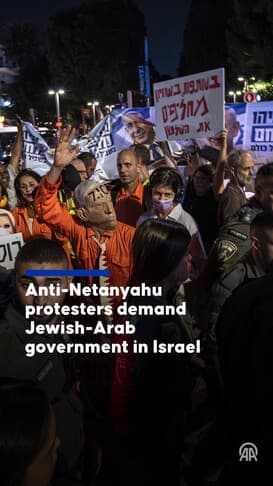
On Saturday evening, demonstrations were held in several Israeli cities demanding the formation of a new government with the participation of Arab parties. According to the Israeli newspaper Haaretz, which is cited by the Anadolu agency,thousands of people gathered on Habima Square in central Tel Aviv, calling for the formation of a government in cooperation with the Joint List and the Raam party. Demonstrators carried placards with the slogans 'Through partnership and equality we change the government' and 'The people gave you their support — form a government now,' after which they headed toward Rabin Square.
Geography of the protests and a numerical symbol
Similar actions, according to Haaretz, took place on Paris Commune Square in Jerusalem, where hundreds of people gathered, on the square by the auditorium in Haifa, and in Beersheba, where dozens of people protested; another demonstration was held at the Ras Amer junction near Tira and Tayibe. Photographs published by the newspaper show that participants of the actions in Haifa and Tel Aviv carried signs with the numbers '67' and '53' — reflecting the balance of power in the Knesset after Tuesday's election: parties opposed to Prime Minister Benjamin Netanyahu won a combined 67 of 120 seats, including 48 for the Jewish parties of the 'change bloc' and 19 for the Arab parties, while Netanyahu's bloc received 53 mandates.
Clashing positions on one square
Meanwhile, hundreds of right-wing activists, according to Haaretz, held an action on Habima Square against cooperation with Arab parties. They chanted slogans such as 'Bibi is the king of Israel' (referring to Netanyahu), 'The people want honest elections,' and 'The people demand new elections.' Police set aside a separate zone for the right-wing protest; however, the newspaper reports, dozens of activists arrived earlier and occupied the area designated for the demonstration in support of Israeli-Arab partnership.
Parliamentary arithmetic: why Arab parties ended up at the center
The key problem for a coalition, The Times of Israel notes citing Anadolu, is that most of the Israeli-led parties opposed to Netanyahu have rejected the idea of forming a governing coalition with the Arab parties. This leaves the Jewish parties of the change bloc with 48 mandates — five fewer than Netanyahu's bloc — and without the 61 seats needed for a majority. According to the newspaper, neither Netanyahu nor his Zionist opponents can obtain a governing majority without the support of the Arab parties or defections of lawmakers from the change bloc. At the same time, Haaretz reports, the Raam party has expressed its readiness to join the government, and the leader of the Joint List, Yusuf Jabarin, stated that his party is ready to pave the way for the removal of Netanyahu's government. Thus, the Saturday protests highlight a contradiction that became apparent immediately after the election: an arithmetic majority against Netanyahu exists, but, according to available reports, most of the Jewish parties of the change bloc lack the political will to form a coalition with its Arab component.