The key facts
- France's GDP fell 0.1% in Q3, against market expectations of 0.3% growth
- Inflation reached 3.4% in October — the highest since January 2024
- Minister Roland Lescure: without a budget, the country will 'hit a wall'
- Minister Roland Lescure: without a budget being adopted, the country will 'hit a wall'
Third consecutive quarter without growth
The French economy contracted by 0.1% in the third quarter of 2026, the National Institute of Statistics and Economic Studies (Insee) reported on Friday, October 30. The market had expected growth of 0.3%. This came after stagnation in the second quarter and a 0.2% decline in the first — that is, three consecutive quarters without growth. This is reported by Anadolu and AFP, citing Insee data.
What exactly declined
Foreign trade was the main drag: it subtracted 0.6 percentage points from GDP after contributing 0.6 points the previous quarter. Exports fell by 1.7% — due to a 9.1% collapse in transport equipment deliveries (primarily aerospace) and a 7% drop in agricultural exports. Overall production of goods and services declined by 0.1%: industry fell 1.4% amid a weak automotive sector, a poor summer harvest, and reduced availability of power plants during heat waves; construction fell 0.4%. Investment dropped by 0.6% after a 0.5% decline in the previous quarter. Meanwhile, household consumption accelerated to 0.4% (supported by electric vehicle purchases and the recovery of electricity spending), and inventories added 0.4 points to GDP — mainly thanks to aerospace products.
Inflation and markets add pressure
At the same time, inflation accelerated to 3.4% year-on-year in October, up from 3.1% in September — the highest level since January 2024, according to Insee. Last week, France's borrowing costs on markets exceeded 5%; on Friday, the yield on ten-year bonds stood at 4.9%, 0.17 points below the October 22 peak, while the Franco-German spread held at around 1.55 points. Euronews notes that the recent ECB meetinglikely contributed to some easing, although its president Christine Lagarde declined to comment on the situation in France.
A 'stalled' economy and the 2027 budget
The Minister of Economy and Finance Roland Lescure on Franceinfo described the economy as 'stalled' and warned: 'France is not heading toward a crisis. But if we fail to achieve the turnaround laid out in the budget, we are heading straight into a wall.' The government is insisting on the timely adoption of the 2027 budget in a parliament where it holds no majority, and does not rule out Article 49.3 of the Constitution (adopting a law without a vote unless a no-confidence motion passes) or ordinances — a procedure never once used to adopt a budget since the founding of the Fifth Republic in 1958. Analysts, according to AFP, believe the quarterly figures make it unlikely that the government's growth forecast of 0.5% for the year — or even the 0.4% expected by Insee and the Bank of France — will be achieved.
Experts: the risk is not the absence of a budget
Experts surveyed by Euronews are not surprised by the weak figures. Jérémie Peloso, chief European strategist at BCA Research, believes France will 'very likely' enter a technical recession in the coming quarters, and notes that this scenario was probable even before the budget turmoil and the bond market collapse. Jérôme Mathis, professor of economics at Université Paris-Dauphine, objects to the focus on the mere fact of adopting a budget: a fiscal correction plan, he says, usually weighs on growth in the near term, and the main risk is not the absence of a budget but the absence of visibility on the trajectory of public finances. He also warns that a budget adopted by ordinance may reduce uncertainty only in the short term, but will not restore long-term fiscal credibility if it is perceived as fragile. In his observation, markets do not doubt France's technical ability to collect taxes and service its debt — they doubt its ability to slow the growth of that debt.
The social backdrop
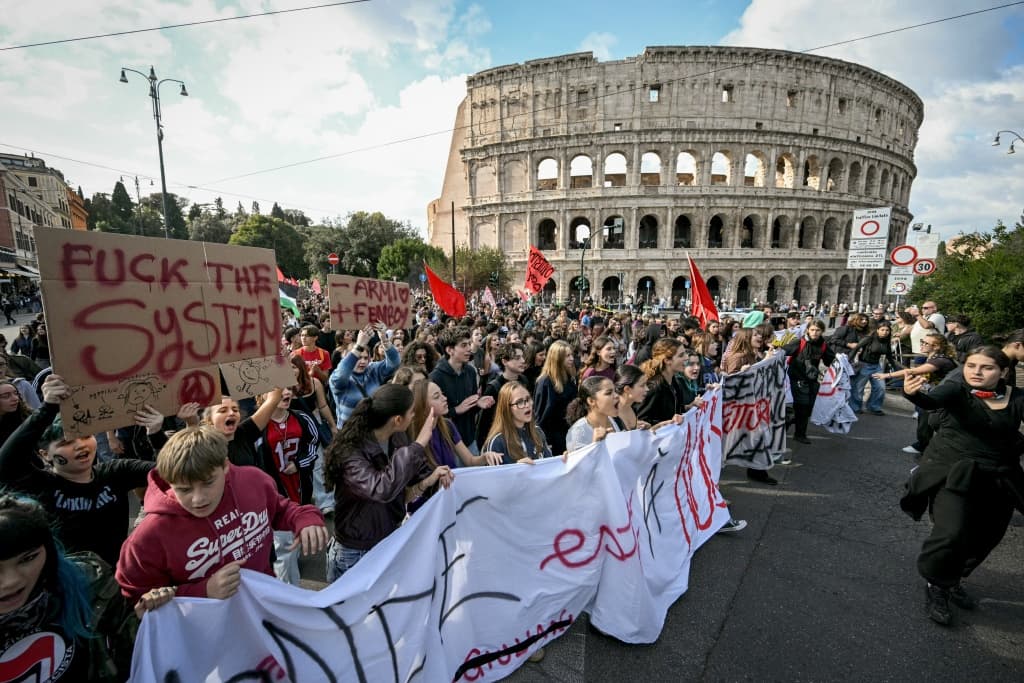
The data was released against the backdrop of an explosive social situation: on October 17, nationwide protests against the rising cost of living escalated, according to AFP, into some of the largest riots in recent years. The 'yellow vests' movement and student unions called for a new day of protests on Saturday. Against this backdrop, AFP notes, the weak draft 2027 budget last month heightened concerns that public spending will remain high ahead of next spring's presidential election, where, according to polls, Marine Le Pen — described as a fiscal populist — has a chance of winning.