The key facts
- The IAA requires 70% of the value of an EV's components (excluding the battery) to be of European origin
- The IAA requires 70% of the value of an electric car's components (excluding the battery) to be of European origin
- Germany and France agreed to grant suppliers from the United Kingdom and Norway 'European origin' status
- Turkey exported $30.1 billion worth of auto components to the EU last year; 73% of its auto industry goes to the EU
- Turkey exported $30.1 billion worth of auto components to the EU last year; 73% of its automotive industry goes to the EU
The essence of the plan and the Berlin–Paris compromise
In March, the European Union proposed the Industrial Accelerator Act (IAA) — a law intended to modernize European car plants and subsidize only vehicles manufactured in Europe. As Deutsche Wellereports, the plan is conceived as a response to China's 'unfair trade practices.' Under the IAA requirements, 70% of the value of a car's components (excluding the battery) must be produced in Europe; initially the rule applies only to electric vehicles, plug-in hybrids and hydrogen models — that is, 27% of new EU registrations last year. After months of deadlock, Germany and France reached a compromise early this month: suppliers from non-EU members the United Kingdom and Norway will be granted 'European origin' status. Under the revised plan, some hybrids as well as petrol and diesel cars will be allowed to be sold after 2035 and will also fall under the 'Made in Europe' rules. The law still has to pass legislative procedures in Brussels.
Who will be affected by the exclusion
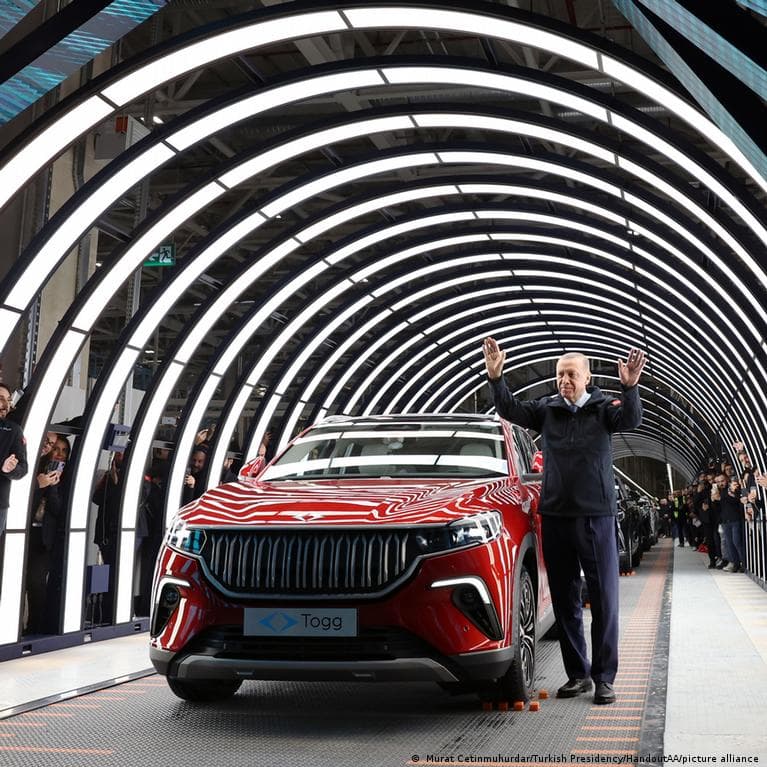
Countries allied with the EU that are deeply embedded in European supply chains are now under threat. Turkey, which has had unrestricted access to the EU market since the mid-1990s, is not included in the new plan. Ayhan Zeytinoğlu, head of the Economic Development Foundation (IKV), told DW that 73% of Turkey's automotive industry is exported to the EU and that the 'Made in Europe' barrier would cause great damage to trade; according to calculations by the exporters' association OIB, Turkey's auto industry supplied the EU with $30.1 billion (€26.8 billion) worth of goods last year. Almost all of the roughly 800,000 cars Turkey exported to the EU would fall under the expanded rules, because they contain a smaller share of European components. Since the COVID-19 pandemic, Morocco has received more than €10 billion ($11 billion) in Chinese investment, according to the consulting firm AlixPartners, mostly in batteries and auto components; for France, the country serves as a low-cost production base, and its exclusion would make budget French models more expensive. Japanese automakers building models at European plants are at risk: imports from Japan will not receive subsidies, while cars assembled in France, Portugal and Eastern Europe will benefit only if they contain a sufficient share of European parts. Hyundai and Kia produce cars in the Czech Republic and Slovakia, but models supplied from Asia will not qualify; Korean batteries made in Poland and Hungary, by contrast, will count as European.
The China factor and the split within Europe
One reason to exclude Turkey is the expansion of Chinese automakers there, who hope to gain a back door into the EU market. The SWM Motors plant in Eskişehir closed within a year because its cars did not meet EU safety standards, and BYD's plans to open a $1 billion plant in Manisa have been suspended. Researcher Tommaso Pardi (GERPISA, CNRS) notes that the 70% threshold is quite generous: the average European electric car, excluding the battery, has about 83% European parts. He also argues that European automotive giants are lobbying to soften the IAA in order to preserve the ability to source abroad, primarily from China. The automakers themselves warn that more expensive components will worsen their position against Chinese competitors, and European battery production will not cover demand in the near future. Component suppliers take the opposite position: Benjamin Krieger, head of the European association CLEPA, called to 'stop the bleeding' and warned that without better protection, up to 650,000 jobs in the region could be lost by 2035. He proposed admitting partners such as Turkey, Morocco, South Korea and Japan through an opt-in mechanism with objective criteria — harmonized regulation, social and environmental standards, absence of market distortion, the rule of law and reciprocity, reinforced by measures against circumvention of the rules. Ankara, meanwhile, is lobbying Brussels, and automakers are seeking a compromise that would allow Turkey to join later — according to Pardi's estimate, only for European companies operating there, but with an exclusion for recent investments with Chinese capital.