The key facts
- From November 9, 2026, a guarantee fee of 20 MRP — 86,500 tenge per electronic queue booking — is being introduced at three checkpoints on the border with Uzbekistan
- The fee is fully refunded upon arrival at the scheduled time; after two consecutive no-shows within 90 calendar days, the amount is transferred to the state budget
- The measure applies to international freight carriers and, according to the department, is aimed at combating artificial queues
Guarantee fee for queue booking
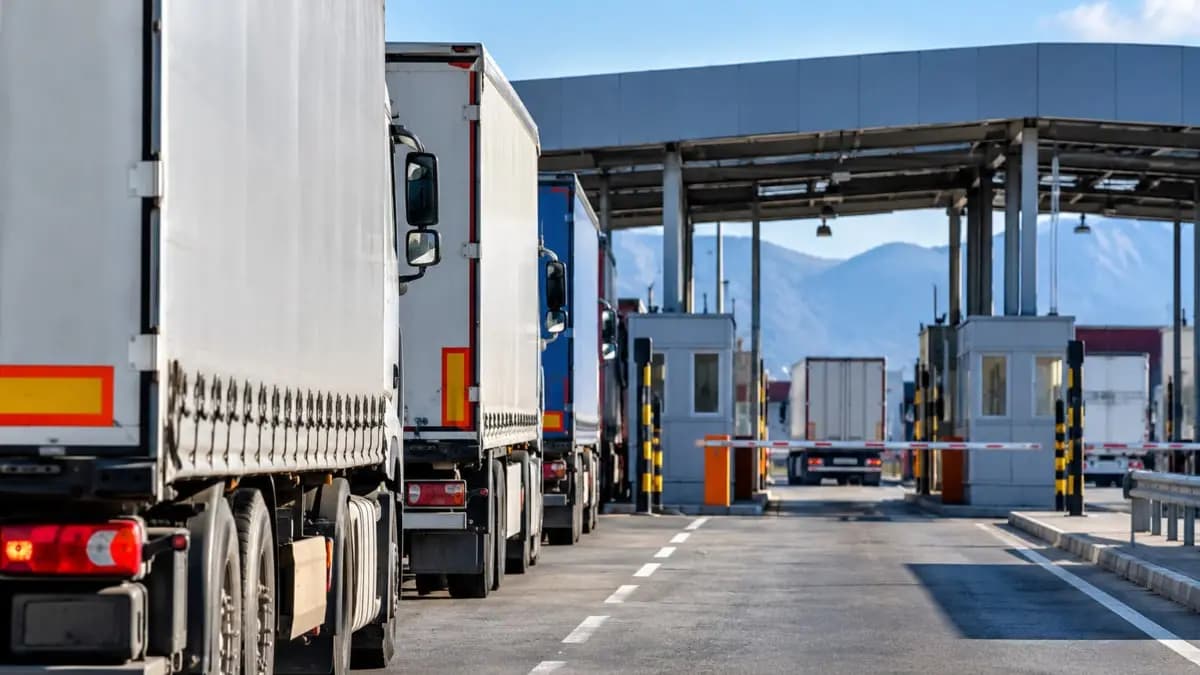
From November 9, 2026, international freight carriers booking an electronic queue at the Kazakhstan–Uzbekistan border will be required to pay a guarantee fee of 20 MRP — 86,500 tenge. This was announced by the Department of State Revenue for the Turkistan Region of Kazakhstan; the change has been reported by both Kazakh and Uzbek media outlets (Daryo.uz, Zamon.uz). The new requirement applies to three border checkpoints — Kazygurt, B. Konysbayev and Atameken. Uzbek publications also cite the amount in soums — approximately 2,261,000 soums, according to Daryo.uz.
How the mechanism will work
To book a slot, the required amount must be held in the carrier's special electronic account. If the vehicle arrives at the checkpoint at the scheduled time, the fee is automatically refunded in full. If, however, the carrier fails to arrive at the appointed time twice in a row within 90 calendar days, the guarantee amount is not refunded and is transferred to the state budget of Kazakhstan.
Purpose of the change and what it alters
The department explains the measure as an effort to prevent the artificial creation of queues at checkpoints and to increase the accountability of international carriers. Zamon.uz clarifies the calculation: the monthly calculation index in Kazakhstan for 2026 is set at 4,325 tenge, so 20 MRP amounts to 86,500 tenge. In practice, this means that queue booking, which previously required no deposit, will become conditionally 'free' from November 9 only if the carrier behaves in a disciplined manner: in effect, the funds must constantly remain in the special account, and the risk of losing them arises upon a repeated no-show. Carriers are advised to top up their electronic account in advance and to take the new requirements into account when planning their trips.