The key facts
- Asteroid 2024 XA1 rotates around its axis every 1.63 seconds — faster than the previous record-holder 2024 BX1 (2.58 seconds)
- Such a rotation speed indicates the body's internal strength rather than a gravitationally bound pile of debris
- The asteroid was detected only 10 hours before atmospheric entry — the 11th successful advance prediction
A rotation speed record
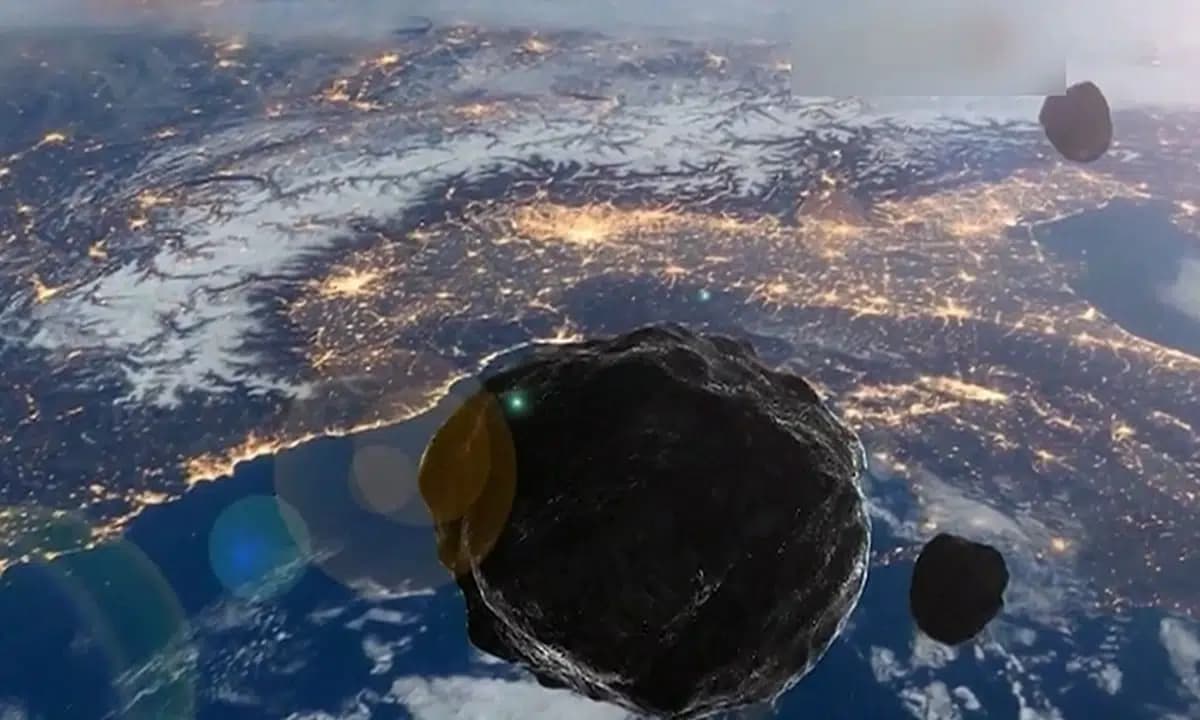
The asteroid 2024 XA1, which entered Earth's atmosphere on the morning of December 4, 2024 over Eastern Siberia, turned out to be the fastest-rotating object of its kind ever measured: it completes one rotation around its axis in 1.63 seconds. The previous record belonged to asteroid 2024 BX1, with a period of 2.58 seconds. Kun.uz reports this citing a study published in The Astronomical Journal.
How the measurements were made
The study was led by Zhang Xiliang, a researcher at the Yunnan Astronomical Observatory of the Chinese Academy of Sciences, and Fan Xiangyu, a graduate student at the same institution. During the final hour before atmospheric entry, scientists observed the object with a telescope featuring a 2.4-meter mirror in Lijiang, recording changes in its brightness, from which they calculated the rotation period.
Why it did not break apart
According to the researchers, the centripetal acceleration at such a fast rotation significantly exceeds the asteroid's surface gravity. This means that 2024 XA1 was not a loose collection of debris held together only by its own gravity, but a solid monolithic body protected from destruction by the internal strength of its material. The scientists suggest the asteroid may have been a fragment formed during the collision and destruction of a larger celestial body.
Context of the early detection
2024 XA1 itself was detected just 10 hours before atmospheric entry — this was the 11th successful advance prediction of an asteroid impact. According to the study, in all 13 documented cases of predicted atmospheric entry, the objects were bodies measuring several meters across, and between detection and atmospheric entry there were between two and 21 hours. The authors expect that new telescopes will help study the physical properties of such quickly detected objects faster, and that these data could be applied to assessing asteroid threats and improving early warning methods.