The key facts
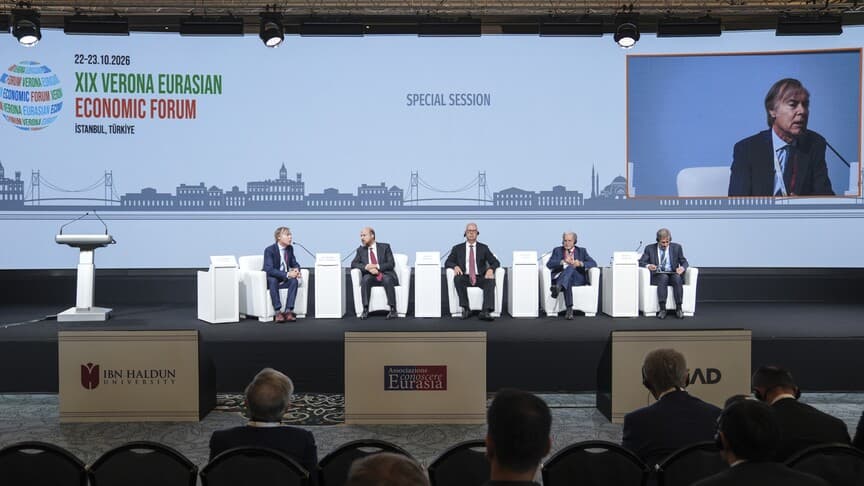
- The forum brought together participants from more than 30 countries at the Çırağan Palace in Istanbul
- Thomas Graham: the US is facing, for the first time in its history, a multipolarity from which it cannot exit
- Thomas Graham: for the first time in history, the United States is facing a multipolarity it cannot exit
- Kirill Dmitriev: Moscow seeks not temporary truces but a permanent settlement; Romano Prodi: 'There can be no peace without Europe'
- Kirill Dmitriev: Moscow is seeking not temporary truces but a permanent settlement; Romano Prodi: 'There can be no peace without Europe'
Discussion on the new world order in Istanbul
The first day of the 19th Verona Eurasian Economic Forum took place on Thursday at the Çırağan Palace in Istanbul and was devoted to the emergence of a multipolar world, Europe's future role, and various approaches to ending the war in Ukraine. Political, business, and academic representatives from more than 30 countries took part in the discussions, and the conversation repeatedly returned to the need for dialogue and a new balance of power between the United States, Russia, Europe, and other major powers.
Turkey: stability as a response to uncertainty
Turkey's Treasury and Finance Minister Mehmet Şimşek said in his opening remarks that the world is going through a period of volatility, uncertainty, complexity, and ambiguity, pointing to conflicts, disruptions in global supply chains, rising commodity prices, and pressure on the global economy. Ankara's response, he said, is maintaining macrofinancial stability: continuing a data-dependent prudent monetary policy, rebuilding fiscal reserves, and accelerating the green transition to reduce dependence on energy imports. Şimşek also emphasized the country's diplomatic role, noting that Turkey is interested in the
The US and Europe in a multipolar system
Thomas Graham, a fellow at the Council on Foreign Relations and a former senior US official responsible for Russia policy, said that for the first time in its history the United States is facing a multipolar order from which it cannot exit. In his view, Washington will have to adapt to an era of 'permanent rivalry,' avoiding direct conflict while maintaining a sufficient level of cooperation to address transnational problems; he sees the goal as regional balances in Europe, the Middle East, and East Asia. Nekmeddin Bilal Erdoğan, head of the Ilim Yayma foundation, linked Turkey's growing regional role to the same shift, noting Ankara's efforts regarding Syria, Iraq, and the Caucasus and calling for keeping channels of dialogue open despite conflicts. Former European Commission President and former Italian Prime Minister Romano Prodi stated that Europe has found itself on the sidelines of contacts between Russia and the US — partly due to its own internal disagreements — but that excluding the continent from a future settlement would be a mistake: “There can be no peace without Europe”. He also drew an analogy to a 'little Yalta,' adding the caveat that a possible US-Russian energy agreement would not by itself solve broader international problems.
Approaches to ending the war in Ukraine
Participants proposed different scenarios for halting the hostilities. Kirill Dmitriev, special presidential envoy of the Russian Federation for investment and economic cooperation and head of the Russian Direct Investment Fund, said that Moscow is seeking not temporary truces but a permanent cessation of hostilities and a stable architecture of European security, since an interim agreement could lead to a resumption of the war. He spoke positively of recent US-Russian contacts and of the Trump administration's efforts to balance the interests of Russia, Ukraine, and Europe. Graham, by contrast, believes that a lasting peace cannot emerge from a single agreement: 'Demanding a permanent peace as a condition for a ceasefire is in fact a call for the war to continue.' In his logic, the parties should first agree on the principles and parameters of a settlement, then conclude a ceasefire and continue detailed negotiations in a less tense environment, which would require concessions from both Russia and Ukraine and active European participation. Dmitriev also called for restoring economic ties between Russia and Europe, described the resumption of Russian energy supplies to Europe as 'economically inevitable,' and pointed to possible expansion of Russian-American cooperation, including in fertilizers.
Significance of the discussion
The forum showed that even amid sharp disagreements — for example, between Dmitriev's approach of a 'permanent settlement' and Graham's step-by-step scheme — the sides are keeping venues for direct dialogue open. For readers in the region, this event matters because Turkey is once again acting as a place for such contacts, while the settlement scenarios being discussed for Ukraine directly affect European security and energy supplies, on which the economies of neighboring countries depend. In practical terms, the speeches suggest that, in the view of most participants, the fate of any settlement will be decided with Europe's involvement, not only by the United States and Russia.