The key facts
- The law was signed on October 21 and enters into force 6 months after publication
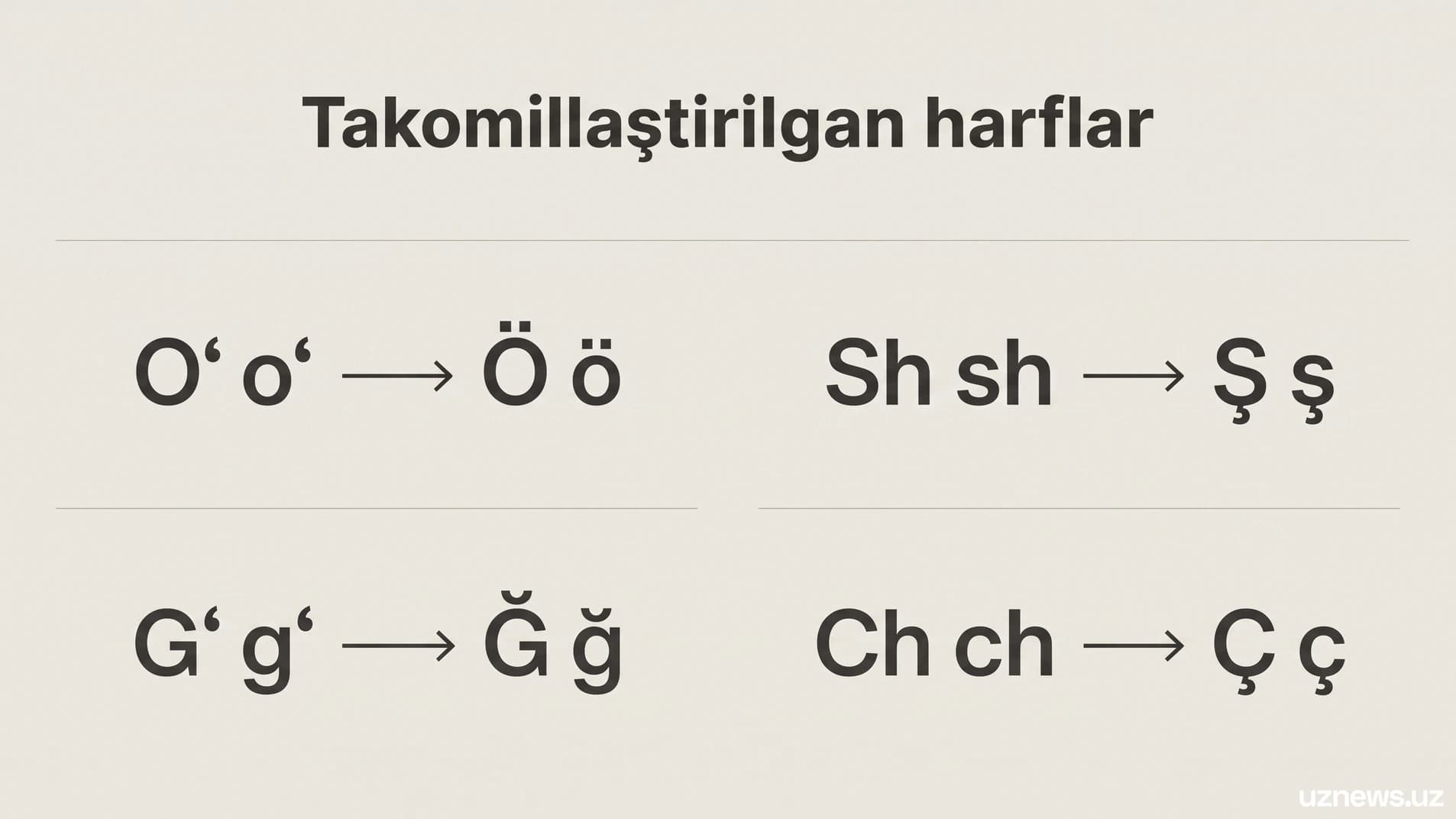
- Oʻ→Ö, Gʻ→Ğ, Sh→Ş, Ch→Ç; Ng is excluded from the alphabet, its pronunciation preserved in orthography rules
- Existing documents, the national currency and securities do not lose their validity
The law was signed on Uzbek Language Day
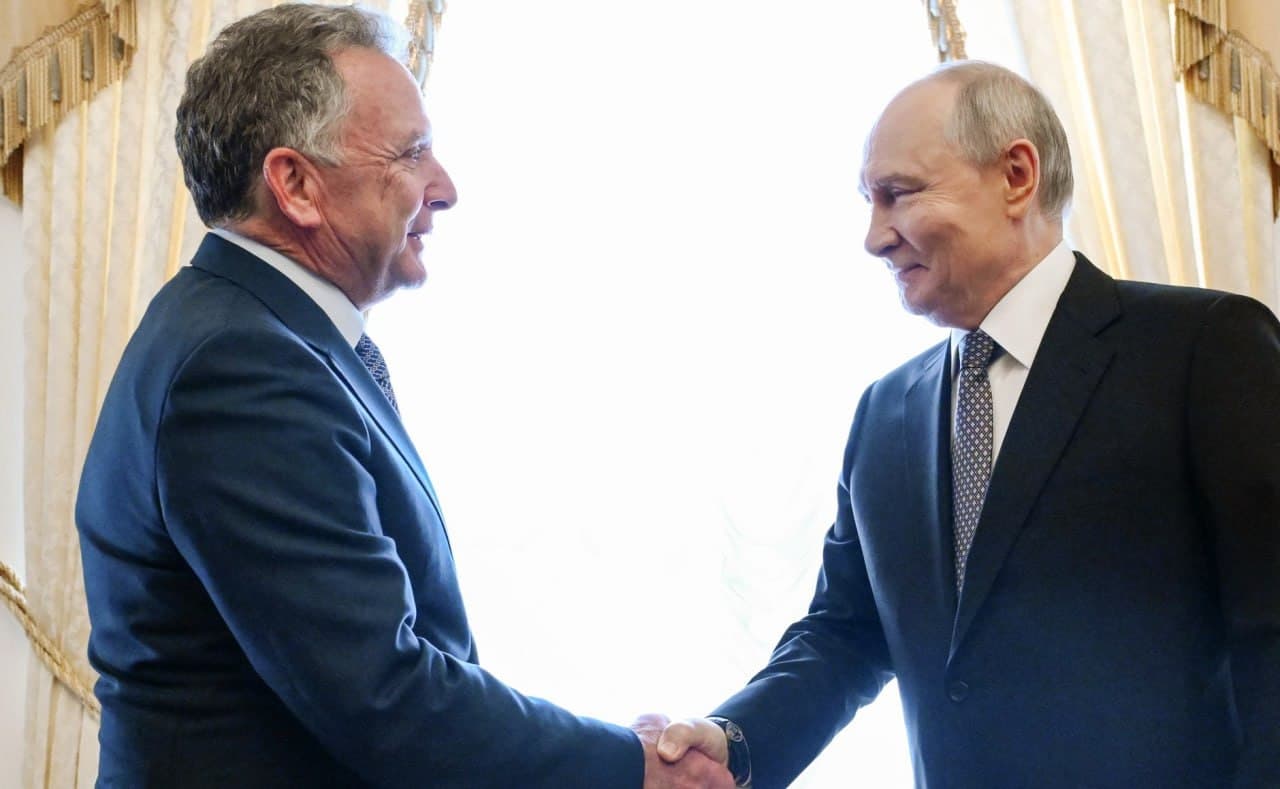
On October 21, President Shavkat Mirziyoyev signed a law amending the 1993 law 'On the Introduction of the Uzbek Alphabet Based on Latin Script.' This was announced by the head of the Presidential Administration, Saida Mirziyoyeva, on her Telegram channel. The date was not chosen by chance: on October 21, the Uzbek language was granted state status, and, according to Mirziyoyeva, the adoption of the law on this day 'carries a deep symbolic meaning.'
What changes in the alphabet
The new version of the alphabet consists of 28 letters and one character — the apostrophe — instead of the current 26 letters and three letter combinations. The combinations Oʻ, Gʻ, Sh and Ch are replaced with the single characters Ö ö, Ğ ğ, Ş ş and Ç ç, and the combination Ng is excluded from the alphabet as an independent letter — its pronunciation will be preserved in the orthography rules. The hardness sign (tutuk belgisi) is retained. The goal of the reform is a transition to the principle of 'one sound — one letter.' According to Daryo.uz, the changes are expected to speed up typing on computers and smartphones, internet search and indexing, as well as the development of AI models for text-to-speech conversion. The new composition: A a, B b, D d, E e, F f, G g, Ğ ğ, H h, I i, J j, K k, L l, M m, N n, O o, Ö ö, P p, Q q, R r, S s, Ş ş, Ç ç, T t, U u, V v, X x, Y y, Z z and the apostrophe.
The law's path and development
The draft law was adopted by the Legislative Chamber of the Oliy Majlis (according to Daryo.uz — at a session on June 7, according to Gazeta.uz and Spot.uz — in early July) and approved by the Senate on September 10. The development involved scholars from the Institute of Uzbek Language, Literature and Folklore of the Academy of Sciences; Zamon.uz also mentions the participation of philologists and 8 ministries and agencies.
Transition period and costs
The law enters into force six months after its official publication. Saida Mirziyoyeva emphasized that a 'path of cost minimization' was chosen: all existing documents, the national currency and securities retain their legal force and remain in circulation. Textbooks, signage and signposts will be replaced gradually, as their service life expires. The symbols of state bodies, bas-relief images of the coat of arms on buildings and signposts with geographical names may be used until they wear out or until the deadlines set by the law implementation program; a similar procedure applies to other items whose list will be determined by the Cabinet of Ministers. From 2027, textbooks for first grades will begin to be printed in the new alphabet, and by 2031 all textbooks are planned to be fully updated — no additional funding will be required, since textbooks are already updated on schedule. Media and official record-keeping will be gradually switched to a unified standard.
Statements and historical context
Saida Mirziyoyeva called the signing of the law a correction of a 'long-standing historical mistake' and recalled that on December 11, 2023, at a conference dedicated to the legacy of the Jadids, she put forward an initiative to refine the alphabet. She acknowledged that 'changes are never easy' and objections are possible, but, in her words, there was no other way to eliminate the shortcomings of the writing system and strengthen the language's position in the digital space. According to Gazeta.uz, the discussions lasted more than 30 years: a draft of the new alphabet was published for discussion in 2018, 2019 and 2021, an alternative version was discussed in 2023, and in October 2020 the president signed a decree on the development of the Uzbek language. In the first 1993 version of the alphabet, the letters Ş, Ç, Õ and Ğ were already present, but in 1995 they were replaced with the combinations Sh, Ch, Oʻ and Gʻ.