The key facts
- For the first time in decades, Thailand allowed refugees from camps on the Myanmar border to work outside the camps — starting October 2025
- In the first year, according to government data, 6,800 refugees were employed; the program covers 43 of 76 provinces
- Human rights advocates report work without contracts, underpayment, and deductions for employment; ministries did not respond to DW's requests
Policy shift after aid cuts
More than 100,000 refugees from Myanmar, some of whom have lived in nine camps along the Thai-Myanmar border since the 1980s, until recently had no right to leave the camps to work and depended on foreign aid. In October 2025, after cuts in foreign aid — mainly from the United States — the camps reduced food support and medical care. At the same time, the territorial conflict between Thailand and Cambodia forced hundreds of thousands of Cambodian migrants to return home, creating a labor shortage. In response, the Thai government changed its policy and began issuing refugees permits to work outside the camps.
First work experience
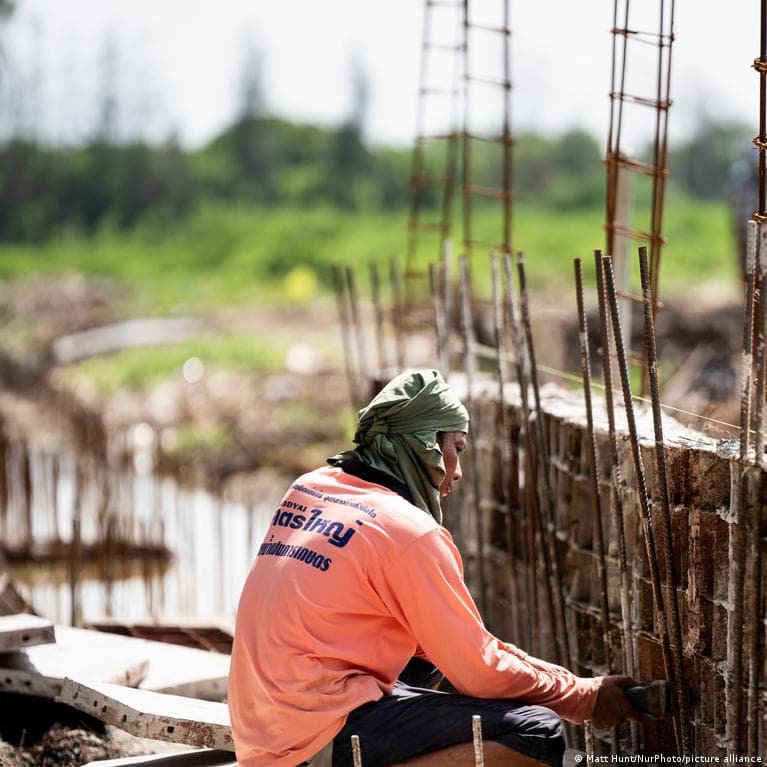
31-year-old Rae Bo, one of the 6,800 refugees who, according to the government, entered the Thai workforce in the first year of the program, has been pouring concrete and assembling scaffolding since last month at the construction of a 12-story residential building in Bangkok for 400 baht (about 12 dollars) a day. He told DW that after aid cuts by USAID and other organizations, the camps stopped regularly distributing rice and other rations, and medical care became insufficient; his family had to borrow from neighbors and cut back on food. 'Compared to how we lived in the camp, it will be a big difference — to have our own income and support the family on our own, without waiting for others to support us day after day,' he said.
Position of authorities and human rights advocates
The program allows work in 43 of Thailand's 76 provinces and in any sector not reserved by law exclusively for citizens of the country. The Ministry of Foreign Affairs reported that it has improved vocational training inside the camps. 'We hope this policy will expand opportunities and help [refugees] realize their potential, as well as contribute to Thailand's socio-economic development,' said Praporn Wenluang, spokesperson for the ministry's information department. Siwawong Suktawi, project coordinator of the International Coalition Against Detention in Thailand, noted that many refugees are glad to have the opportunity to earn more than in the camp and not depend on aid.
Problems at the start
Human rights advocates call the program's start slow and point to numerous shortcomings. According to them, many refugees do not receive contracts from employers, and the conditions, difficulty of work, or pay turn out worse than promised; there is no system for filing and reviewing complaints. K'nyaw Paw, general secretary of the Karen Women's Organization, reported that some refugees return to the camps and leave again several times, and their families raise money or borrow so that a family member can return to work. According to Siwawong and K'nyaw Paw, refugees are sometimes forced, through wage deductions, to reimburse employers for hiring costs — medical examinations, permits, and transportation — which means they start work already in debt, sometimes without warning.
The case of Aqwa
Aqwa, a father of two, left the camp in November 2025 with a group of 20 refugees for supposed sugarcane harvesting work on the other side of the country for 250 baht a day. Upon arrival, he was told to cut down eucalyptus trees — much harder and more dangerous work, according to him — for 200 baht a day. The work had to be done outdoors, without electricity, with water from the nearest pond. 'We talked to the owner, but he didn't care. He said:
Reaction of authorities and NGO proposals
The Ministry of Foreign Affairs did not respond to DW's request for comment on the reported problems; the labor and interior ministries, which oversee the program, also did not respond to interview requests. Human rights advocates propose guaranteeing refugees detailed contracts translated into Burmese, Karen, or Karenni, creating an accessible complaint system, expanding the list of provinces, and vetting recruiter intermediaries who come to the camps. According to them, NGOs are working with the government on improvements and hope the program will get better. Despite the shortcomings, most refugees, in their observation, still strive to participate. 'I had a bad experience, but I still want to go again, because food in the camp is a problem,' said Mu Da Hsit, who fell ill at work and left after the employer refused to pay for the health insurance the program is supposed to guarantee. 'I have no mother, I have a sick father and siblings I must take care of. So I will have to go, otherwise we won't survive,' she said.