The key facts
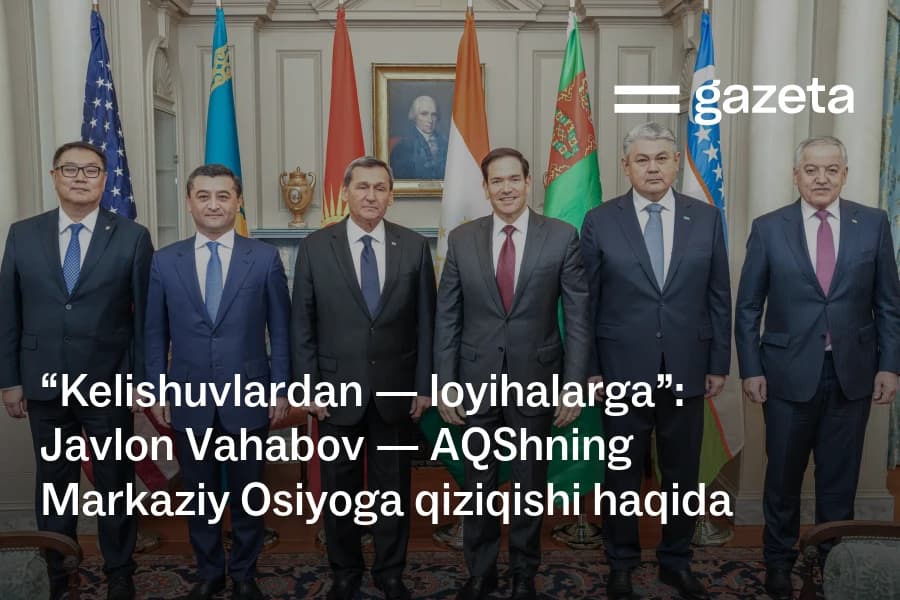
- On October 19, a meeting of Central Asian foreign ministers with US Secretary of State Marco Rubio will take place in Samarkand in the C5+1 format; a delegation of more than 200 American business representatives is expected.
- Priority areas: energy, transport connectivity, critical minerals and modern manufacturing; in February 2026, Uzbekistan and the US signed a memorandum on the extraction and processing of critical minerals.
- The Jackson-Vanik amendment applies to four of the five countries of the region; Uzbekistan benefits from a conditional normal trade relations regime subject to annual review.
The Samarkand meeting and priority areas
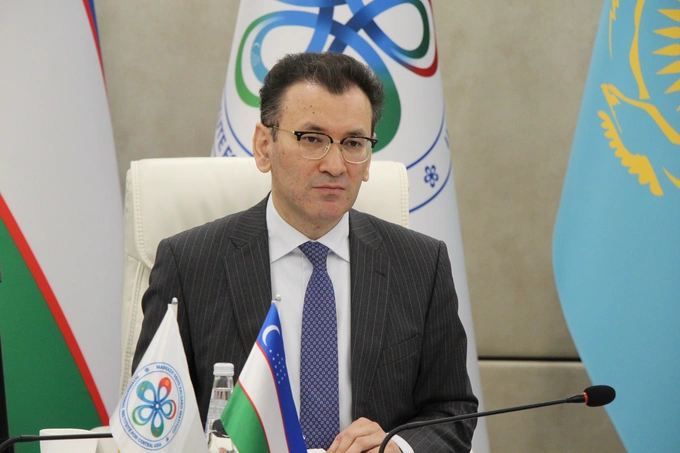
On October 19, a meeting of foreign ministers of Central Asian countries with US Secretary of State Marco Rubio will be held in Samarkand. On the eve of the event, director of the International Institute of Central Asia (IICA) Zhavlon Vakhabov, in an interview with Gazeta, assessed the current US economic interest in the region. In his view, four areas are of the greatest practical interest: energy, transport connectivity, critical minerals and modern manufacturing, which should be seen as links in a single task — attracting investment, creating production and ensuring access to external markets. For Uzbekistan, the most promising are the modernization of the energy system, deep processing of raw materials, industrial cooperation, digital solutions and agricultural technologies. Practical mechanisms have already been created: a joint investment platform with the US International Development Finance Corporation (DFC), cooperation with the Export-Import Bank of the United States (EXIM), and the US-Uzbekistan Business and Investment Council. The expert named the main task as moving from agreements to concrete investment projects.
Critical minerals and a regional alliance
At a recent meeting in Awaza, President Shavkat Mirziyoyev put forward an initiative to create a Regional Alliance on Critical Minerals. Vakhabov recalled that cooperation with the US already has an institutional basis: in 2024, the C5+1 Critical Minerals Dialogue began operating, Uzbekistan and the US signed the first bilateral memorandum, and in February 2026 — a new memorandum on cooperation in the extraction and processing of critical minerals and rare earth elements. The Alliance could complement existing mechanisms through a common regional agenda. As a first step, the expert considers the implementation of the idea proposed by Uzbekistan of a Unified Digital Map of Critical Mineral Reserves, which would systematize information on the region's resources. Next, combining efforts in preparing projects and negotiating with investors is possible, as well as forming, together with American partners, a list of flagship projects with defined funding sources, buyers and timelines.
How serious is US interest
Vakhabov proposed distinguishing between political interest, commercial agreements and actually invested capital. The first two have noticeably intensified: an investment platform has been launched, agreements on financing industrial and infrastructure projects have been reached, and a delegation of more than 200 American business representatives is expected in Samarkand. According to the expert, the scale of participation indicates serious interest, but does not mean that decisions on long-term investments have already been made: American companies are assessing payback, predictability of rules and commercial risks. He named the main indicator as the number of projects that have received funding, moved to construction and started operating.
Political dialogue and the Jackson-Vanik amendment
Beyond the economy, the region is interested in a more substantive political dialogue with Washington, primarily on regional security, counterterrorism and counternarcotics. The expert separately highlighted the TRIPP initiative (the 'Trump Route for International Peace and Prosperity'), which envisions developing transport links through the territory of Armenia: its implementation could contribute to stability in the South Caucasus, the development of the Trans-Caspian corridor and the expansion of Central Asia's ties with European markets. The Jackson-Vanik amendment is still applied to four of the five countries of the region, including Uzbekistan. In Vakhabov's view, the main reason is the gap between political support for repeal and the adoption of a legislative decision: administrations of both parties have advocated revision, but the consent of both chambers of Congress is required. The amendment does not block trade — Uzbekistan benefits from normal trade relations, but this regime is conditional and subject to annual review. Lawmakers from both parties have introduced bills in the Senate and the House of Representatives to terminate the application of the amendment. Practical work with Washington is conducted primarily through bilateral channels, although initiatives covering several countries of the region are being advanced in Congress.
Trust, competition and multi-vector policy
As an indicator of growing trust, the expert cited the participation of the leaders of all five Central Asian states in the first C5+1 summit at the White House in November 2025, as well as agreements in aviation and critical minerals and the development of the B5+1 platform. Answering a question about competition between Uzbekistan and Kazakhstan for American investment, Vakhabov called it a natural and healthy process, noting the complementarity of the economies: Kazakhstan has a resource base and access to the Caspian, Uzbekistan — an internal market and industrial potential. For large investors, a region with a population of more than 80 million people is more interesting as an interconnected market than as five separate economies. Speaking about multi-vector policy, he noted that the US, China, Russia and the EU offer different conditions, and it is important for the countries of the region to evaluate offers from the standpoint of their own interests; in some cases, partners' interests may diverge, which creates difficulties but does not change the commitment to an independent course.
Sustainability of the current stage and the regional agenda
The main difference between the current stage of relations and previous ones, in the expert's assessment, is a broader basis of mutual interest: if in the early 2000s relations were defined by security tasks and the situation in Afghanistan, now interests intersect in industrial modernization, energy, critical minerals, technology and transport. The impetus of President Shavkat Mirziyoyev's visit to Washington in 2018 was continued in the Strategic Partnership Dialogue and the creation of the Business and Investment Council. Sustainability, Vakhabov emphasizes, must be confirmed by the implementation of projects. The formula 'Six economies — one product,' proposed by Uzbekistan, reflects the logic of combining the raw materials, energy, technology and logistics of the countries of Central Asia and Azerbaijan. At the same time, taxation, investment conditions and the choice of external partners will remain the competence of nation-states. 'A tight-knit Central Asia is not five countries with identical policies, but five countries able to act together where a common result is more advantageous than an individual one,' the expert concluded.