The key facts
- Maryam Yarmohammadi, 28, mother of two, was killed on October 5 by her brother and husband using knives; she died in hospital, and both men were arrested.
- According to a 2020 study by Iran's Police Academy, 'honor killings' accounted for up to 45% of all murders in some conservative provinces in the west and south of the country.
- The UN rapporteur reported in March 2025 that 179 femicides within the family circle occurred in 2024.
Murder on Kishm Island
In the early hours of October 5, 28-year-old Maryam Yarmohammadi, a mother of two, was attacked with knives by her brother and husband on Kishm Island in southern Iran. She sustained mutilating injuries, including mutilation of her genitals. She soon died in hospital. The husband and brother were arrested. According to media reports, about 50 relatives gathered outside the hospital in protest against the arrests — they reportedly believed that death was the 'least severe punishment' Yarmohammadi deserved. What her relatives accused her of was not publicly reported, but the circumstances and extreme cruelty of the murder correspond to the typical pattern of so-called 'honor killings,' in which a man must 'erase' the imagined shame brought upon the family by a sister, daughter, or wife, or else face rejection and humiliation in the community.
Lack of support and gaps in justice
Women's rights activists have spent years trying to create support networks across the country for women under threat; one such initiative is the campaign against 'honor killings.' Its representative Rezvan Moghaddam told DW that apparently there were no activists or groups in the region capable of helping Yarmohammadi. According to her, through the campaign's civil networks it was sometimes possible to move women under threat to safe places, and Yarmohammadi's death should not be seen as a reproach to activists: 'I myself am from Khuzestan in southern Iran and know well the restrictions that exist there.' Iranian legislation, based on interpretations of sharia, does not consider women equal citizens in many areas: decisions about education, work, or travel may depend on the consent of a father or husband. Even after a woman's death, male relatives can influence the course of a criminal case: in murder cases, the victim's relatives have the right to demand retribution (up to the death penalty) or to forgive the perpetrator. When the suspected perpetrator is himself part of this circle of relatives, a serious conflict of interest arises, exposing, according to critics, gaps in protection from violence in the Iranian justice system.
Scale of the problem
According to a 2020 study by Iran's Police Academy, 'honor killings' — murders of women by fathers, brothers, or uncles for allegedly violating norms of modesty and family honor — accounted for up to 45% of all murders in some traditionally conservative provinces in the west and south of the country. In March 2025, the UN Special Rapporteur on human rights in Iran reported that in 2024 at least 179 women were killed by men from their family circle; these cases were recorded as femicides.
Public reaction and context
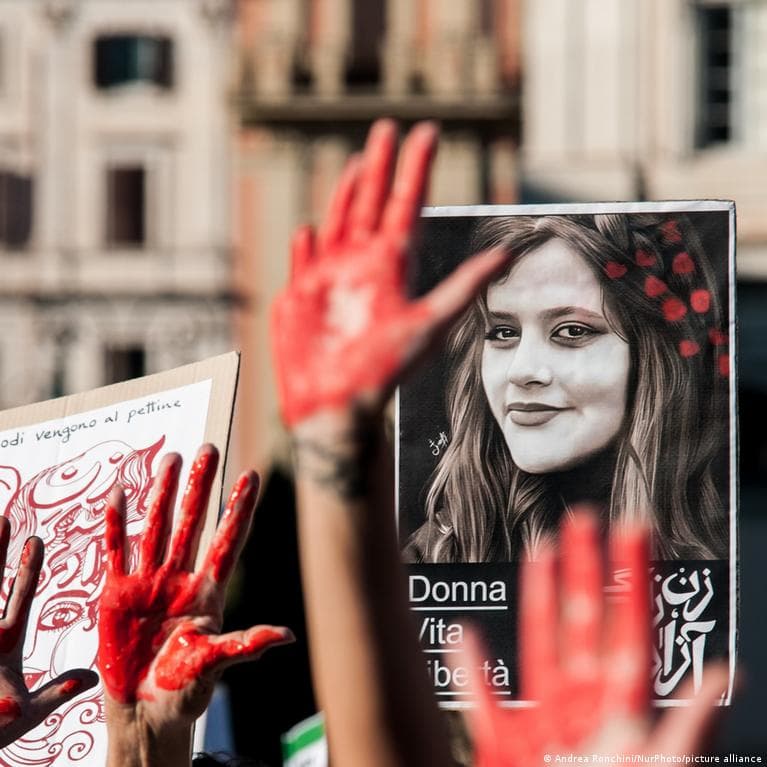
The cruelty of the murder caused particular shock: a wave of grief and anger rose on social media, and many women reacted to the femicide, which they believed was committed out of hatred in the name of 'honor' and 'shame.' At the same time, many comments contained victim-blaming — the murder was called a 'punishment for an unfaithful woman' or justified by 'understanding men's anger.' Psychoanalyst Saba Alele explains that men are socialized to consider themselves responsible for controlling women, and male identity is tied to her 'obedience'; violence becomes normalized when beliefs, public approval, and silence reinforce one another. According to her, the intertwining of cultural, social, political, economic, legal, and educational factors, combined with women's economic dependence and the absence of support and preventive mechanisms, increases the risk of violence. Sociologist and activist Atefeh Rangriz noted that 'femicides have always existed,' and their political manifestations can be traced from the forcible removal of the veil under Reza Shah Pahlavi in the 1930s to the slogan 'Either the headscarf or a blow to the head' in the Islamic Republic. She emphasized women's achievements: they have driven cars since 1940, voted and run for office since 1963, make up half of university graduates, and the number of divorces is growing. The 'Woman, Life, Freedom' movement, which arose after the death of Jina Mahsa Amini in police custody in 2022, changed public perceptions of women; many no longer wear the mandatory hijab in public places. 'Women have learned to focus on the present rather than postponing justice to the future. They demand it now,' said Rangriz, calling it 'a kind of radical revolution.' It remains unknown what Maryam Yarmohammadi herself wanted and how she wanted to live: she was brutally murdered.