The key facts
- Uzbekistan's internal affairs system turned 35; the Ministry of Internal Affairs did not send a representative to Gazeta's discussion
- According to Abdurakhmon Tashanov, the ministry's staff exceeds 143,500 people
- Khamid Sadik believes the system inherited a 'colonial' philosophy and needs serious reform
Round table marking the 35th anniversary of the system
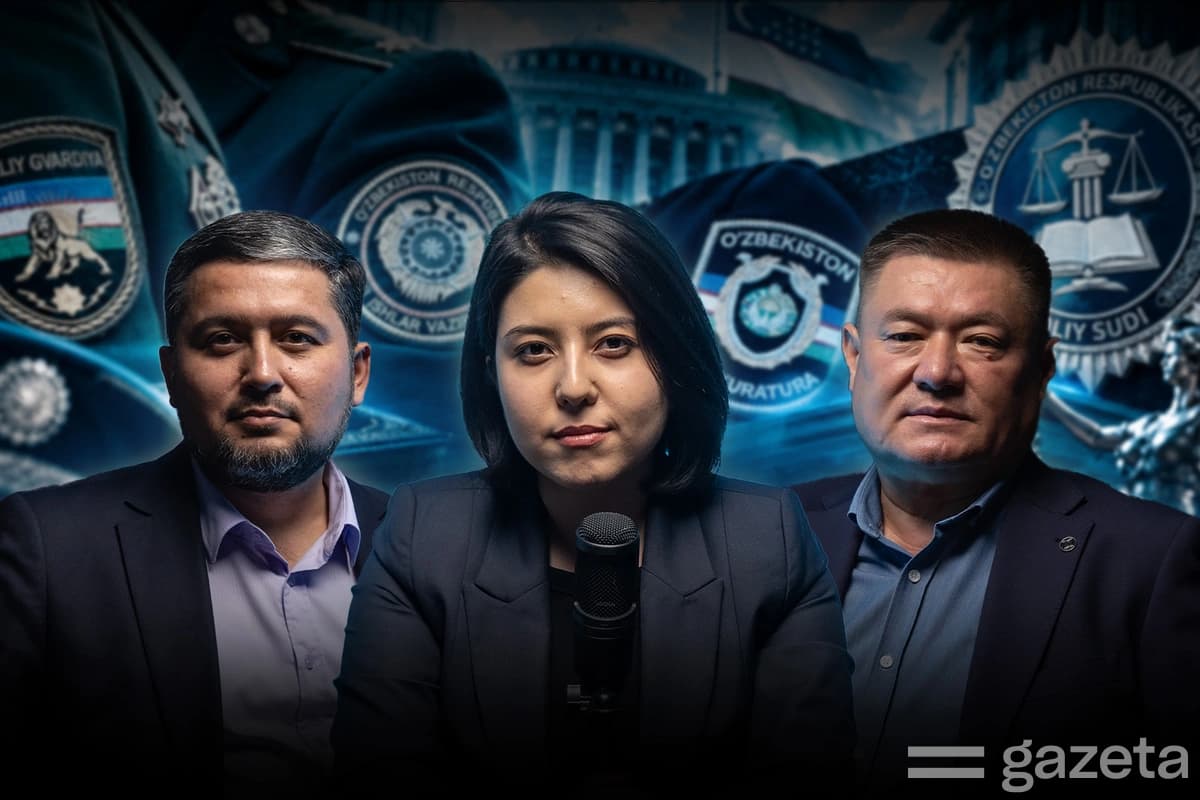
This year the internal affairs system of Uzbekistan turned 35. To mark the occasion, which coincided with the professional holiday of internal affairs officers, the outlet Gazeta held a discussion featuring human rights activist Abdurakhmon Tashanov and political scientist Khamid Sadik. The outlet noted that a representative of the Ministry of Internal Affairs was also invited to the conversation, but no one from the agency came. The full recording of the discussion was published on Gazeta's YouTube channel; the material was prepared by Dilshoda Shomirzaeva.
The scale and structure of the system
Abdurakhmon Tashanov cited figures according to which the personnel of Uzbekistan's Ministry of Internal Affairs today exceeds 143,500 people. According to him, it is the country's largest law enforcement structure — two to three, or even four times larger than the State Security Service or the Prosecutor General's Office. He recalled that some of the ministry's powers were later transferred to the National Guard, but in his assessment the system remains a 'very large army' built on administrative-command principles, and, in the speaker's view, it should long ago have been transformed into a police force, with redundant structures cut and some functions distributed among other agencies. Tashanov also noted that the heads of the agency have traditionally held a prominent place in the government, citing former ministers Zokir Almatov and Bakhtiyor Babajanov, as well as the current head of the agency, Aziz Tashpulatov.
'Colonial' legacy and the staffing issue
Khamid Sadik, who, in his own words, himself studied and worked in this system for ten years, believes that after gaining independence Uzbekistan adopted wholesale the model of internal affairs inherited from the colonial period, under which the people are viewed as the main threat and the priority is protecting the authorities and the elite. In his assessment, after 2016, when certain freedoms emerged in the country, the agency's authority, which had previously rested on 'institutional fear,' began to decline, and the openness of the media and bloggers worsened the staffing shortage. He pointed to overwork, low salaries and psychological pressure as key problems and called on those responsible for the system to answer the question of how to rid it of 'colonial' traits. In his words, only then will officers be able to protect both the authorities and the people 'from the standpoint of justice,' rather than on orders from superiors.
Legal framework and assessment of the agency
Tashanov noted that distrust of the police is a global trend, found in the United States, India and Malaysia, among others. He recalled that for a long time the agency's activities were regulated only by a provisional statute: the law on internal affairs bodies was adopted only after 2015, and, in his assessment, not in full; human rights defenders' appeals to Islam Karimov's government calling for the adoption of a law went unanswered. The speaker also said that at the beginning of this year he spoke with the Minister of Internal Affairs, who joked that in the past those who finished school with C and B grades went into the police — in Tashanov's view, such an admission speaks to the low quality of personnel. He also criticized the agency's recent press conference, at which, according to him, threats were made against bloggers and journalists.
Why this matters
The discussion concerns all residents of Uzbekistan, since the Ministry of Internal Affairs is the country's largest law enforcement structure, working directly with the population. The facts presented suggest that questions of reforming the system, its legal framework and staffing remain open, and the agency itself avoided a public dialogue by failing to send a representative to the discussion. As the agency's position on these claims has not been officially presented, the assessments remain the opinions of the invited experts.