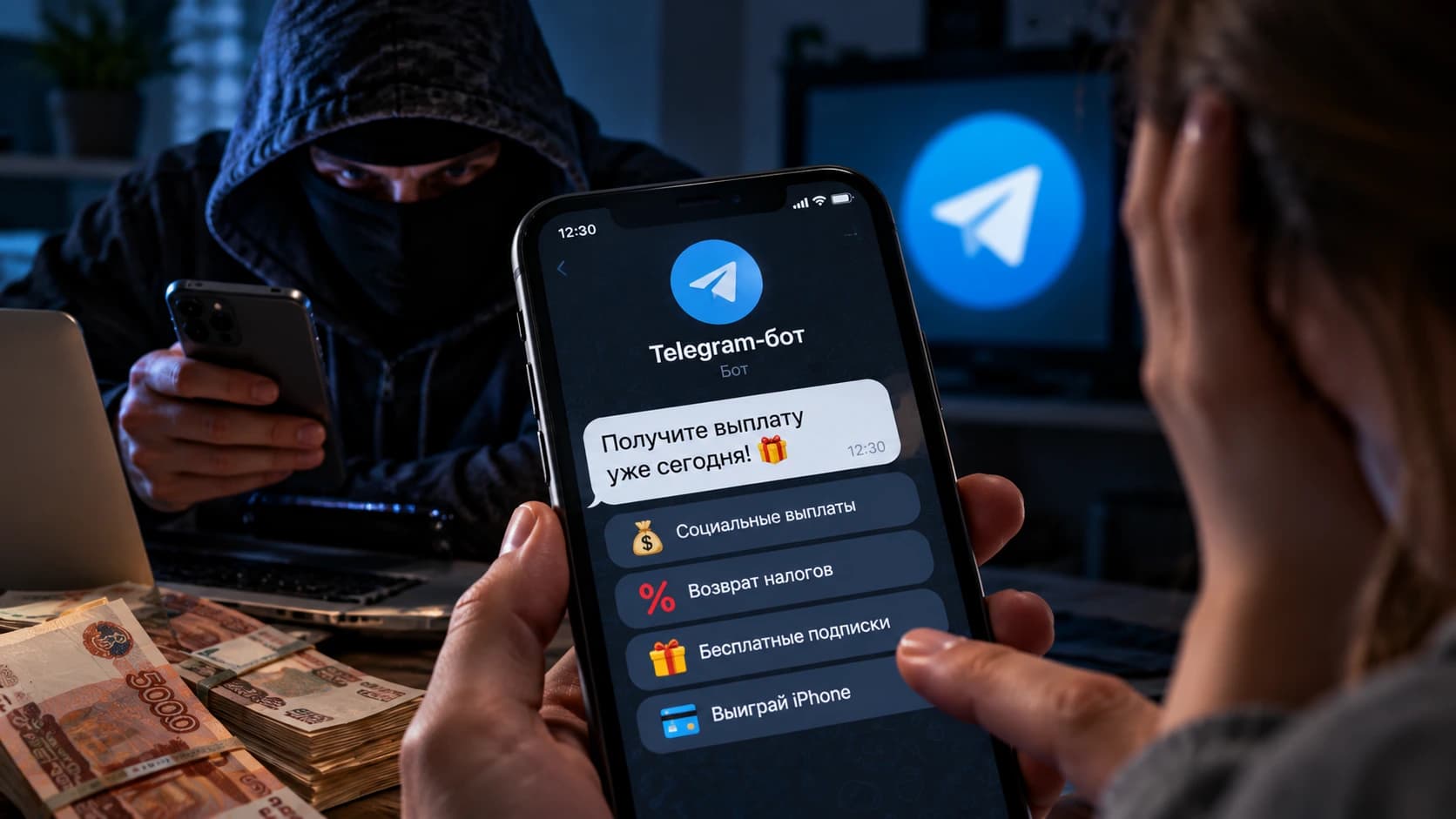
The key facts
- Ministry of Internal Affairs: Telegram bots are attractive to scammers due to their accessibility, ease of setup, and built-in features
- Bots can accept payments and collect personal data and one-time confirmation codes
- According to the Ministry of Internal Affairs, the bots themselves are not the main weapon: the deception is achieved through a combination of automation and social engineering
Why scammers need Telegram bots
Scammers actively use Telegram bots because such services are easily accessible and allow them to quickly create tools for deceiving users. This was reported to TASS by the press center of the Russian Ministry of Internal Affairs. According to the agency, what attracts the criminals is the ease of setting up bots and the wide range of built-in features.
How bot-based scam schemes work
As Life.ru reported, citing the Ministry of Internal Affairs, criminals use automated message handling: the bot interacts with a potential victim according to a pre-prepared script. In addition, bots can connect to payment systems and accept money transfers. Another function popular among fraudsters is creating forms in which users are asked to enter personal information and one-time confirmation codes.
The role of social engineering
The Ministry of Internal Affairs emphasized that such programs by themselves are not the criminals' main weapon: a successful scam requires convincing a person to take the desired actions. Therefore, criminals combine the bots' technical capabilities with social engineering methods — automation helps them extract money and confidential information, while psychological tricks make users trust fraudulent instructions.
Context: messengers remain the main attack channel
Earlier, Life.ru reported that Telegram and WhatsApp* remain the main messengers that scammers use to commit IT crimes. This was stated on October 14 by Anton Kononenko, head of the cybercrime combat department at the Moscow main directorate of the Ministry of Internal Affairs. According to him, criminals exploit the capabilities of these platforms, including to distribute messages on behalf of government agencies. The police representative reminded that official agency employees do not contact citizens via messengers with demands to take certain actions.
Why this matters
This information concerns all messenger users: according to the Ministry of Internal Affairs, bots can not only accept payments but also collect personal data and one-time codes, meaning the direct risk is losing money and access to accounts. The practical conclusion from the police's words is obvious: official agencies do not contact citizens via messengers with demands to do anything, so such messages should be treated as a sign of fraud. The editorial team notes that the source describes a general scheme without providing statistics on victims or specific cases.