The key facts
- The US-China Economic and Security Review Commission presented its annual 2026 report to Congress
- According to the commission's assessment, China is preparing for a possible escalation around Taiwan by 2027, including a blockade or quarantine scenario
- The report contains 30 recommendations: data protection, strengthening semiconductor manufacturing, and increasing Taiwan's resilience
What the report says
The US-China Economic and Security Review Commission published its annual report to Congress for 2026 on Wednesday. According to the commission's assessment, Beijing is increasingly combining military, economic, technological, and diplomatic tools to strengthen its position against Washington while avoiding direct confrontation. China is expanding its military capabilities, intensifying intelligence gathering, and using economic ties to grow its global influence, especially in Latin America.
Taiwan: pressure without a full-scale invasion
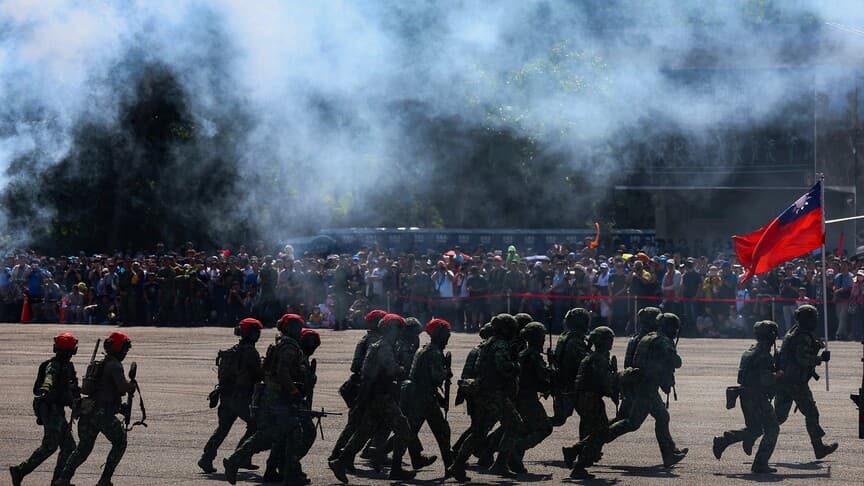
Taiwan is named in the report as one of the main areas of concern: the commission asserts that Beijing is intensifying pressure on the island through military activity, cyber operations, economic levers, and political influence. According to the authors' conclusions, China seeks to achieve its goals without a full-scale invasion, but is developing the ability to establish a blockade or 'quarantine' around Taiwan, which could disrupt international trade and global semiconductor supplies. The People's Liberation Army continues its modernization, and preparations are moving toward the 2027 readiness milestone for a Taiwan scenario.
The underwater domain and technology competition
A separate section is devoted to China's underwater activity: oceanographic research, seabed mapping, and the development of underwater sensor technologies capable of improving submarine operations and anti-submarine warfare. The commission warns that these actions could gradually erode the technological advantage of the American military in the western Pacific, although China still faces serious technical limitations in the underwater domain.
Data, AI, and Latin America
In the technology area, the report notes the collection and use of data through cyber operations, commercial activity, and state surveillance systems: according to the commission, Beijing is applying artificial intelligence to combine financial, biometric, and communications data, turning disparate information into intelligence for military planning, espionage, and influence operations. The development of Chinese AI and the promotion of its models abroad, including the use of distillation to replicate the capabilities of leading American models and the spread of cheap open-weight alternatives, are named a challenge to US technological leadership.
The Panama example and recommendations
Latin America is described as another direction of expanding influence. As an example of how commercial relationships become an instrument of political pressure, the commission cites the dispute over port operations in Panama: after Panama's Supreme Court decided to annul the concessions of a Hong Kong-based company, the Chinese shipping company COSCO withdrew from the port of Balboa, and Chinese authorities, according to the report, detained nearly 500 ships flying the Panamanian flag. The commission also warns about illegal networks operating in the region that are linked to China and connected to local and transnational crime. Congress is recommended to strengthen cybersecurity, reduce dependence on Chinese supply chains, and deepen cooperation with allies, primarily in the Indo-Pacific region; in total, the report contains 30 recommendations, including protecting sensitive data, strengthening semiconductor manufacturing, and increasing Taiwan's resilience to pressure.