The key facts
- Projects worth $130 million involving a Chinese bank in Surkhandarya, Kashkadarya, Bukhara and Namangan regions have not seen a single sum spent
- CITIC and CAMC offered prices more than twice the estimated cost; even after the tender, the winner's price was still 20% higher
- The ministry is negotiating with Sinohydro; canal concreting is planned for 2027–2028
What happened
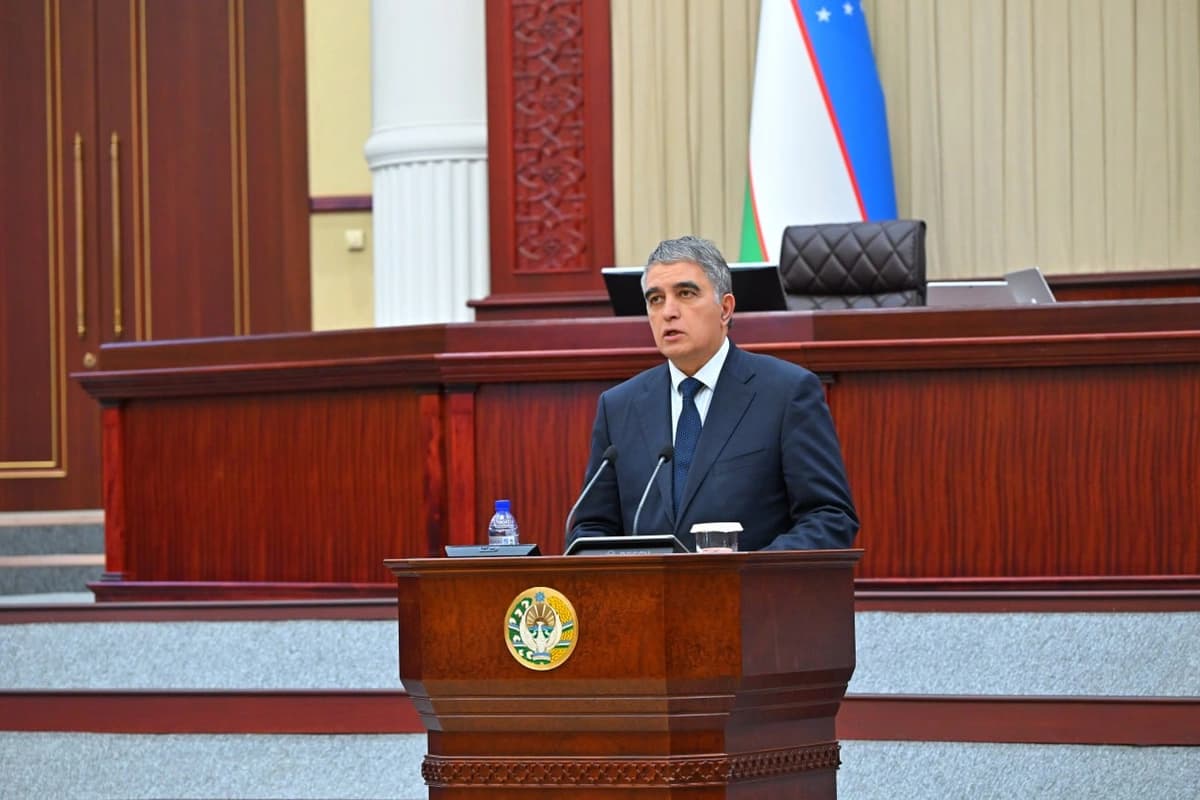
On November 11, during the 'Government Hour' in the Legislative Chamber of the Oliy Majlis, Water Management Minister Shavkat Khamraev explained why the implementation of irrigation infrastructure reconstruction projects involving Chinese companies is delayed. The issue was raised by deputy Imomnazar Tursunov of the Uzbekistan People's Democratic Party: according to the ministry's data, work on several projects planned for 2026 had not started at all. He cited a $130 million project involving a Chinese bank in Surkhandarya, Kashkadarya, Bukhara and Namangan regions: 'The presented table shows that not a single sum has been spent,' the deputy said, and asked why the development of investments had not begun and what measures the ministry was taking.
Why the deadlines were missed
According to the minister, the ministry initially planned to engage the Chinese companies CITIC and CAMC: the contractors were to start construction at their own expense, with costs later covered by concessional loans from China. 'When we negotiated with these companies, they offered prices not 10%, not 20%, but more than twice as high,' Khamraev said. The negotiations lasted more than a year and yielded no result, after which the government turned to the Export-Import Bank of China (Eximbank). Review and expertise of the projects at the bank took about six months, and selecting contractors under the bank's procedures took another year or so.
The tender did not lower the price
A tender was then held with three companies participating, but even the winner's price — that of CITIC — turned out to be 20% higher. The ministry tried to negotiate a price reduction with CITIC, but the parties failed to reach an agreement. After that, negotiations began with another major Chinese company, Sinohydro; the next meeting with it took place on the morning of November 11, before the parliamentary session. The minister stressed that the ministry is not ready to accept inflated prices for the sake of speed: 'If we do it expensively, thinking we will do everything faster — tomorrow the budget will still have to be repaid. That is why this is on pause.' According to him, this is a large program whose implementation will take at least two years; the design documentation has been developed and has passed expertise, and canal concreting is scheduled for 2027–2028. The minister promised to carry out the work with quality and within the allocated funds.
What the presidential decree provided for
On November 29, 2024, President Shavkat Mirziyoyev signed a resolution (PF-409) on implementing irrigation infrastructure reconstruction projects in Bukhara, Namangan, Surkhandarya and Kashkadarya regions with the participation of the Export-Import Bank of China. The document provided for two projects with a total initial cost of $220 million: $160 million for reconstruction in Bukhara, Namangan and Surkhandarya regions and $60 million in Kashkadarya region. The customer was designated as the Center for the Implementation of Foreign Investment Projects in Water Management under the Ministry of Water Management, with the funding source being concessional loans from the Chinese bank. The resolution, as an exception, pre-designated the general contractors: CITIC Construction Co. Ltd for the first project and CITIC Construction Co. Ltd together with China CAMC Engineering Co., Ltd for the Kashkadarya one. The agencies were instructed to agree on concessional financing without insurance payments, and the water management ministry, the Prosecutor General's Office and the khokimiyats of the four regions were tasked with cutting excessive expenses. For 2025, the Kashkadarya project also provided for the allocation of 120 billion sums from local budgets for a 15% advance payment.
Context
Thus, the original resolution initially secured the contract for CITIC and CAMC, but it was precisely with these companies, according to the minister, that an acceptable price could not be agreed, and the procedure had to be restarted through bank selection and a tender. Moreover, even winning the tender did not produce the desired price. The gap between the plan to spend the funds in 2026 and the new canal concreting timeline of 2027–2028 shows that the delay amounts to at least about two years. The final terms of the contract with Sinohydro and the final cost of the work have not yet been disclosed.