The key facts
- In a single day, November 14, 1,488 people were rescued in 14 boats — a record since November 7, 2020 (1,461 people)
- 12 boats with 1,235 people arrived in El Hierro, where a social emergency had previously been declared
- Over two days, 2,331 people arrived on the archipelago in 22 boats; the President of the Canary Islands, Fernando Clavijo, appealed to the European Commission
A record day on the Atlantic route
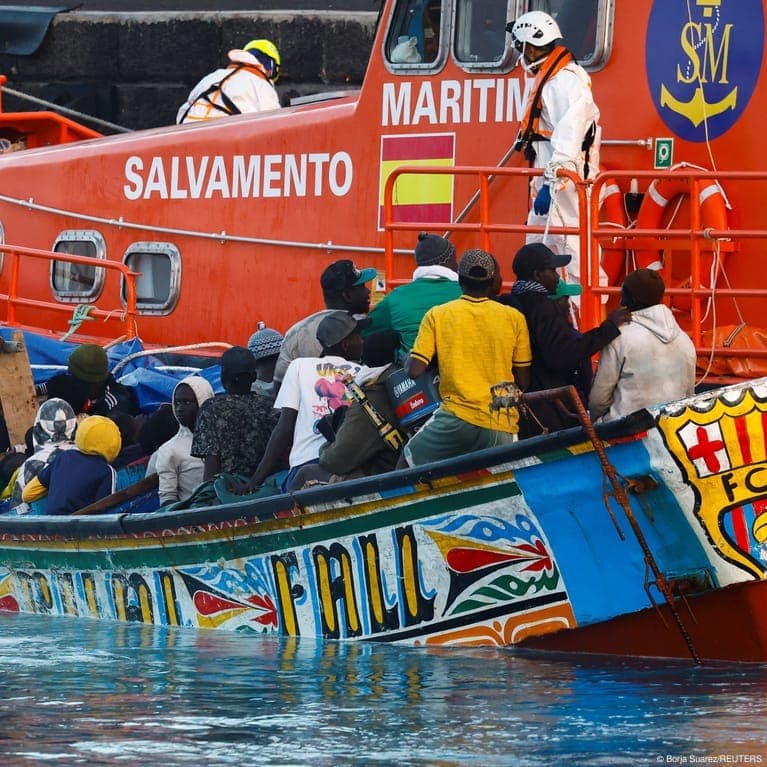
On November 14, 1,488 migrants arrived on the Canary Islands in 14 boats — the highest number of arrivals in a single day since November 7, 2020, when 1,461 people were rescued. The record figures are reported by the EFE agency, citing the maritime rescue service; Anadolu and euronews also reported them.
How the landings were distributed
According to euronews, 12 large wooden boats brought 1,235 people to El Hierro, another 203 people in one boat were intercepted off Gran Canaria, and 50 arrived in Tenerife. According to preliminary data, among the arrivals were 108 women and 167 minors. Anadolu specifies that one of the rescued boats was carrying 240 people, including 12 women and 36 children, and that most of those rescued were from Senegal, Gambia and Guinea. Saturday's count did not include two rescue operations still underway and 122 people on a large canoe who reached La Restinga at 23:55 on Friday. Thus, over two days, 2,331 people arrived on the archipelago in 22 boats.
The reception system at its limit
Six vessels of the maritime rescue service and two patrol boats of the Civil Guard took part in the operation. By Saturday, 317 people were in the temporary reception centre for foreigners (CATE) on El Hierro, not counting the new arrivals; 158 people were transferred by ferry to Tenerife, and 11 people remained in hospital. The Island Council of El Hierro had already declared a social emergency after the arrival of more than 8,000 people in five weeks. The President of the Canary Islands, Fernando Clavijo, said that the constant arrival of boats this month has completely exhausted the island's resources, and wrote to the European Commissioner for Migration, Magnus Brunner, calling for urgent action; according to him, Prime Minister Pedro Sánchez promised to urgently convene the Interministerial Commission on Immigration.
Causes of the surge and assessments
The Ministry of the Interior recorded 6,194 arrivals in October — the month with the greatest migration pressure on the route since 2023. Forecasts do not suggest a decline until December, when weather conditions will change on the route of more than 1,000 kilometres linking the Canary Islands with Senegal, Gambia and Mauritania. The authorities of the archipelago link the surge to the loss of control by Senegalese security forces deployed at sporting events in Dakar. Timbo Samb, a Senegalese man who has lived in Spain for 20 years and became a central figure in the documentary film 'Los cayucos de Kayar', nominated for the Goya award, links the rise in migration to the decline in the influence of Ousmane Sonko, whom President Bassirou Diomaye Faye removed from the government several months ago, which deepened the sense of hopelessness amid corruption and lack of work. Themba Santana, a former adviser to the Canary Islands government on migration, believes that the residents of El Hierro are protesting not against migrants but against the slow or absent response of the authorities, and calls for strengthening services without waiting for the high season and for moving people off the island as quickly as possible to prevent a collapse.
Context
The Atlantic route from West Africa to the Canary Islands is considered one of the deadliest migration routes in the world: every year thousands of people try to cross it in overcrowded boats, despite stormy seas, strong currents and long distances. The surge since October is placing additional strain on reception points and emergency services, especially on sparsely populated islands such as El Hierro.