The key facts
- Bukele sent more than 2,000 troops and special forces to Haiti to search for four Salvadorans missing after an ambush on October 18
- Haiti's Prime Minister Alix Didier Fils-Aimé announced the destruction of the 400 Mawozo gang's headquarters; he called the video of Bukele's helicopters unverified
- UN report: from July to September 2026, at least 1,167 people were killed in Haiti, with more than half of the violence linked to security forces' operations
What happened
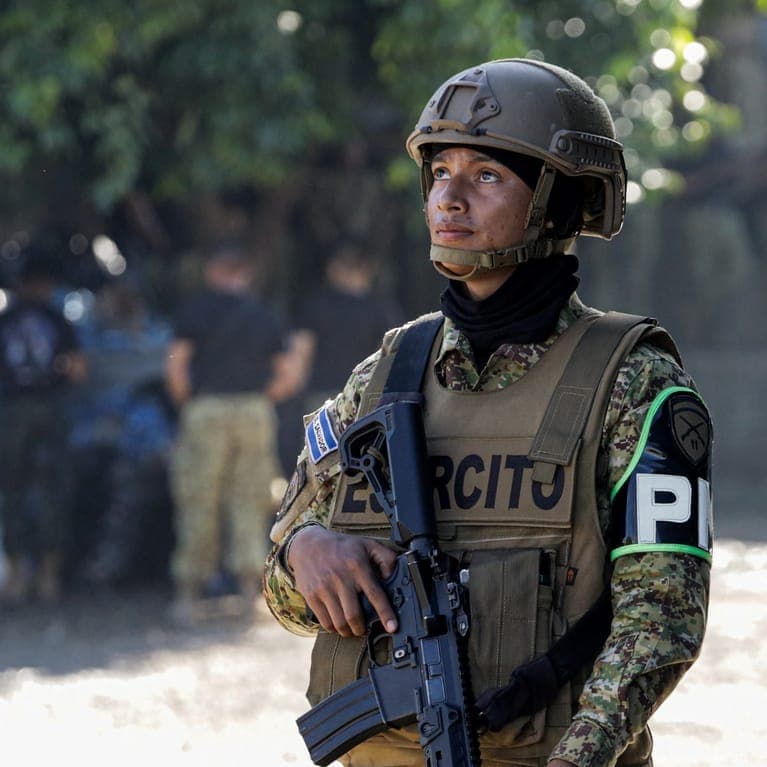
Salvadoran troops have been in Haiti, nearly 2,000 km from home, since the beginning of 2025 — mainly to contain the influence of gangs. In October, El Salvador's President Nayib Bukele sent more than 2,000 service members and special forces there, officially to search for four Salvadorans who were ambushed on October 18 and have still not been found.
Claims of victory over the gangs
Haiti's Prime Minister Alix Didier Fils-Aimé called 'the commitment of Salvadoran forces in the fight against gangs' a major victory in the battle against violence and thanked the Salvadoran army, adding that the two countries are working together with the UN-backed Gang Suppression Force (GSF) to 'regain control over territory and restore state authority.' Bukele earlier said that the joint task force had 'destroyed' what he called 'the Lanmo San Jou house and the headquarters of the 400 Mawozo gang,' and posted on the social network X a video of helicopters firing on a vast area — noting that it had not yet been verified.
Doubts and the cost of the operation
Haiti expert Jake Johnston of the Washington-based Center for Economic and Policy Research told The New Humanitarian agency that he was seriously concerned about how the actions of numerous different structures and security formations are delineated and coordinated, and noted that El Salvador is trying to present the operation as its own choice and action. A UN report published on Thursday documented 'bloody wars over territory, sexual violence and other horrors' in the Port-au-Prince metropolitan region and in the Artibonite and Sud-Est departments: from July to September 2026, at least 1,167 people were killed and 459 wounded, with more than half of the violence linked to ground and air operations by security forces against gangs, sometimes with the support of a private military company using drones.
Can the Salvadoran experience be replicated
Observers see the chaos in Haiti as part of its appeal to Bukele, who, in their view, seeks to export his 'iron fist' (mano dura) policy abroad — mass imprisonment of gang members and a sharp drop in the homicide rate. However, expert Román Le Cour Grandmaison of the Global Initiative Against Transnational Organized Crime believes Haiti's gang problem runs deeper: 'Haiti currently lacks the conditions to replicate the Salvadoran model: the prisons were emptied in 2024, the justice system is largely paralyzed, and criminal groups look more like militias than gangs — with territory, taxes, weapons of war and political networks that protect them.'
The role of the United States
Relations between the United States and El Salvador improved markedly during Donald Trump's second term, even though in 2018 he included El Salvador in the list of countries named in his infamous remark, which he later partially disavowed. The number of migrants deported from the US to El Salvador rose by 98% in early 2026, and Le Cour Grandmaison notes the 'central, though very restrained role' of the US in El Salvador's public life. Trump confirmed his position in November: 'He said he had a big problem with Haiti. I said: