The key facts
- Bild reports informal Russian demands: Finland's exit from NATO, a ban on alliance bases in Estonia, Latvia and Lithuania, and neutral status for Ukraine
- Under the plan, Russia keeps the occupied territories and receives the entire Donbas; the ports of Odesa and Mykolaiv are to be demilitarized
- In return, the withdrawal of nuclear weapons from Belarus and a refusal to station intermediate-range missiles there is proposed
Demands going beyond Ukraine
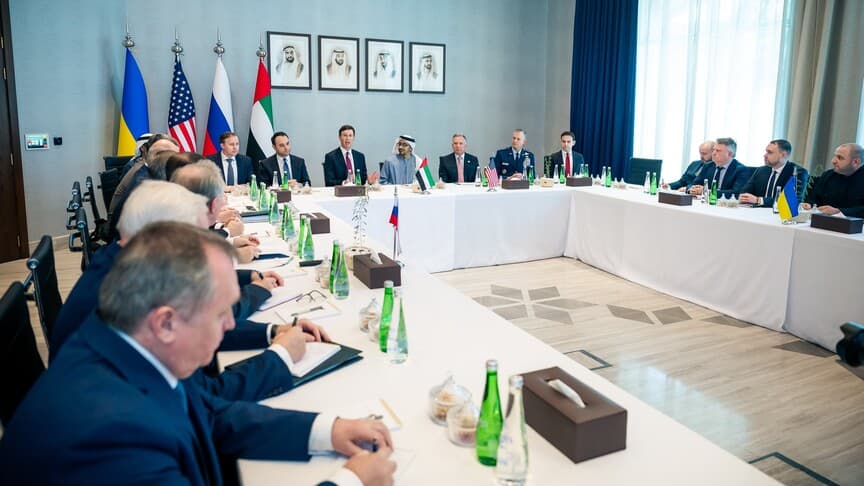
At the talks in Abu Dhabi, Russian negotiators put forward proposals that go far beyond the Ukrainian conflict and are aimed at shaping a 'new order of European security.' This is claimed by the German newspaper Bild, citing sources: the informal proposals were conveyed to European representatives. Russian officials meanwhile continue to assert that Western governments once promised not to expand NATO eastward.
What is proposed regarding Ukraine
According to the plan outlined by Bild, Russia keeps all occupied Ukrainian territories and receives the entire Donbas: Ukraine must give up the areas of the Donetsk and Luhansk regions still under its control. The ports of Odesa and Mykolaiv are to be demilitarized and barred from use as naval bases, while separate arrangements must guarantee freedom of navigation in the Black and Baltic Seas. Under the plan, Ukraine remains permanently non-bloc — NATO membership is ruled out, but the possibility of joining the European Union is not closed off.
Finland, the Baltics and Moldova
The broadest demands concern third countries. The plan provides for a ban on NATO military bases in Estonia, Latvia and Lithuania, and Finland is to return to the status it had before joining the alliance. For Moldova, the plan envisions a federal republic comprising the country's main territory, Transnistria and Gagauzia: if Moldova joins the EU, Transnistria and Gagauzia would be allowed to hold independence referendums. Gazeta.Ru, citing Bild, adds that Moscow is ready to withdraw its troops from Transnistria.
Counter-concessions and the context of the talks
In return, the Russian side, according to the publications, proposes withdrawing nuclear weapons from Belarus and refraining from stationing intermediate-range missiles there. Bild emphasizes that this is only one of the proposals being discussed in negotiating circles — that is, the document is not an agreed position of the parties.
The course of the talks
On November 10–11, trilateral talks were held in Abu Dhabi with the participation of delegations from Russia, Ukraine and the United States, and on November 12 the US president's special envoys Jared Kushner and Steve Witkoff met with Vladimir Putin in the Kremlin. Shortly afterwards, Kushner said that Russia and Ukraine had agreed on the participation of European Union representatives in the next round of talks, and stressed that a durable cessation of hostilities requires reliable security guarantees, demarcation mechanisms and mutual commitments to de-escalation. The information about the Russian demands is based on Bild's sources and has not been officially confirmed by either side.