The key facts
- Guterres reaffirmed the goal of covering every person on Earth with an early warning system by the end of 2027; about a third of countries remain unprotected.
- He tasked UNEP with developing a global near-zero methane standard for oil and gas and called for an end to voluntary measures.
- About 3,000 GW of renewable projects and storage are waiting to be connected to grids; the queue grew by 60% in a year.
Remarks on the sidelines of COP31 in Antalya
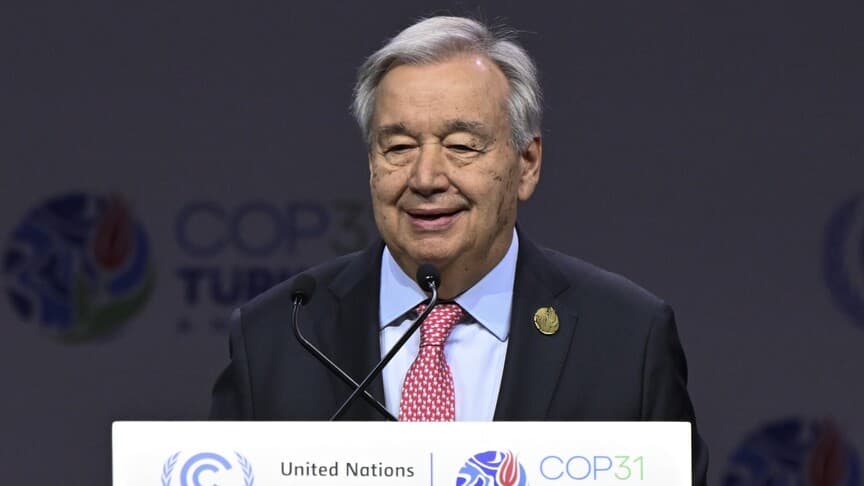
UN Secretary-General António Guterres on Wednesday spoke at a series of high-level events on the sidelines of the COP31 climate summit, which is taking place in Antalya, Turkey. “The climate crisis is accelerating. Our protection of people must accelerate with it,” he told delegates, noting that rising temperatures and dependence on fossil fuels continue to claim lives and burden economies.
Early warnings for all
At an event on disaster readiness, Guterres reaffirmed the goal of covering every inhabitant of the planet with an early warning system by the end of 2027. Since 2022, donors have mobilized $2 billion to assist roughly 160 countries, yet, in his words, about one in three countries remains unprotected; the biggest gaps are in developing states, conflict zones and small island states. The Secretary-General pointed to a disparity: some European countries have more weather stations meeting global standards than the entire African continent. According to his data, comprehensive systems reduce disaster mortality nearly sixfold. “We cannot warn people about what we cannot see,” he said, urging governments to include early warning systems in national budgets and expand accessible financing across the entire forecasting and alerting chain.
Waste and methane
At the leaders’ round table on the circular economy, Guterres thanked Turkey and the president’s spouse Emine Erdogan for hosting the zero-waste summit. He recalled that humanity produces more than 2 billion tonnes of municipal waste annually and throws away food equivalent to 1 billion meals a day, and called on countries to halve food waste by 2030. Waste, he said, also contributes to global warming, while methane accounts for nearly a third of current warming. At the same time, according to Guterres, of more than 5,000 methane leak alerts issued since 2023 by the UN Environment Programme (UNEP), barely one in eight received a response. “Voluntary actions are no longer enough,” he declared, tasking UNEP with developing a science-based global near-zero methane standard for the oil and gas sector and urging governments to introduce rules and incentives for waste prevention, recovery and responsible management.
Electrification and financing
At the electrification dialogue, Guterres endorsed the global 35-by-35 initiative — raising the share of electricity in energy consumption to 35% by 2035 — and warned that tensions in the Middle East expose the economic vulnerability of fossil fuel imports. In his words, about 3,000 gigawatts of renewable energy and storage projects are idle awaiting grid connection, and the queue grew by 60% in a year. Developing economies outside China receive only about one in five dollars of clean energy investment, facing borrowing costs two to three times higher than in developed countries. “We can build a future of energy independence on clean energy, or lock in another generation of fossil fuel dependence,” the Secretary-General said, calling on shareholders of multilateral development banks to expand concessional financing.