The key facts
- The Memur-Sen and ILC exhibition is open in the foyer of the congress center of COP31’s “green zone” in Antalya from November 9 to 20
- The display includes 63 photographs by Anadolu photojournalists, works by Palestinian artists, an olive tree and a map made of keys
- The damage figures cited by the organizers differ between publications: 164 and 208 damaged heritage sites
An exhibition on the sidelines of the climate summit
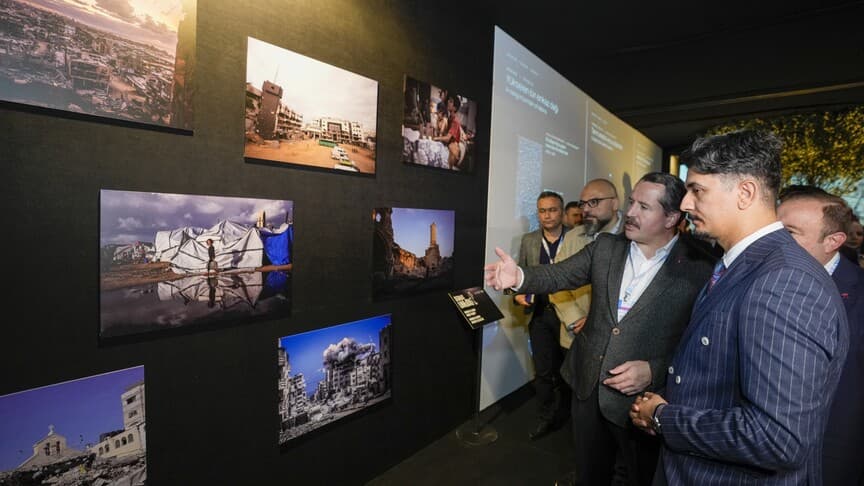
In Antalya, host of the 31st Conference of the Parties to the UN Framework Convention on Climate Change (COP31), the exhibition “Hope of Return: Al-Awda — the story of an olive tree” has opened. It was organized by the Turkish Confederation of Public Sector Trade Unions (Memur-Sen) and the International Labour Confederation (ILC), with the participation of the Anadolu Agency, to draw attention to the humanitarian and environmental devastation in Gaza. The exhibition is located in the foyer of the congress center of the summit’s “green zone” and is open to visitors from November 9 to 20.
What is on display
The centerpiece is a damaged but surviving olive tree — a symbol of Palestinians’ connection to their native land. Next to it is a map of Palestine made of house keys: according to the organizers’ concept, it refers to the families who left their homes in 1948 and passed the keys down from generation to generation as a symbol of the right of return. Through interactive installations, visitors follow a path from Gaza’s once-bustling streets to the destruction, accompanied by personal testimonies recorded among the ruins; also on display are everyday objects brought from Palestine and animated comparisons of the city before and after the devastation. The photographic section consists of 63 images by Anadolu photojournalists who worked in Gaza, as well as works by Palestinian painters and graphic artists. At the exit there is an installation where visitors can leave a digital message of hope for Gaza and humanity.
Damage figures and discrepancies between publications
At the opening, Memur-Sen chairman and ILC president Ali Yalçın said that Gaza had turned into an enormous pile of rubble: according to him, 164 historical and cultural sites have been damaged, 80,000 people have been killed, and greenhouse gas emissions associated with the war and destruction are estimated at 33.2 million tons of CO2 equivalent. “A world in which prosperity grows in one part of the planet while in another people are offered ruins, destruction, hunger, destitution and poverty as the only option is an unjust world,” the agency quotes him as saying.
Damage figures and discrepancies between publications
A second Anadolu publication cites a broader set of figures presented at the exhibition itself: the explosive power of the munitions dropped on Gaza is equivalent to roughly 13 of the bombs dropped on Hiroshima in 1945; carbon emissions in the first 60 days of the conflict exceeded the annual emissions of 20 countries; the number of olive trees has fallen from about 2 million to 150,000; around 81% of buildings have been damaged and more than 61 million tons of debris have accumulated; 97% of agricultural land is unusable, and 45 of 54 water facilities are out of operation. However, on heritage sites the exhibition gives figures that differ from Yalçın’s speech: according to the display, 208 of 325 historical and cultural sites have been destroyed — versus the 164 damaged sites cited in his speech. Both figures come from the same original source — Anadolu materials — and the editorial team has no data that would explain the discrepancy.
Recognition of the agency’s contribution
Yalçın also told an Anadolu correspondent that the photographs capture Gaza’s mothers with their hopes extinguished, people torn from their everyday lives, and children continuing their studies in abandoned buildings. He thanked Anadolu Director General Serdar Karagöz and his team, the Palestinian artists and all participating organizations, and presented the agency with a commemorative plaque in appreciation of its contribution to preparing the exhibition.