The key facts
- Turkey did not invite Israel to the two-day high-level segment of COP31 in Antalya, attended by about 90 heads of state and government
- The US is absent after the Trump administration withdrew from the UNFCCC and the Paris Agreement
- It has not been confirmed whether lower-level Israeli delegates will take part in the negotiations
Refusal to invite and its justification
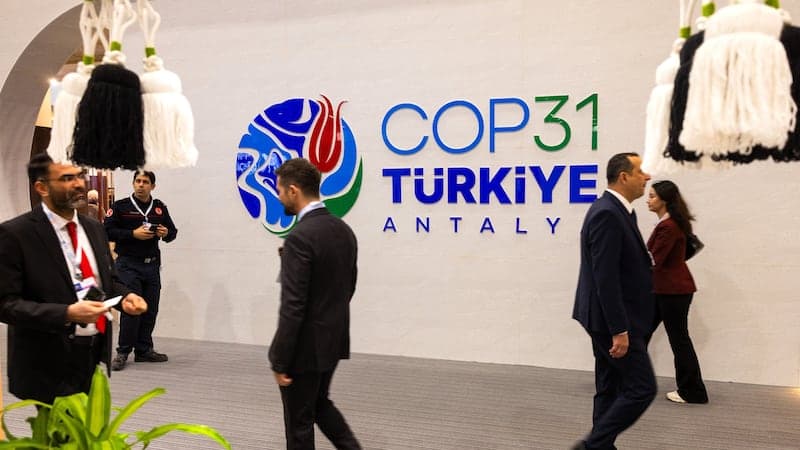
Turkey, the host of the COP31 climate summit, has not invited Israeli leaders to the meeting of heads of state and government. This was announced by COP31 president Murat Kurum, who serves as Turkey's Minister of Environment, Urbanization and Climate Change. “As the host country of the leaders' summit, we did not send an invitation to Israel,” he told Turkish media, adding: “We say that there can be no climate justice where there is no peace.” According to him, the refusal was motivated by the mass casualties among Palestinians in Gaza.
Who is absent in Antalya
In Antalya, on Turkey's Mediterranean coast, about 90 heads of state and government have gathered for the two-day “high-level segment” of the two-week conference. Israel is a member of the UNFCCC, whose parties gather annually at COP summits, yet no Israeli delegation has been seen in Antalya. Neither Israel nor the UNFCCC secretariat has confirmed whether lower-level Israeli delegates will take part in the negotiations after the country's leaders were refused an invitation. Israeli ministers have not publicly reacted to Kurum's words; according to the Israeli outlet Ynet, Israeli officials are likely not to attend the conference due to “security concerns and diplomatic isolation.” The National's request for comment from Israel's Foreign Ministry went unanswered at the time of publication.
The US and the Palestinian presence
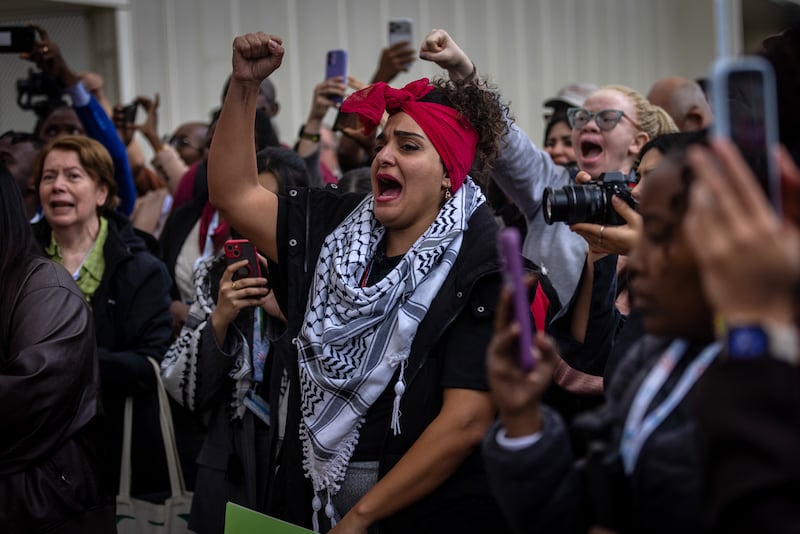
The US government is also absent from the summit: the administration of Donald Trump earlier this year withdrew the country from the UNFCCC and the Paris Agreement, as well as from the Intergovernmental Panel on Climate Change (IPCC). Trump has called climate change “the greatest hoax imposed on the world,” while advocating for expanded fossil fuel extraction. At the same time, the Palestinian presence at the conference is noticeable: at the Palestine pavilion, participants were picking up badges shaped like the Palestinian flag, and banners displayed photomontages of the destruction in Gaza. Zaghul Samhan, head of the Palestinian Environment Quality Authority, called the refusal to invite Israel “a political issue, not a technical one” and a decision by Turkey, recalling the US refusal to grant a visa to President Mahmoud Abbas to speak at the UN General Assembly in New York in September.
Context and consequences
Turkish-Israeli relations, previously developing actively, have sharply deteriorated since the start of the war in Gaza: Ankara severed trade ties worth billions of dollars a year, diplomatic missions operate in a reduced capacity, and Turkish ministers regularly accuse Israel of genocide. Israel denies the accusations of genocide and criticizes Turkey for maintaining ties with Hamas. Kurum said that Turkey's position on the conflict in Gaza “will continue throughout the conference,” and the summit program includes exhibitions of works by children from Gaza and Palestinian artists. According to The National, since the start of the war that followed Hamas's October 7, 2023 attacks, at least 74,000 Palestinians have been killed in the enclave; the attacks themselves claimed about 1,200 lives. A September 2025 report by the UN Environment Programme documented an “unprecedented level of environmental damage” in the territory: since 2023, Gaza has lost 97% of its tree crops, 95% of its shrubland and 82% of its annual crops. Greenpeace Israel noted that, although the country is not represented at the summit, the decisions made there on emission reductions and adaptation funding will also affect the future of Israelis.