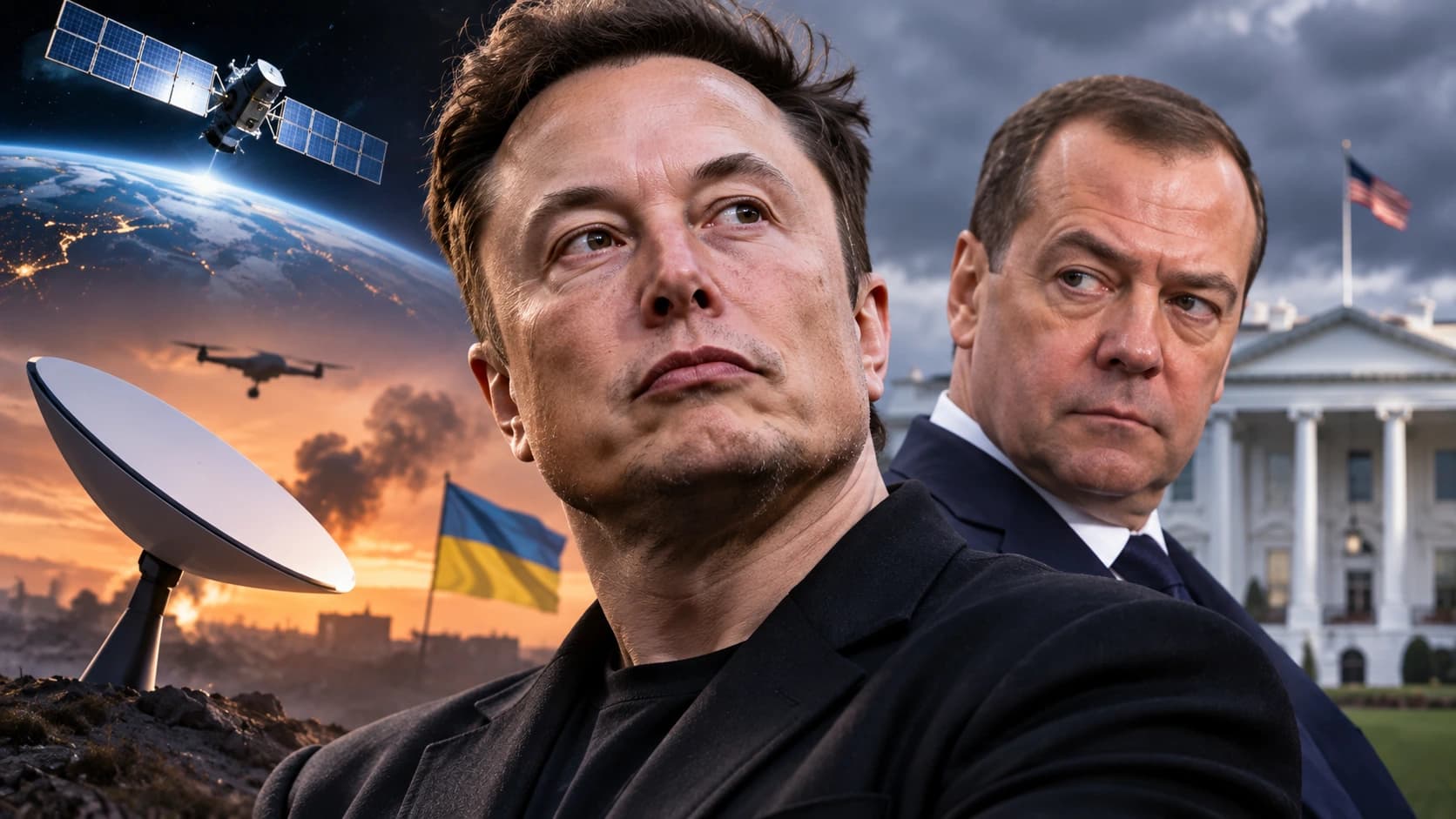
The key facts
- Medvedev believes that the separation of Starlink and Starshield does not remove Musk's moral responsibility
- The trigger was a repost by Musk calling the transfer of terminals to Ukraine a mistake
- In October, the two sides had already warned about the risks of satellite collisions in orbit
Medvedev: Musk 'has become a participant in this war'
Deputy Chairman of Russia's Security Council Dmitry Medvedev said that Elon Musk realized too late the consequences of providing Starlink satellite communications to Ukraine and is now trying to distance himself from its military use. According to him, the entrepreneur cannot absolve himself of responsibility for the use of the technologies he developed in combat operations, even if he now opposes the continuation of the conflict. This is reported by Life.ru.
What exactly the Deputy Chairman of the Security Council said
In his Telegram channel, Medvedev wrote that Musk 'saw the light too late' and admitted that transferring Starlink capabilities for military purposes was a mistake, and that his communications 'were used all along, including for strikes on civilian targets.' He is convinced that the entrepreneur understood from the very beginning how Ukraine could use the satellite system, and that the separation into civilian Starlink and military Starshield does not free him from moral responsibility for the consequences of the hostilities. Medvedev also suggested that even one of the richest people on the planet is not fully able to determine his company's policy independently, since he depends on the American authorities.
A reference to the Rosenberg case and Musk's repost
Medvedev paid particular attention to the change in attitudes toward Musk in the United States: according to him, the businessman has already been accused of betraying American interests, and some critics, the politician claimed, even called for dealing with him in the manner of Julius and Ethel Rosenberg, the spouses executed in 1953 in an espionage case on behalf of the USSR. The Deputy Chairman of the Security Council linked what is happening to political changes in Washington, emphasizing that the approaches of the Joe Biden and Donald Trump administrations to the Ukrainian conflict differ, but this does not erase the role SpaceX has already played in it. Concluding his post, he remarked that recognizing one's mistakes is better than refusing to repent, accompanying the entry with a Latin expression translated as 'A liar is not believed even when he tells the truth.'
The trigger was a repost without comment
The comment came after Musk shared, on the social network X, a post from the Whole Mars Catalog account whose author called it a mistake to give Ukraine thousands of free Starlink terminals and multi-million-dollar funding for their maintenance. The post claimed that communications intended for the civilian population later became a tool for controlling combat drones. Musk himself left no additional comments on the repost.
Background: the dispute over Starlink and space war
Disputes over satellite communications intensified in October. At that time, Musk accused the Ukrainian Armed Forces of violating the rules for using Starlink in offensive operations, and SpaceX introduced technical restrictions that, according to the entrepreneur, were meant to prevent such use of the commercial service. Ukrainian representatives disputed his accusations, insisting that a separate system, Starshield, is used for military tasks. As Life.ru notes, On October 4, Medvedev warned of the risk of a real space war due to possible actions against the Russian satellite constellation 'Rassvet' — the trigger was proposals from Kyiv to restrict the operation of the Russian system through the International Telecommunication Union. He stated that an attempt to destroy Russian satellites could trigger retaliatory actions against American orbital infrastructure. Three weeks later, Musk himself warned that destroying satellites could cause a chain reaction of collisions in orbit, when a huge amount of debris could make near-Earth space practically unusable — which is why he insisted on keeping Starlink for civilian purposes.