The key facts
- Turkey plans $500 billion in energy investment by 2040
- The share of renewables in installed capacity will rise from 63% to 77%, with nuclear capacity reaching 10 GW
- By 2040, the country expects 100% self-sufficiency in oil and gas
A roadmap to 2040
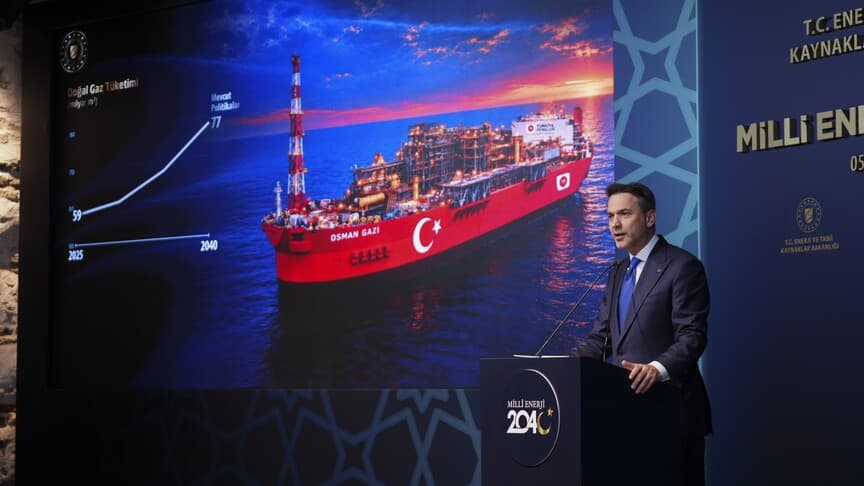
Turkey has unveiled its National Energy 2040 energy program, which envisions $500 billion in investment and the creation of 108,000 direct jobs. The country's Minister of Energy and Natural Resources Alparslan Bayraktar announced the plans on Thursday, Anadolu reports. The program aims to increase domestic production, expand renewable and nuclear generation, and strengthen energy independence.
Electricity and grids
Electricity consumption, according to the ministry's forecast, will grow from 365 TWh in 2025 to 680 TWh in 2040, of which 90 TWh will come from electric vehicles. Installed capacity is to increase from 123 to 281 GW, requiring $190 billion in investment; the share of renewables in it will rise from 63% to 77%. Solar generation will grow from 26 to 112 GW, wind from 15 to 63 GW ($100 billion in investment), and their combined capacity will reach 175 GW — a fourfold increase. Another $116 billion is planned to be invested in electricity transmission and distribution: transformer capacity will grow by 50%, line length by 30%, 28 GW of high-voltage direct current lines spanning 10,000 kilometers will be built, and distribution grids are planned to achieve full coverage with smart meters, SCADA systems, and urban ring networks. Nuclear capacity is to reach 10 GW by 2040 through the Akkuyu, Sinop, and Thrace nuclear power plants, as well as small modular reactors. In transport electrification, the targets are 20 million electric vehicles and 1.5 million charging stations.
Oil, gas, and state enterprises
In the oil and gas sector, Turkey has set the task of fully covering consumption with domestic production by 2040: the share of local oil in consumption is to rise from 15% to 100% while daily consumption falls from 993,000 to 718,000 barrels, and a similar transition from 15% to 100% is planned for gas as consumption declines from 59 to 57 billion cubic meters. The combined production target is 1.7 million barrels of oil equivalent per day. Five state companies — TEIAS, EUAS, Eti Maden, TPAO, and BOTAS — are to invest a total of $210 billion. Bayraktar also said that in the coming days the state-owned Eti Maden, together with MTAIC, will receive its first gold from the project in Niger. In addition to generation, the program provides for reducing primary energy intensity by 40% in 2025–2040, which, according to the ministry's estimate, will yield $240 billion in savings.